Choose the visa that fits your trip. Fully online process, real-time tracking.
Vietnam, a land of striking contrasts between karst bays, terraced rice fields and vibrant cities, ranks among the most sought-after destinations in Southeast Asia. Good news for French, German, Spanish and Italian travellers: since 15 August 2023, these nationalities benefit from a visa exemption for stays of up to 45 days. Beyond this period, or for other nationalities, the Vietnam e-Visa is the ideal solution: this genuine electronic visa is obtained entirely online, with no visit to the embassy required, and authorises a stay of up to 90 days, with single or multiple entries.
01 · The essentials
The Vietnam e-Visa application is completed entirely remotely, with no visit to the embassy or postal submission required.
The e-Visa is offered as a single entry or multiple entry, depending on each traveller's needs.
Since Resolution 389/NQ-CP of 2 December 2025, the e-Visa has been accepted at 83 international entry points — airports, land border gates and seaports — across the whole of Vietnam.
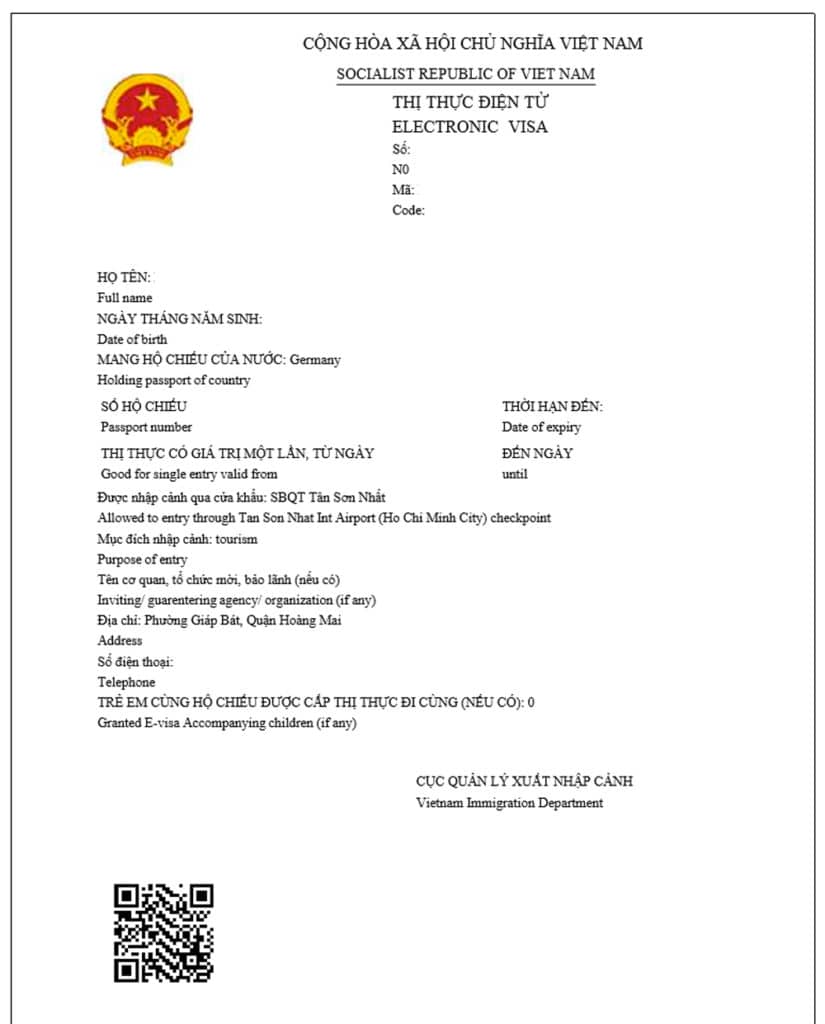
The e-Visa for Vietnam is an official electronic visa — a genuine visa, not a mere travel authorisation. Issued by the Vietnamese authorities, it allows entry into the country for purposes of tourism, business or visits to acquaintances, for stays not exceeding 90 days.
The procedure is entirely paperless: you submit your personal details and documents via an online form. Once approved by Vietnamese immigration services, the e-Visa is sent to you in PDF format. It is strongly advised to print it before your arrival in Vietnam and to present it at immigration checks at eligible entry points, along with your passport.
Two options are available: the single-entry e-Visa, for travellers who do not plan to leave and re-enter Vietnam, and the multiple-entry e-Visa, which is more flexible and allows you to leave and re-enter the country several times during the validity of the document. Processing takes approximately 6 days after the submitted documents have been verified.
The 6-month validity rule, counted from the date of entry, now applies to every category of traveller.
First roll-out at Tan Son Nhat airport.
Noi Bai and Da Nang join the scheme, ahead of a gradual roll-out to all Vietnamese airports.
New framework for the health declaration at Vietnamese border checkpoints.
Vietnam does not issue visas on arrival to travellers who simply turn up at the border: the e-Visa must be obtained before departure. Submit your application several days ahead to give yourself a comfortable margin.
As for the health declaration governed by Decree 165/2026/ND-CP, it is not permanently required of every traveller, contrary to what is often reported. The Vietnamese Ministry of Health has clarified that it is activated case by case, by order, for a given infectious disease and a given period, based on the global epidemiological situation and the risk of introduction into Vietnam. When it is active, the form — separate from the e-Visa and the Digital Arrival Card — must be completed, online or on paper, within the 7 days before travel. Check its status shortly before departure.
02 · Eligibility
Vietnam's visa policy rests on two distinct frameworks: the visa exemption for short stays and the e-Visa for longer stays or nationalities that are not exempt.
Since 15 August 2023, as part of its tourism recovery programme, the Vietnamese government has extended and strengthened its visa exemption schemes. The 45-day exemption now rests on two separate resolutions, with different scopes and different expiry dates: Resolution 44/NQ-CP covers 12 countries from 15 March 2025 to 14 March 2028, regardless of the purpose of travel; Resolution 229/NQ-CP (tourism stimulus programme) covers 12 further countries from 15 August 2025 to 14 August 2028, for tourism stays.
For stays of 45 to 90 days maximum, or for non-exempt nationalities, the e-Visa is required. All nationalities are now eligible for the e-Visa, including French, Spanish, Italian and German nationals who wish to extend their stay beyond 45 days.
Resolution 44/NQ-CP (15 March 2025 – 14 March 2028, any purpose of travel): France, Germany, Spain, Italy, United Kingdom, Russia, Japan, South Korea, Denmark, Sweden, Norway, Finland. Resolution 229/NQ-CP (15 August 2025 – 14 August 2028, tourism purposes): Belgium, Bulgaria, Croatia, Czech Republic, Hungary, Luxembourg, Netherlands, Poland, Romania, Slovakia, Slovenia, Switzerland. In both cases a passport valid for 6 months from the date of entry and an onward ticket are required.
Nationals of Belarus, Cambodia, Indonesia, Kazakhstan, Kyrgyzstan, Laos, Malaysia, Mongolia, Myanmar, Singapore and Thailand benefit from a 30-day exemption. Belarus no longer falls under the 45-day scheme but under a 30-day bilateral agreement; Indonesia moved from 14 to 30 days on 15 July 2026.
Nationals of Chile and Panama benefit from a 90-day visa exemption under separate bilateral agreements.
Citizens of the Philippines may stay for up to 21 days without a visa in Vietnam.
Nationals of Brunei benefit from a 14-day exemption.
Phu Quoc Island has a special regime: all nationalities can stay for up to 30 days without a visa, provided they arrive directly at the island by air or sea from abroad and do not travel to mainland Vietnam. This applies regardless of the traveller's nationality — including those that would normally require a visa for Vietnam. If you wish to continue to mainland Vietnam, however, an e-Visa is required before departure.
Minors are subject to the same rules as adults: they must have their own individual e-Visa if they are not covered by a visa exemption. Regarding transit through Vietnam: airside transit of under 24 hours without leaving the sterile zone generally does not require a visa. However, any passenger wishing to pass through immigration controls — even when transiting to a third country — must hold a valid visa.
If your nationality does not qualify for a visa exemption and is not eligible for the e-Visa, you will need to contact the Embassy of Vietnam in your country to apply for a traditional visa. In France, the Embassy of Vietnam is located at 62-66, rue Boileau, 75016 Paris. Applications by registered post are also accepted.
03 · The procedure
The e-Visa process for Vietnam is designed to be simple and quick. It is carried out entirely from home, with no visit to the embassy or postal submission required. Before you start, make sure you have gathered the documents essential for your application: a digital copy of your passport and a recent passport-size photograph. You will also need to know your planned arrival date in Vietnam and your accommodation address there (at least for the first night).
Processing takes approximately 6 days after your documents have been verified. It is therefore advisable to submit your application well in advance, ideally two to three weeks before your departure, to allow yourself a comfortable margin. If your application is incomplete or contains irregularities, additional delays may apply.
Fill in the application form with your personal details: identity, contact information, purpose of travel (tourism, business, visit), planned stay dates, entry point into Vietnam, address of first accommodation. The form is entirely online and can be saved.
Attach a scanned copy of your passport (identity pages, legible and in colour) and a recent passport-size photograph in the correct format. These are the only two documents required to complete the Vietnam e-Visa application.
Your application is checked to ensure that all submitted information is consistent and that the documents meet the requirements of the Vietnamese authorities. This preventive step helps minimise the risk of rejection due to formal errors.
The complete application is submitted to Vietnamese immigration services. The usual processing time is approximately 6 days. If the authorities request additional information, you will be notified.
Once the e-Visa has been approved by the authorities, you will receive your official document by email in PDF format. Carefully check that all information (name, passport number, dates) is correct.
Print your PDF e-Visa before you leave. Upon arrival at one of the eligible entry points, present your printed e-Visa together with your passport to immigration officers. If the document is lost, a copy can be requested by email.
04 · Entry points
The Vietnam e-Visa offers great geographical flexibility: unlike some countries where the electronic visa is only accepted at a few airports, the Vietnamese government has opened e-Visa access at 83 international entry points spread across the entire territory — airports, land border crossings and seaports. This network, raised from 42 to 83 points by Resolution 389/NQ-CP of 2 December 2025, covers 17 international airports and the vast majority of land and sea crossings.
Whether you arrive by plane in Hanoi or Ho Chi Minh City, by land from Cambodia, Laos or China, or by cruise ship at a coastal port, the main tourist and commercial access points are eligible for the e-Visa. Here is a selection of the main entry points.
Hanoi (Noi Bai), Ho Chi Minh City (Tan Son Nhat), Da Nang, Cam Ranh (Nha Trang), Phu Quoc, Can Tho, Hai Phong (Cat Bi), Phu Bai (Hue), Van Don. These airports cover the country's major tourist destinations.
With Laos: Bo Y, Cha Lo, Cau Treo, Lao Bao, Na Meo, Nam Can, La Lay, Tay Trang. With Cambodia: Moc Bai, Vinh Xuong, Ha Tien, Tinh Bien, Xa Mat. With China: Lao Cai, Mong Cai, Huu Nghi.
Travellers arriving by cruise ship can present their e-Visa at many coastal ports, including Da Nang, Nha Trang, Ho Chi Minh City, Hai Phong, Vung Tau, Quy Nhon, Phu Quoc (Duong Dong), Chan May, and many others.
The list of eligible entry points is subject to change. It is advisable to verify that your planned entry point is compatible with your e-Visa before finalising your application, especially for less frequently used land crossings.
05 · Fees & renewal
Consular fees for the Vietnam e-Visa are 25 USD €21.78 for a single-entry visa and 50 USD €43.56 for a multiple-entry visa. In addition to these official consular fees, service fees related to application assistance apply. An invoice can be requested upon completion of the process.
In the event of a refusal of your application by the Vietnamese authorities, the application fees are refunded. You will then be advised to contact the Embassy of Vietnam to consider applying for a traditional visa.
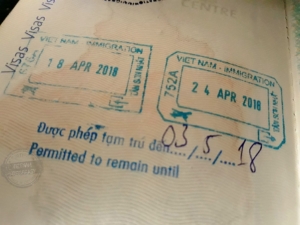
It is important to note that no extension or renewal of the e-Visa is possible while in Vietnam. If you wish to stay more than 90 days, you will have to leave the country, then submit a new e-Visa application before returning. If your nationality qualifies for the 45-day visa exemption, you may also benefit from this scheme upon a short re-entry.
06 · Before you go
Vietnam stretches over more than 1,600 km from north to south, offering remarkable geographical and cultural diversity: the northern mountains around Sapa, Ha Long Bay and its karst formations listed as a UNESCO World Heritage Site, the historic cities of Hanoi and Hue, the beaches of Da Nang and Phu Quoc, and the vibrant metropolis of Ho Chi Minh City. To make the most of this richness, thorough preparation is essential.
In terms of the best time to travel, Vietnam experiences significant climate variations depending on the region. Generally speaking, the dry season, between November and April, is considered the ideal period for visiting the centre and south of the country. For the north, the months of March to May offer pleasant temperatures before the intense summer heat. The central region is subject to heavy rainfall between September and December.
Gastronomically, Vietnam is a must-visit destination: phở, the iconic noodle soup, bánh mì, a filled baguette inherited from the colonial era, bò bún, bánh xèo (crispy crepes) and fresh seafood by the sea are all culinary discoveries not to be missed. Vietnamese cuisine also varies by region, with specialities unique to Hanoi, Hue and Ho Chi Minh City.
The Vietnam e-Visa is an official electronic visa — not a mere travel authorisation — that allows you to stay in Vietnam for up to 90 days, with a single entry (25 USD €21.78 consular fee) or multiple entries (50 USD €43.56). Processing takes approximately 6 days. French, German, Spanish, Italian and around twenty other nationalities benefit from a visa exemption for stays of 45 days or less, in force until 14 March 2028 for the 12 countries under Resolution 44/NQ-CP and until 14 August 2028 for the 12 countries under Resolution 229/NQ-CP. Beyond that, the e-Visa is required. In every case your passport must be valid for at least 6 months from your date of entry. No extension is possible on the ground: plan ahead. Always print your PDF e-Visa before departure, and present it to immigration officers at one of the 40+ eligible entry points, by air, land or sea.
Safety
The vigilance level recommended by five foreign ministries, on a shared scale.
Average level
No specific threat reported by the ministries.

US Department of StateAdvice dated June 24, 2026
Normal precautions · Vietnam - Level 1: Exercise Normal Precautions

Global Affairs CanadaAdvice dated September 9, 2026
Increased caution · Vietnam — Exercise a high degree of caution

German Federal Foreign OfficeAdvice dated August 27, 2026
Normal precautions · Vietnam: Travel and Security Information

UK Foreign Office (FCDO)Advice dated June 26, 2026
Normal precautions · Vietnam travel advice

France DiplomatieAdvice dated September 15, 2026
Increased caution · Vietnam: Travel advice
Levels published by the ministries cited, reproduced unchanged. Visamundi is a private agency with no ties to these administrations.
FAQ