France is one of the world's leading immigration destinations: 384,000 first residence permits issued in 2025, steadily rising entry flows, and a wide diversity of profiles welcomed. Obtaining a visa for France nonetheless requires mastering a complex administrative system — the Schengen area, the France-Visas website, VFS or TLS centres depending on your country of residence — with processing times and document requirements that vary according to nationality, purpose of stay and visa type. This guide covers the essentials: who needs a visa, what steps to follow, what costs to expect, and how to navigate this administrative process with confidence.
01 · The essentials
A valid passport is required of all applicants, regardless of the visa type: it must have been issued less than 10 years ago and remain valid for at least 3 months after the planned date of departure from the Schengen area.
France is ranked among destinations with a complex application process: initial visa refusals are often poorly reasoned, and appeals are lengthy and costly.
In 2024, nearly one in seven Schengen visa applications was refused by France — a rate that underlines the importance of preparing a thorough application before submission.
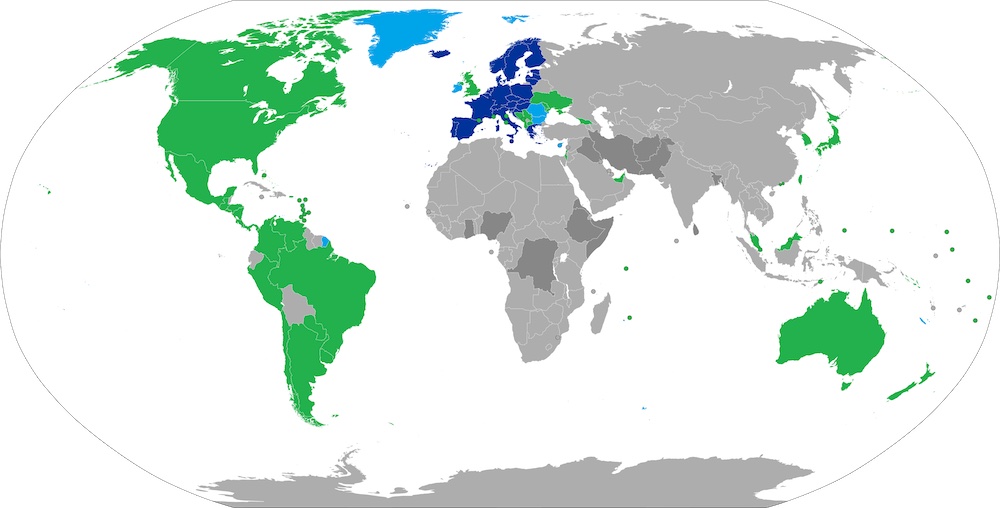
France is part of the Schengen area, a free-movement zone comprising 27 European countries. A Schengen visa issued by France therefore allows travel throughout this entire area — and conversely, a visa granted by another Schengen country may permit entry into France, under certain conditions.
This membership of Schengen directly structures visa requirements: nationals of the European Union, Switzerland, Liechtenstein, Iceland and Norway need no visa to stay in France, regardless of the length of stay. For other nationalities, the rule varies depending on the intended length of stay and whether the country of origin has or has not signed a visa-waiver agreement with the Schengen area.
Short stays (up to 90 days within any 180-day period) fall under the short-stay visa, known as the "Schengen visa". Stays exceeding 90 days require a long-stay visa, issued directly by the French authorities depending on the purpose: work, study, family reunification, business creation, etc.
02 · Eligibility
The answer depends on your nationality and the length of your stay. Nationals of the European Union, Switzerland, Liechtenstein, Iceland and Norway are exempt from visa requirements for any stay in France, including for permanent settlement. They do not require a residence permit for the first few months either, although specific administrative steps may be required beyond a certain period depending on the situation.
Many other nationalities benefit from a short-stay visa exemption in the Schengen area. These include nationals of Albania, Andorra, Antigua and Barbuda, Argentina, Australia, the Bahamas, Barbados, Bosnia and Herzegovina, Brazil, Brunei, Canada, Chile, Colombia, Costa Rica, Dominica, Georgia, Grenada, Guatemala, Honduras, Hong Kong, Israel, Japan, Kiribati, Macao, Malaysia, the Marshall Islands, Mauritius, Mexico, Micronesia, Moldova, Monaco, Montenegro, New Zealand, Nicaragua, North Macedonia, Palau, Panama, Paraguay, Peru, Saint Kitts and Nevis, Saint Lucia, Saint Vincent and the Grenadines, Samoa, San Marino, Serbia, Seychelles, Singapore, Solomon Islands, South Korea, Taiwan, Timor-Leste, Tonga, Trinidad and Tobago, Tuvalu, Ukraine, the United Arab Emirates, the United Kingdom, the United States, Uruguay, the Vatican and Venezuela.
This visa exemption applies exclusively to short stays (maximum 90 days) within any 180-day period. If you intend to stay beyond 90 days — to work, study or settle — a long-stay visa remains compulsory, regardless of your nationality (except EU/EEA/Swiss nationals).
Nationals of countries not on this list who wish to visit France, even for just a few days of tourism, must obtain a short-stay visa (Schengen visa) before departure.
No visa required, neither for a short stay nor for long-term settlement in France. Freedom of movement guaranteed by European treaties.
Approximately 60 nationalities may enter the Schengen area without a visa for stays of up to 90 days within 180 days. Beyond 90 days, a long-stay visa is required.
A Schengen visa (short stay) or long-stay visa is required depending on the intended duration. Applications are submitted to the competent French consulate or an authorised collection body (VFS Global, TLS Contact).
Rolled out progressively from 12 October 2025 and <strong>fully operational on 10 April 2026</strong>, the Entry/Exit System (EES) replaces the physical stamping of passports with an electronic biometric record at each entry into or exit from the Schengen area. All non-EU travellers are affected, including those exempt from visa requirements.
ETIAS (the European Travel Information and Authorisation System) is expected in the last quarter of 2026. It will apply to nationals of visa-exempt countries, who will have to obtain this authorisation online (around €20, valid for 3 years) before travelling. It is not a visa and does not concern holders of a Schengen visa.
03 · Visa types
The French system distinguishes two main visa categories, to which are added residence permits issued on French territory after lawful entry.
The short-stay visa (known as the "Schengen visa") is intended for stays not exceeding 90 days within a rolling 180-day period. It covers tourism, visits to relatives, business trips or short professional travel. This visa is issued by the French consulate in the applicant's country of residence, or by an authorised collection body (VFS Global, TLS Contact depending on the country).
The long-stay visa covers stays of more than 90 days and those whose purpose is to settle permanently in France. There are numerous variants depending on the purpose:
For employees, posted workers, service providers, VIE/interns. Includes the categories "salarié" (employee), "travailleur temporaire" (temporary worker), "intragroupe" (intra-group transfer) and the Talent visa (formerly Passeport Talent for highly qualified profiles, researchers, investors, artists, athletes, start-up founders).
For higher education studies or internships in France lasting 3 to 12 months. Allows the holder to subsequently obtain a temporary student residence card (1 year) or a multi-year card (2 to 4 years).
To join a family member (spouse, minor child) legally residing in France. The main applicant must generally demonstrate a certain period of residence and stable financial resources.
For persons wishing to reside in France without engaging in professional activity or benefiting from family reunification (retirees, persons of independent means). Proof of sufficient financial resources is required.
Once in France with a long-stay visa equivalent to a residence permit (VLS-TS), the holder must generally complete formalities with the French Office for Immigration and Integration (OFII) within three months of arrival. The republican integration pathway (interview, medical examination in certain cases) is part of these obligations for new arrivals.
For more complex immigration projects — intra-group mobility, secondment of foreign nationals, new recruitment of a foreign profile, appeals following a refusal — assistance from lawyers specialising in immigration law is strongly recommended to secure the process and avoid repeated consular visits.
04 · The procedure
A visa application for France must be submitted from the applicant's country of residence. The process goes through the official France-Visas website (france-visas.gouv.fr), the portal of the French Ministry of the Interior that centralises all applications, allows you to verify the type of visa to apply for, compile the file online and track the progress of the application.
Depending on the country of residence, the file may be submitted directly at the consulate or at an authorised collection centre:
Determine whether your nationality requires a visa and which type of visa matches your plans (short stay, long stay, purpose). The simulator on the France-Visas website (france-visas.gouv.fr) guides you according to your situation.
Gather the required documents: valid passport (issued less than 10 years ago, at least 2 blank pages, valid for at least 3 months beyond the planned date of departure from the Schengen area), ICAO-format identity photographs, application form completed via France-Visas, and supporting documents depending on the purpose (employment contract, enrolment certificate, proof of financial means, accommodation, return ticket, health insurance).
Book an appointment through the consulate or authorised collection centre (VFS Global, TLS Contact) as early as possible, especially during peak periods. Appointment lead times can be significantly longer depending on the country and time of year.
Attend your appointment with your complete file. Biometric data collection (fingerprints, digital photograph) is generally required for adult applicants. Check in advance the specific rules of the relevant consulate.
For a short-stay visa, allow approximately 15 calendar days. For a long-stay visa, the processing time is approximately one month, or longer depending on the period and consulate. These times may vary: plan ahead.
If approved, your passport is returned with the visa affixed. In the event of a refusal, the challenge follows a two-step procedure: a <strong>mandatory prior administrative appeal</strong> before the <strong>Commission for Appeals against Visa Refusal Decisions (CRRV)</strong>, based in Nantes, within <strong>30 days</strong> of notification of the refusal; then, if rejected, a <strong>judicial appeal</strong> before the <strong>Administrative Court of Nantes</strong> — the only court with first-instance jurisdiction over visa disputes since 2010 — within <strong>two months</strong>. These are lengthy and technical procedures, for which specialist legal assistance is strongly advised.

The France-Visas website (france-visas.gouv.fr) is the official French government portal for all visa applications. It allows you to verify the visa type suited to your situation, download forms, track your file online and book an appointment. The WelcomeToFrance website (welcometofrance.com) is also a useful public resource for new arrivals.
Despite the introduction of these digital tools, immigration files often remain complex to compile, particularly for profiles requiring especially careful presentation: regulated professions, intra-group mobility, entrepreneurial projects, atypical family situations. In these cases, support from immigration law experts maximises the chances of approval and minimises the risk of errors or missing documents.
05 · Fees and processing times
The fees shown are consular fees, i.e. the official charges levied by the French authorities for processing the application. They do not include the service fees of authorised collection centres (VFS Global, TLS Contact), which are added depending on the country and provider, nor the fees of an advisor or specialist lawyer if applicable.
It is important to note that certain countries have concluded special agreements with France — or more broadly with the Schengen area — that may alter the amount of visa fees applicable to their nationals. Check with the competent French consulate for the exact fee applicable to your nationality.
As regards processing times, they can increase considerably during peak demand periods (summer holidays, end-of-year festivities, university enrolment). In Senegal, for example, the Consulate General of France in Dakar experienced particularly long appointment waiting times with the resumption of travel after the health crisis. It is therefore advisable to begin the process as early as possible once the travel date is set.
06 · Before you leave

Preparing a visa application file for France begins well before the consular appointment. Some documents can take time to obtain — particularly proof of financial means, accommodation documents or civil status records — and errors or omissions can lead to the rejection of the file or longer processing times.
The documents required vary according to the purpose of the stay (employment, study, family reunification, tourism, etc.). However, a few documents are common to all applications: a valid passport meeting the required format criteria, ICAO-format identity photographs, and the application form completed via France-Visas. The consulate or collection centre will provide the full list of supporting documents expected based on your profile.
An important precaution: provide all pages of your passport that contain visas, entry or exit stamps, or any other markings. A missing page can be enough to delay or jeopardise the processing of your file.
Immigrating to France involves navigating a multi-level administrative system: consular visa, work permit, residence permit, integration pathway. The type of visa to apply for depends directly on the applicant's nationality, the intended length of stay and the purpose of the visit. Processing times — approximately 15 calendar days for a short stay, one month for a long stay — must be anticipated taking into account peak consular demand periods. In the event of a refusal, appeal options exist but are complex: support from immigration law professionals is an investment that often helps avoid costly blocking situations in terms of time and energy.
Safety
The vigilance level recommended by five foreign ministries, on a shared scale.
Average level
Terrorism and civil unrest; the other ministries report no particular risk.

US Department of StateAdvice dated May 28, 2025
Increased caution · France - Level 2: Exercise Increased Caution

Global Affairs CanadaAdvice dated September 18, 2026
Increased caution · France — Exercise a high degree of caution

German Federal Foreign OfficeAdvice dated September 4, 2026
Normal precautions · France: Travel and Safety Notices

UK Foreign Office (FCDO)Advice dated August 11, 2026
Normal precautions · France travel advice
Levels published by the ministries cited, reproduced unchanged. Visamundi is a private agency with no ties to these administrations.
FAQ