Choose the visa that fits your trip. Fully online process, real-time tracking.
Visamundi service: €39 incl. VAT
Consular fee: ≈ €75(770 MAD)
Electronic visaLaunched in 2022, the Morocco e-Visa is a fully digital travel authorisation issued by the Kingdom's Ministry of Foreign Affairs. For eligible nationalities, it replaces the mandatory visit to an embassy or consulate: the entire process — submission, processing, and receipt of the document — takes place online. Valid for 180 days from its date of issue, it authorises a continuous stay of up to 30 days and is for single entry only.
01 · The essentials
Morocco launched its e-Visa in 2022: the entire process — submission, processing and receipt of the document — takes place online, without a visit to an embassy.
For the e-Visa the Moroccan authorities require an <em>ordinary</em> passport valid for at least 90 days on the date the application is submitted. Refugee and stateless travel documents and non-ordinary passports are not accepted. Allow at least two blank pages; many airlines also apply their own six-month rule.
The complexity level is assessed as medium: eligibility depends on passport nationality rather than country of residence, which can cause confusion.
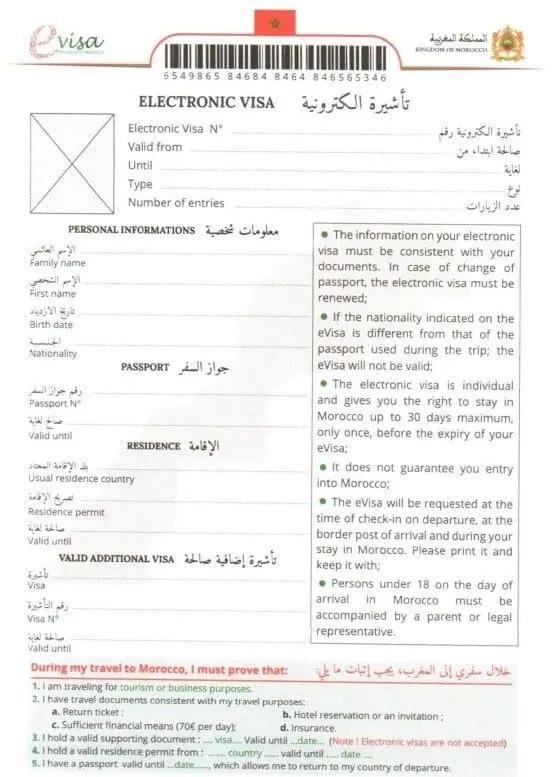
The Morocco e-Visa is a fully-fledged electronic visa. It is not a simple travel authorisation reserved for visa-exempt nationals: it is an official document issued by the Moroccan authorities to nationalities that would otherwise need to submit a physical application at a consulate. The distinction is important: only nationalities eligible for the e-Visa may use it; nationals of countries whose citizens are visa-exempt for Morocco do not need to apply for one.
Once approved, the e-Visa takes the form of a PDF document received by email. The traveller presents it — printed or displayed on their phone — at boarding and at the Moroccan border control point. It is valid for all official entry points of the Kingdom: international airports, seaports (Tanger Med, Nador, Casablanca) and land border crossings.
The e-Visa authorises stays for tourism, occasional professional purposes (meetings, trade fairs, negotiations) and events. It does not, however, cover student stays, religious missions, salaried employment or long-term settlement: these situations require a conventional consular visa.
02 · Eligibility
Morocco's visa policy distinguishes three main categories of travellers. Before taking any steps, it is essential to determine which category you fall into, as each follows different rules.
Many countries benefit from a full visa exemption for tourist or professional stays of less than 90 days. These include nationals of European Union countries (France, Germany, Spain, Italy, Belgium, the Netherlands, Portugal…), the United Kingdom, the United States, Canada, Australia, New Zealand, Japan, South Korea, Singapore, Hong Kong, the United Arab Emirates, Kuwait, Qatar, Bahrain, Oman, Switzerland, Norway, Iceland, Brazil, Mexico, Argentina, Chile, Peru, Tunisia, Senegal, Turkey, and several other countries. These travellers only need a passport valid for at least six months beyond their entry date.
Special case — Côte d'Ivoire. The visa exemption previously granted to holders of an ordinary Ivorian passport has been suspended since 1 September 2024, at the request of the Ivorian authorities and for an announced period of up to two years: a visa is therefore required to enter Morocco. The suspension does not cover Ivorian diplomatic or service passports, holders of a Moroccan residence permit, or holders of a Schengen, US, Canadian or UAE visa. As the measure is temporary and its lifting is not automatic, check the rules in force before booking.
The terms of use published by the Moroccan authorities define three eligibility categories. You only need to meet one of them: contrary to a widespread belief, eligibility does not depend solely on passport nationality — your country of residence and a visa you already hold also open access to the e-Visa.
Category A — through nationality. Nationals of Azerbaijan, Benin, Brunei Darussalam, Cambodia, Guatemala, India, Israel, Jordan, Laos, Thailand and Vietnam may apply with their ordinary passport alone, valid for at least 90 days on the date of application. (China and several other countries sometimes cited by mistake do not belong to this category: Chinese nationals are visa-exempt for 90 days.)
Category B — through country of residence. Visa-required nationals legally residing in the European Union, the United States, Canada, the United Kingdom, Japan, Norway, New Zealand, Switzerland or the United Arab Emirates are eligible whatever their nationality, on presentation of a valid, final residence permit (application, renewal or extension receipts and special permits are refused). A minimum remaining validity is required on the date of application — check it on before applying.
Category C — through a visa already held. Visa-required nationals holding a visa issued by a Schengen country, the United States, Canada, the United Kingdom, Ireland, Japan, Norway or New Zealand are eligible — subject to three cumulative conditions: the visa must be non-electronic (a physical sticker or stamp), multiple-entry and valid for at least 90 days on the date the e-Visa application is submitted.
The list is subject to change: check your eligibility on the official portal before submitting your application.
Nationals of countries that are neither visa-exempt nor eligible for the e-Visa must submit a full application to the nearest Moroccan embassy or consulate to their place of residence. This procedure generally includes an interview, submission of original documents and a longer processing time.
Residence (category B) or a visa already held (category C): a visa-required national may be eligible for the e-Visa even when their nationality is not listed in category A. For category C the visa relied upon must be non-electronic, multiple-entry and valid for at least 90 days on the date of application — a single-entry visa, or one expiring within 90 days, is not enough.
For the e-Visa the Moroccan authorities require an ordinary passport valid for at least 90 days on the date of application, with at least two blank pages. As airlines frequently apply a six-month rule, a wider margin remains advisable.
Each traveller, regardless of age, must have their own authorisation and their own passport. Minors may no longer travel on a parent's passport.
Morocco has maintained normalised diplomatic relations with Israel since 2020. The presence of an Israeli stamp or visa in the passport is not grounds for refusal of entry.
Certain nationalities are excluded from the Moroccan e-Visa, whether under the standard procedure or the conditional procedure (holders of a Schengen visa or equivalent): Iran, Kosovo, Palestine, Syria, Taiwan and Tuvalu. Nationals of these countries cannot apply for the e-Visa and must contact the Moroccan embassy or consulate for any visa request.
Furthermore, nationals of the following countries require prior approval from the Moroccan Ministry of the Interior for any type of visa, which considerably extends processing times: Afghanistan, Iraq, Iran, Lebanon, Libya, North Korea, Pakistan, Syria, Yemen.
Two rules combine here, and confusing them is the leading cause of rejected applications.
Visa exemption depends exclusively on passport nationality. A national of a visa-required country who lives in France, Germany or Spain is not visa-exempt: a European residence card does not pass on the exemption enjoyed by EU citizens.
Eligibility for the e-Visa, by contrast, is assessed through three alternative gateways: nationality (category A), country of residence (category B) or a non-electronic multiple-entry visa already held (category C). In other words, your European residence permit does not exempt you from a visa, but it may open the faster, fully online e-Visa route instead of a consular file.
03 · The procedure
The Morocco e-Visa procedure is entirely digital: no trip to an embassy, no postal submission. Before you begin, have your valid passport, your approximate travel dates, and — if you fall into the 'Schengen or equivalent visa' category — a digital copy of that valid visa to hand.
Make sure your nationality is listed among the countries eligible for the e-Visa, or that you hold a valid Schengen, US, British, Irish, Canadian, Australian, New Zealand or Japanese visa. If in doubt, consult the official list from the Moroccan Ministry of Foreign Affairs.
Gather your ordinary passport (valid for at least 90 days on the date of application, with at least 2 blank pages), a legible colour copy of its biographical page, a recent identity photo (35 x 45 mm, less than 6 months old) and, depending on your category, a double-sided copy of your residence permit (category B) or a copy of your non-electronic multiple-entry visa (category C). For a "Business" purpose, an invitation or a professional recommendation is also required.
Complete the e-Visa application form by entering your personal details, contact information (valid email address), travel dates and the purpose of your stay (tourism, business or event). Check every piece of information carefully before submitting.
Pay the consular fees set by the Moroccan authorities (770 MAD €70.43). Payment is made online at the time of form submission.
The issuance time announced by the Moroccan authorities is 24 hours, counted in Moroccan working days, for a complete and accurate file; it does not apply to incomplete or inaccurate applications. Moroccan weekends and public holidays extend it. Submit your application well in advance of your departure.
Once your application is approved, you will receive your e-Visa as a PDF by email. Print it (a paper copy is strongly recommended; some airlines require it at boarding) and also keep a digital copy in your inbox or on a cloud service.
04 · Fees and timelines
The government fees for the Morocco e-Visa amount to 770 MAD €70.43. These fees are set by the Moroccan authorities and may change; verify the exact amount at the time of your application.
The issuance time announced by the Moroccan authorities is 24 hours, counted in Moroccan working days, for a complete and accurate file; it does not apply to incomplete applications or applications containing inaccurate information. This period does not include Moroccan weekends and public holidays, which can add several days to the wait. It is therefore recommended that you submit your application at least one week before your planned departure, and ideally two weeks before if your trip coincides with a busy period (national holidays, major sporting or cultural events).
Once issued, the e-Visa is subject to three strict rules that must be clearly understood before departure:
It is strongly inadvisable to exceed the 30-day stay permitted by the e-Visa. Extensions are not automatic: they must be requested from the police authorities (Direction de la Sûreté Nationale) in Morocco, with a justified reason. If an overstay is detected at the time of departure, a fine and a re-entry ban may be imposed by the Moroccan authorities.
05 · Morocco
A major destination in North Africa, Morocco attracts more than 14 million international visitors every year from all continents. The Kingdom combines exceptional geographical diversity: from the snow-capped peaks of the Atlas to the dunes of the Sahara, from the Atlantic coasts of Tangier and Essaouira to the Mediterranean shores of Al Hoceima. Its cultural heritage is recognised by UNESCO across nine sites.
Each Moroccan region offers a unique experience: Marrakech and its Jemaa el-Fna square, a UNESCO intangible heritage site, Fès and its thousand-year-old medina, Chefchaouen the blue city perched in the Rif, Casablanca and the Hassan II Mosque, Rabat the administrative capital, the Todra Gorge, the oases of Merzouga at the gateway to the Sahara. Morocco is also an internationally recognised gastronomic destination — tagine, couscous, pastilla, mint tea — and a crossroads of Berber, Arab, Andalusian and African influences.
On the practical side, the country has a dense air network with direct flights from Europe, North America, the Middle East and Africa. A regular maritime service connects Spain (Algeciras, Barcelona) to the ports of Tanger Med and Ceuta. The hotel infrastructure is highly developed, from the traditional riad to the five-star resort, and travel costs remain affordable compared to other Mediterranean destinations.
Atlas mountains, Saharan dunes, Atlantic and Mediterranean coastlines: Morocco offers radically different landscapes within a few hours' drive.
Nine Moroccan sites are listed as UNESCO World Heritage, including the medinas of Fès and Marrakech, the ksar of Aït-Ben-Haddou and the Jemaa el-Fna square.
Direct flights from Europe, North America, Africa and the Middle East to the airports of Casablanca, Marrakech, Fès, Rabat, Agadir, Tangier and Oujda.
Morocco is internationally recognised for its cuisine: lamb tagine, Friday couscous, pigeon pastilla, harira, msemen and fresh mint tea.
06 · Before you leave
Beyond the visa, a trip to Morocco requires a minimum of preparation. Here are the key points to check before your departure, based on the official e-Visa conditions and practices observed at entry into Moroccan territory.
The Morocco e-Visa is the simplest and most direct solution for eligible nationalities wishing to visit the Kingdom for a tourist, professional or event stay of up to 30 days. The procedure is entirely online and the official 24-hour working-day issuance time allows you to plan ahead without constraints — provided you do not leave it to the last minute. The main point to watch out for is single entry: if your itinerary involves leaving and returning to Morocco, you will need to submit a new application for each entry.
For nationals of visa-exempt countries (including EU citizens, US, Canadian or Australian nationals), no prior steps are required: a valid passport is sufficient. If you are unsure of your situation, verify your eligibility based on your actual nationality — not your country of residence or your residence permit.
Safety
The vigilance level recommended by five foreign ministries, on a shared scale.
Average level
Terrorism; risks tied to outdoor activities, beaches and wildfires, plus rabies and food hygiene. One area remains entirely off-limits.

US Department of StateAdvice dated September 4, 2026
Increased caution · Morocco - Level 2: Exercise Increased Caution

Global Affairs CanadaAdvice dated September 9, 2026
Increased caution · Morocco — Exercise a high degree of caution (with regional advisories)

German Federal Foreign OfficeAdvice dated September 14, 2026
Normal precautions · Morocco: Travel and Security Advice

UK Foreign Office (FCDO)Advice dated August 19, 2026
Normal precautions · Morocco travel advice
France DiplomatieAdvice dated September 15, 2026
Increased caution · Morocco: Travel advice
Levels published by the ministries cited, reproduced unchanged. Visamundi is a private agency with no ties to these administrations.
FAQ