Choose the visa that fits your trip. Fully online process, real-time tracking.
South Korea captivates: K-pop, gastronomy, thousand-year-old temples, wild islands and ultra-connected cities. For most European travellers, obtaining a traditional visa is not necessary. However, an electronic authorisation exists: the K-ETA (Korea Electronic Travel Authorization), an online travel authorisation comparable to an ETA — it is not a visa. Thanks to a temporary exemption in force until 31 December 2026, many nationalities (including France, Germany, Italy, Spain, the United Kingdom, the United States and Japan) are currently exempt from it; applying nonetheless remains possible and recommended to enjoy its benefits (exemption from the e-Arrival Card, repeat entries). Since 1 January 2026, an e-Arrival Card is also mandatory for travellers who do not hold a valid K-ETA.
01 · The essentials
The passport must be valid for at least 6 months after the date of arrival in South Korea, regardless of the option chosen.
All entry formalities (K-ETA or e-Arrival Card) are carried out exclusively online before departure — none can be obtained on arrival.
Since 1 January 2026, an online e-Arrival Card is mandatory for any traveller who does not hold a valid K-ETA.
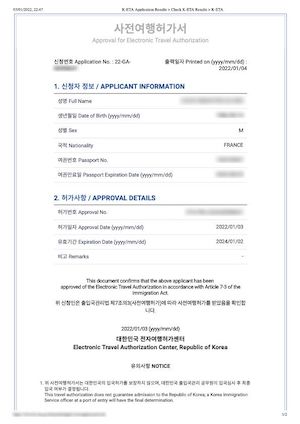
The K-ETA (Korea Electronic Travel Authorization) is an electronic travel authorisation issued by the South Korean authorities. It is not a traditional visa: it is exclusively for nationals of countries exempt from a visa for South Korea under the Visa Waiver Program (VWP) established by the Korean government.
This programme covers up to 112 nationalities. French, Belgian and Swiss nationals are included: they may travel to South Korea for a stay of up to 90 days without a consular visa, provided they hold a valid K-ETA. Other nationalities are limited to 30 or 60 days per stay; Canadian nationals may stay for up to 6 months.
The K-ETA does not permit working or settling in South Korea. For any other purpose (internship, employment, long-term studies), a traditional visa from the Embassy of the Republic of Korea remains mandatory.
02 · Eligibility
As part of the Visit Korea Year, South Korea has granted a temporary K-ETA exemption to 22 countries and territories until the end of 2026. Nationals of the following countries may therefore enter South Korea without a K-ETA for a short stay:
Germany, Australia, Austria, Belgium, Canada, Denmark, Spain, United States, Finland, France, Hong Kong, Italy, Japan, Macau, New Zealand, Norway, Netherlands, Poland, United Kingdom, Singapore, Sweden, Taiwan.
However, even if your nationality is exempt from the K-ETA until end of 2026, it is strongly recommended to apply in advance. Holding a valid K-ETA exempts you from the e-Arrival Card (a formality that has been mandatory since 1 January 2026), saves time at immigration and eliminates any uncertainty at boarding.
The temporary K-ETA exemption runs until 31 December 2026. Unless it is extended again by the Korean authorities, from 1 January 2027 the K-ETA will once again be mandatory for all nationalities in the visa-waiver programme (up to 112 countries), including travellers from France, Belgium, Switzerland, Canada and the European Union.
If your trip takes place in 2027 or later, check the current status on the official website before booking: without a valid K-ETA, boarding may be refused by the airline.
Entry is possible without a K-ETA for short stays, but the e-Arrival Card remains mandatory (unless a valid K-ETA is held). The K-ETA is strongly recommended to simplify arrival formalities.
The K-ETA is mandatory before any trip to South Korea for tourism or business purposes. Without a K-ETA, boarding may be refused by the airline.
The K-ETA does not apply to you. You will need to apply for a traditional visa from the Embassy of the Republic of Korea in your country of residence.
No K-ETA is required if you do not leave the international zone of the airport, regardless of the transit duration. An application is only necessary if you wish to exit the airport.
03 · New in 2026
Since 1 January 2026, South Korea has abolished paper arrival cards. They have been replaced by a mandatory online e-Arrival Card, to be submitted within the 3 days before arrival. This formality applies to all travellers who do not hold a valid K-ETA; registered foreign residents of Korea and airline or ship crew are, however, exempt.
In practice, for French and European nationals whose nationality is exempt from the K-ETA until end of 2026, the e-Arrival Card becomes the default entry form. It must be completed on the official website.
However, holding a valid K-ETA fully exempts you from the e-Arrival Card. This is one of the concrete advantages of completing the K-ETA process even when it is not strictly mandatory in 2026.
04 · The process

The K-ETA application process is entirely online. It is straightforward and quick, provided you gather the required documents before starting. Submit your application at least 3 days before departure, the recommended lead time to receive the document without stress. For urgent departures, the K-ETA can be issued within 72 hours.
The information requested in the form relates to the reason for your trip, your arrival and departure dates, your identity and passport details. You will also need to provide a residential address in South Korea (hotel, family, accommodation) along with the contact details of the establishment or person hosting you. This information is verified by the authorities.
Gather a copy of your passport (valid for at least 6 months after your arrival date) and a recent colour identity photo. These two documents are essential to complete the application.
State the purpose of your stay (tourism, business, events, visiting family or friends), your travel dates, your exact identity as it appears on your passport, and the address of your first accommodation in South Korea.
Pay the consular fee of 10,000 South Korean won €6.3 online, via the secure payment system. This rate applies regardless of your nationality or the intended length of stay.
After payment, attach a copy of your passport and your identity photo. The team checks that your documents comply before submitting them to the Korean authorities.
You will receive your K-ETA in PDF format electronically. Print it before departure: the airline may ask to see it at boarding. If you lose your K-ETA, a copy can be resent to you free of charge.
05 · Fees and processing times
The K-ETA stands out for its flat fee and long validity period. With 10,000 KRW €6.3 in consular fees, you receive an authorisation valid for three years allowing unlimited entries to South Korea — within the maximum length of stay per visit, which depends on your nationality.
In the event of a K-ETA refusal by the South Korean authorities, you may consider submitting a visitor visa application to Korean immigration. The Korean authorities generally communicate quickly in the event of rejection, but no modification to the file is possible after submission: a completely new application is required.
If your K-ETA expires before your next trip, you simply need to submit a new online application. The document cannot be renewed: each new application results in a new K-ETA.
06 · Before you go
Seoul, Busan, Daejeon, Gyeongju, Jeju Island: South Korea offers an exceptional range of experiences, from historical heritage to ultra-modern infrastructure. To make the most of your stay, thorough document preparation is essential. Here are the points to check before departure.
Regarding children and seniors: travellers aged 17 or under and those aged 65 or over are exempt from the K-ETA, regardless of nationality (in force since 3 July 2023). They must still complete the e-Arrival Card if they do not hold a valid K-ETA. Travellers aged 18 to 64 must hold a K-ETA (unless they qualify for the temporary exemption in force until the end of 2026). If you are travelling as a family, plan one application per person concerned and launch all applications simultaneously.
For business or event-related travel, the K-ETA is appropriate (conferences, trade fairs, business meetings, partner visits). However, if you are planning an internship or paid assignment, you should contact the Embassy of the Republic of Korea for an appropriate visa application.
It is not essential to present a return ticket at boarding. However, the immigration officer may ask you to prove that you will leave the territory before the authorised length of stay expires.
No vaccines are required to enter South Korea. Consult a doctor or vaccination centre for recommendations based on your travel profile.
The stay granted by the K-ETA cannot be extended on the spot. If you wish to stay beyond the authorised duration, you will need to make a new application from abroad.
If you lose your K-ETA before or during your trip, a copy can be resent to you free of charge by e-mail. Also keep a digital copy on your phone.
The K-ETA is an electronic travel authorisation (not a visa), intended for nationals exempt from a visa for a stay of 30 to 90 days in South Korea for tourism, business or event purposes. Valid for 3 years with unlimited entries, it is issued within 72 hours for 10,000 KRW €6.3 in consular fees. Since 1 January 2026, holding a valid K-ETA exempts you from the e-Arrival Card that is mandatory for all other travellers. Even if your nationality is exempt from the K-ETA until end of 2026, the process is strongly recommended to save time at immigration and avoid the additional e-Arrival Card formality.
Safety
The vigilance level recommended by five foreign ministries, on a shared scale.
Average level
Demonstrations and a physician shortage affecting healthcare; one border area remains advised against.

US Department of StateAdvice dated May 28, 2025
Normal precautions · South Korea - Level 1: Exercise Normal Precautions

Global Affairs CanadaAdvice dated September 9, 2026
Normal precautions · South Korea — Exercise normal security precautions

German Federal Foreign OfficeAdvice dated July 7, 2026
Normal precautions · Republic of Korea (South Korea): Travel and Security Advisories

UK Foreign Office (FCDO)Advice dated May 14, 2026
Normal precautions · South Korea travel advice

France DiplomatieAdvice dated September 15, 2026
Normal precautions · South Korea: Travel Advice
Levels published by the ministries cited, reproduced unchanged. Visamundi is a private agency with no ties to these administrations.
FAQ