
Available travel documents
Choose the visa that fits your trip. Fully online process, real-time tracking.
Arrival Card
Visamundi service: €29 incl. VAT
Arrival cardSince 20 November 2025, China requires all foreign travellers, regardless of nationality, to complete a Digital Arrival Card with the NIA (National Immigration Administration). This customs formality applies both to holders of a standard visa and to nationals benefiting from a visa exemption — such as French, German or Swiss citizens. The good news: the process is entirely free of charge and completed online, up to 72 hours before arrival on Chinese territory.
01 · The essentials
The Digital Arrival Card: a customs declaration, not a visa
Mandatory since 20 November 2025, the Digital Arrival Card applies to all foreign travellers without exception of nationality.
The process is completed entirely online via the NIA's official system, within the 72 hours preceding arrival on Chinese territory.
No refusal possible: it is a customs declaration with no eligibility criteria and no risk of rejection.
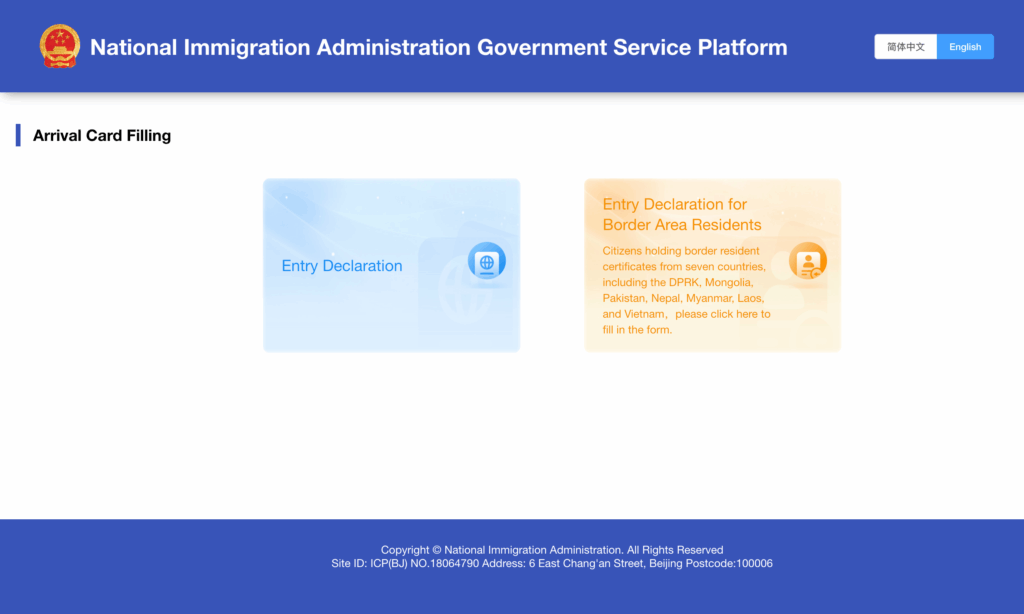
The Digital Arrival Card is an electronic customs declaration introduced by the NIA in November 2025. It replaces the old paper form that travellers used to fill in on board aircraft or upon arrival in China. This change is part of a drive to modernise and accelerate immigration formalities.
It is essential to understand the exact nature of this document: it is not a visa, nor an entry authorisation. The Arrival Card is a declaration — you are informing the Chinese authorities of your itinerary, your mode of transport and your situation with regard to visa policy. It is therefore independent of any visa you may hold. Whether you are travelling with a valid Chinese visa or your country benefits from a visa exemption, you are required to complete it.
Once the form is submitted, you receive a QR code that immigration officers will scan upon your arrival. This digital code contains all your declared information and enables a fast, paperless border crossing.
- Official name
- Digital Arrival Card
- Nature of document
- Electronic customs declaration
- Issuing authority
- NIA – National Immigration Administration of China
- Government fees
- None (completely free)
- Maximum submission deadline
- 72 hours before arrival
- Result obtained
- Arrival QR code to present to immigration officers
- Accepted purposes
- Tourism, business, conference, studies, visiting relatives
- In force since
- 20 November 2025
02 · Who is concerned?
A universal obligation, regardless of nationality
Unlike the rules governing visas for China — which vary considerably depending on bilateral diplomatic agreements — the obligation to complete the Digital Arrival Card does not depend on your nationality. Any person holding a foreign (non-Chinese) passport entering the mainland territory of the People's Republic of China is subject to this formality.
Two main categories of travellers are therefore subject to this obligation:
- Holders of a standard Chinese visa (tourism, business, studies, etc.): they will need to enter their visa number when completing the form.
- Nationals travelling without a visa, under an exemption granted to their country: they will need to select the corresponding entry policy (30-day exemption or 240-hour transit).
The application of this rule is universal: regardless of your nationality, your reason for travel or your mode of entry into the country, the Digital Arrival Card is a mandatory step in your entry formalities for China.
The entry policy you have to declare on the form, on the other hand, depends entirely on your nationality and your itinerary. The table below sets out the four main regimes in force in 2026.
| Entry policy | Who is concerned | Permitted stay |
|---|---|---|
| Standard Chinese visa | All nationalities not covered by a visa-free scheme, and all purposes excluded from the exemptions (work, long-term study, journalism) | Depends on the visa category |
| Unilateral 30-day exemption | 50 countries since 17 February 2026 (Canada and the United Kingdom added on that date), including France, Belgium, Switzerland, Germany, Italy, Spain, the Netherlands, Austria, Australia, New Zealand, Japan, South Korea, Brazil, Argentina and the Gulf states. Extended until 31 December 2026 | 30 days |
| 240-hour visa-free transit | 57 countries since 20 August 2026, with an onward ticket to a third country, through 65 ports of entry across 24 provincial-level regions | 10 days |
| Regional schemes | Hainan: 61 nationalities since 20 August 2026, through the province's open ports (Haikou Meilan, Sanya Phoenix, Boao). Cruises: tour groups arriving and departing on the same vessel, notably via Shanghai and the coastal ports | 30 days (Hainan) / 15 days (cruises) |
Entry policies for mainland China in force in 2026. The 30-day stay granted under the unilateral exemption is counted from 00:00 on the day after entry. The country lists change several times a year: check yours on the NIA website before booking.
Every non-Chinese citizen holding a foreign passport must complete the declaration, without exception. The rule applies regardless of country of residence or country of passport issuance.
Whether you hold a traditional visa or benefit from a visa exemption (such as the 30-day exemption granted to French nationals), the Arrival Card remains mandatory.
The formality applies to all means of access to the territory: air, sea, cross-border train, car or on foot at certain border crossings. The form adapts to the declared mode of transport.
Tourism, business travel, conference, studies, visiting relatives: all purposes of stay are subject to this arrival declaration obligation.
It is important to note that the Digital Arrival Card applies to all of mainland China. Non-Chinese residents of Hong Kong and Macau holding a valid permit to travel to the mainland benefit from a specific exemption. They are not subject to this formality in the context of their regular trips to the mainland.
03 · Exemptions
Who is not required to complete the Arrival Card?
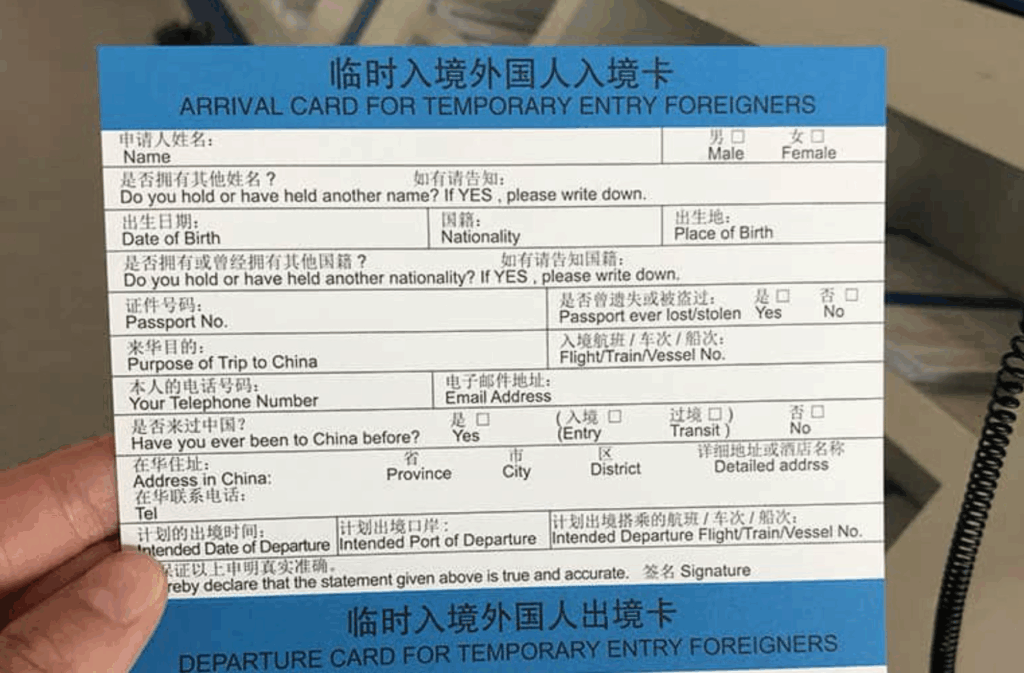
While the vast majority of foreign travellers are subject to this obligation, the regulations provide for several categories of exemption. The following persons do not need to complete the Digital Arrival Card:
- Holders of a valid Permanent Residence Card for Foreigners in China at the time of entry.
- Travellers using the automated gates (E-channel) on arrival.
- Persons in direct transit of less than 24 hours who do not leave the controlled zone of the port of entry.
- Members of tour groups benefiting from a group visa exemption or holding a group visa.
- Passengers on cruise ships arriving and departing on the same cruise (without crossing the border independently).
- Foreign crew members of international means of transport (aircraft, ships, cross-border trains).
- Non-Chinese residents of Hong Kong and Macau holding a valid permit to travel to the mainland.
If you have a long layover in China and wish to leave the international transit zone (for example to visit Beijing or Shanghai between two flights), you are not exempt from the Arrival Card. On the contrary, you will need to complete the form and select the “240-Hour Transit” option in the “Entry Policy Selection” section. This 240-hour (10-day) visa-free transit scheme has been open to nationals of 57 eligible countries since 20 August 2026 — Kyrgyzstan and Viet Nam joined the list on that date — including France, Belgium and Switzerland. You must hold an onward ticket to a third country within the 240-hour window and enter through one of the authorised ports (65 entry points across 24 provincial-level regions; Xinjiang, Tibet, Inner Mongolia, Ningxia, Qinghai, Gansu and Jilin are not covered). The scheme allows tourism, business, exchanges and family visits, but neither work, nor study, nor journalistic reporting. However, a direct transit of less than 24 hours without leaving the controlled zone entirely exempts you from this process.
04 · The procedure
How to complete and submit the form step by step
- 1Prepare your documents
Have your valid passport, your plane ticket or transport document (for flight/ship/train information), and if applicable your Chinese visa (you will need the visa number shown on the sticker) ready.
- 2Access the online form
Go to the NIA's official system — s.nia.gov.cn, the “NIA 12367” app or the official WeChat/Alipay mini-programme — to submit your Digital Arrival Card. Since the form is free, beware of sites imitating the portal: only .gov.cn domains and the official apps are genuine. Submission can be made up to 72 hours before your scheduled arrival in China. Do not submit too far in advance as the information must precisely match your travel period.
- 3Enter your identity and passport information
Enter your surname, first name, date of birth, nationality, and your passport details (number, expiry date). These data must correspond exactly to those shown on your travel document.
- 4Answer the key question about your entry authorisation
The system will ask you “Do you hold a valid visa or other entry permit?”. If you hold a Chinese visa, answer “Yes” and enter your visa number (located at the top right of the sticker in your passport). If you are travelling without a visa, answer “No” and proceed to the “Entry Policy Selection” section.
- 5Select your entry policy (visa-free travellers)
If you are travelling without a visa, you must indicate the legal framework of your entry: “30-Day Visa Waiver” for nationals benefiting from the short-stay exemption (such as French citizens), or “240-Hour Transit” if you are on a long layover eligible for visa-free transit.
- 6Enter your itinerary
Indicate your mode of transport (air, sea, train, car, on foot), the details of your flight or journey, and your first accommodation address in China.
- 7Confirm and retrieve your QR code
After submitting the form, you will receive an arrival QR code. Save it on your phone or print it to present to immigration officers upon your arrival in China.
The distinction between answering “Yes” and “No” to the question about holding a visa is crucial. An error in this section can create inconsistencies in the immigration system, which instantly cross-references your passport data with the legal framework of your stay. Take the time to verify your situation before completing the form.
If you answered “Yes” but are actually travelling without a visa (or vice versa), the generated QR code will be non-compliant and may cause difficulties at the border crossing. If you are unsure of your status with regard to Chinese visa policy, consult the competent consular authorities or a specialist service provider.
05 · Fees and timelines
Free and fast: what you need to know about deadlines and costs
Accessing and submitting the form directly on the NIA's state system is completely free of charge. No government fee is charged to generate this Arrival Card. It is an administrative formality covered by the Chinese state as part of the modernisation of its immigration procedures.
As for the submission deadline, it is advisable to complete the form within the 72 hours preceding your arrival. This time window ensures that your transport information (flight number, arrival date and time) is perfectly up to date and corresponds exactly to your actual journey. Submitting too far in advance could create inconsistencies if your itinerary were to change.
In practice, the form can be completed a few hours before boarding, once you have all your travel information to hand. Specialist service providers can handle this process on your behalf, for a service fee, and send you the document as soon as submission is possible within the 72-hour window.
The Chinese Digital Arrival Card is an officially free form. If you complete it yourself on the NIA website, there is nothing to pay. However, if you use a service provider for assistance with the process, service fees may apply — this is distinct from government fees, which do not exist in this case. Be sure to distinguish between the two.
06 · Before you leave
Practical tips and checklist for a smooth border crossing
Even though the Digital Arrival Card is designed to be simple and accessible, a few common-sense precautions will help you avoid inconveniences on arrival. Here are the main points to incorporate into your travel preparation.
- Valid passportMake sure your passport is valid for the entire duration of your stay in China. Check the number, expiry date and your nationality as they appear on the document.
- Chinese visa (if applicable)If you are travelling with a standard visa, locate the visa number on the sticker affixed in your passport (top right). You will need to enter it in the form.
- Confirmed transport ticketHave your confirmed plane, train or ship ticket ready. You will need the flight number (or equivalent), date and expected arrival time to complete the form.
- Accommodation address in ChinaPrepare the full address of your first place of stay in China (hotel, residence, with relatives). This information is required in the form.
- Know your entry policyFind out before completing the form: are you travelling with a standard visa, under a 30-day visa exemption, or on a 240-hour transit? The answer determines which sections to complete.
- QR code accessible on arrivalOnce the form is submitted, save the generated QR code on your phone and/or print it. Check that you can access it easily even without an internet connection (screenshot or printout recommended).
The Digital Arrival Card is required at all entry points into mainland China, regardless of your mode of transport:
- Air: all international airports in mainland China.
- Sea: maritime ports and regional sea links (except exempt cruise passengers).
- Cross-border train: international rail services via cross-border railway networks.
- Car: land border crossings accessible by vehicle.
- On foot: certain specific border crossings allowing pedestrian or combined car/pedestrian crossing.
The online form automatically adapts to the mode of transport you select, and the fields requested will vary accordingly.
The Arrival Card does not exempt you from the obligation set out in Article 39 of the Exit and Entry Administration Law: every foreign national must register their place of stay with the local police within 24 hours of arrival, and again at every change of address.
- In a hotel: the establishment handles the formality at check-in, using your passport. You have nothing to do.
- With friends or family, in a rental or in private accommodation: you — or your host — must report to the neighbourhood police station within 24 hours. Several cities, including Beijing and Shanghai, now offer online registration.
Failure to register is punishable by a warning and a fine of up to 2,000 yuan. Keep the receipt: you may be asked for it during a check or an administrative procedure.
In summary, China's Digital Arrival Card is a recent formality, simple in principle and completely free of charge. It does not replace your visa or visa exemption: the two processes are complementary and independent. By completing it within the 72 hours before your departure, you arrive in China with all formalities in order, for a smooth and swift border crossing.
Safety
Travel advisories for China
The vigilance level recommended by five foreign ministries, on a shared scale.
Average level
Risk of arbitrary enforcement of local laws, exit bans and wrongful detention, flagged by the United States.
- Read the advice

US Department of StateAdvice dated September 4, 2026
Increased caution · China - Level 2: Exercise Increased Caution
- Read the advice

Global Affairs CanadaAdvice dated October 1, 2026
Increased caution · China — Exercise a high degree of caution (with regional advisories)
- Read the advice

German Federal Foreign OfficeAdvice dated September 25, 2026
Normal precautions · China: Travel and Security Information
- Read the advice

UK Foreign Office (FCDO)Advice dated August 28, 2026
Normal precautions · China travel advice
- Read the advice

France DiplomatieAdvice dated September 15, 2026
Normal precautions · China: Travel Advice
Levels published by the ministries cited, reproduced unchanged. Visamundi is a private agency with no ties to these administrations.
FAQ
Frequently asked questions
