Choose the visa that fits your trip. Fully online process, real-time tracking.
Visamundi service: €49 incl. VAT
Consular fee: €70
Electronic visaVisamundi service: €49 incl. VAT
Consular fee: €70
Electronic visaVisamundi service: €49 incl. VAT
Consular fee: €175
Electronic visaVisamundi service: €49 incl. VAT
Consular fee: €70
Electronic visaVisamundi service: €49 incl. VAT
Consular fee: €350
Electronic visaVisamundi service: €29 incl. VAT
Arrival cardVisamundi service: €49 incl. VAT
Consular fee: €175
Electronic visaVisamundi service: €49 incl. VAT
Consular fee: €35
Electronic visaVisamundi service: €49 incl. VAT
Consular fee: €70
Electronic visaThailand has moved to a fully online visa system: applications submitted from home, processed by the embassy closest to your place of residence, with no need to visit a consulate in person. All passports are accepted — including refugee travel documents. Entry is possible by air, sea or land. For tourist stays not exceeding 30 days, nationals of France and 59 other countries and territories may enter visa-free from 15 September 2026. Beyond that, for non-tourist purposes or for nationalities not covered by the exemption, an e-Visa or another visa remains mandatory.
01 · The essentials
The e-Visa application is completed entirely online, with no need to visit an embassy, regardless of the type of visa chosen.
Since 1 May 2025, all foreign travellers must complete the TDAC electronic arrival card within 72 hours before each entry into Thailand.
The average processing time is around 3 weeks, with frequent requests from the Thai authorities for document compliance.
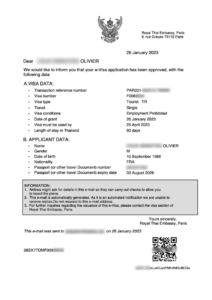
The Thailand e-Visa is a fully-fledged electronic visa, issued by an accredited Thai embassy or consulate. It is not a travel authorisation of the ESTA or eTA type (reserved for nationals exempt from visa requirements): it is an official document that replaces the visa sticker in the passport and is required for travellers whose tourist stay exceeds 30 days, whose purpose is not strictly tourism, or whose nationality does not benefit from the current automatic exemption.
Once granted, the e-Visa is sent by email as a PDF. The traveller keeps it printed or in digital form (smartphone, tablet) to present at check-in and at the immigration counter on arrival. Officers can verify its validity electronically, but it is advisable to keep a backup copy in case of technical failure.
The document contains two blocks of information: the Visa Data section (transaction number, visa type and number, employment conditions, issue date, latest entry date, authorised length of stay and travel method) and the Applicant Data section (name, gender, date of birth, nationality, passport number and expiry date). A QR code in the bottom right is used for immigration checks.
02 · Eligibility
Thailand's entry policy distinguishes between several categories of travellers. Identifying yours before submitting an application will save you time and money.
Since 15 September 2026, passport holders from 60 countries and territories — including France, Belgium, Switzerland, Canada, the United States, the United Kingdom and all 27 EU member states — may enter Thailand visa-free for tourism for stays of up to 30 days per visit. An onward or return ticket within 30 days may still be requested, and land-border entries under this regime are generally limited to 2 per calendar year, except for specific exemptions including Malaysia, Brunei Darussalam, Indonesia and Singapore.
The temporary 60-day scheme introduced on 15 July 2024 for 93 nationalities ended for new entries from 15 September 2026, after publication in the Royal Gazette on 31 August 2026. Travellers who entered on or before 14 September 2026 keep the length of stay stamped on arrival.
The current framework also includes 2 nationalities with a 15-day exemption (Mauritius and Seychelles), 3 nationalities eligible for visa on arrival (Azerbaijan, Belarus and Serbia), and separate bilateral arrangements granting 14, 30 or 90 days depending on the passport. Some nationalities that previously enjoyed the 60-day exemption, such as China, Russia, Brazil, Mexico, Colombia, Vietnam and Kazakhstan, are no longer on the general 60-country list and must check whether a bilateral arrangement still applies or obtain an e-Visa. For business trips, meetings or other non-tourist travel, the 30-day exemption is not the right basis: it is limited to tourism only.
Since 15 September 2026, Thailand's visa on arrival is available to three nationalities only: Azerbaijan, Belarus and Serbia. It allows a stay of 15 days and must be obtained with the relevant formalities and fee at the border; it should not be confused with visa-free entry.
Since 15 September 2026, 60 countries and territories including France benefit from a 30-day visa exemption for tourism. Land-border entries are generally limited to 2 per calendar year.
Under the visa-exemption scheme, travellers must be able to show sufficient funds: 20,000 THB per person or 40,000 THB per family (or the equivalent in foreign currency, a bank statement or a credit card). This check, at the discretion of the immigration officer at the border, may condition entry. Children under 12 are exempt.
The passport must be valid for at least 6 months from the date of arrival in Thailand, regardless of the type of stay or visa.
The e-Visa is strictly personal. Each member of a group — including children — must have their own application. Thailand has introduced specific visa types for dependants of long-stay visa holders.
The Very Long Stay O-X visa is reserved for persons over 50 who are nationals of France, Japan, Australia, Denmark, Finland, Germany, Italy, the Netherlands, Norway, Sweden, Switzerland, the United Kingdom, Canada and the United States.
03 · Visa types
The range of Thai visas is one of the most diverse in the world, with categories specifically designed for retirees over 50, digital nomads and long-term expatriates. Here are the main families.
Two variants: the TR Single-Entry visa and the TR Multiple-Entry visa (TR-M). Both allow a maximum stay of 60 days. The single-entry visa allows only one entry into the country, while the multiple-entry visa — valid for 6 months — allows unlimited return visits to Thailand, with the 60-day period resetting at each entry.
For stays exceeding 60 days or for specific purposes: the B visa covers business travel, the ED visa covers studies and conferences, and the O visa covers humanitarian missions, family visits and dependants of long-stay visa holders. These visas offer a stay of 90 days.
Thailand is one of the few countries to have created a range of visas dedicated to people over 50. The O-A visa (Long Stay, 1 year) allows multiple entries over a period of 12 months. The O-X visa (Very Long Stay) is valid for 5 years, renewable for an additional 5 years, allowing up to 10 years of presence in Thailand. For the O and O-A visas, it is mandatory to take out insurance covering repatriation, medical and hospitalisation costs to a minimum of 20,000 € or 400,000 THB (6 months of coverage for the O visa, 12 months for the O-A visa).
Launched in 2022 and supervised by the Board of Investment (BOI), the LTR visa targets four profiles: wealthy global citizens, affluent retirees, professionals working in Thailand for international groups, and highly skilled experts in priority sectors. This visa offers 10-year validity, renewable. Among its benefits: elimination of the quarterly 90-day reporting requirement (replaced by an annual declaration), Fast Track access at airports and a reduced income tax rate of 17% for experts. Candidates must meet strict financial or skills criteria and submit their application via the official BOI portal.
Introduced in mid-2024, the DTV has quickly established itself as the reference option for digital nomads, freelancers and participants in Thai 'Soft Power' activities (Muay Thai, cooking classes, medical care, cultural events). This 5-year multiple-entry visa allows stays of up to 180 days per entry, with the possibility of a single extension of 180 additional days through local immigration — nearly a full year without leaving the country. The financial criterion is a bank balance of 500,000 THB (approximately 13,000 €), which must now have been held for at least 3 months: consulates require bank statements covering 3 to 6 months and reject last-minute deposits. The funds must be evidenced again when applying for an in-country extension. Since 2026, Thai language courses are no longer accepted as a qualifying 'Soft Power' activity. The main applicant must be at least 20 years old; spouses and children under 20 are also eligible. The DTV allows legal work for entities outside Thailand without a standard work permit, but prohibits working for a company registered in Thailand, freelancing for Thai clients and applying for a Thai work permit. Since 1 January 2025, all Thai missions process the DTV exclusively through the e-Visa portal. The application fee is approximately 10,000 THB (approximately 261 €) and the 180-day extension costs 1,900 THB at the immigration office.
04 · The procedure
Determine whether you need an e-Visa (tourist stay > 30 days, non-tourist purpose or non-exempt nationality) or whether you benefit from the automatic exemption. If you are a French national staying 30 days or fewer for tourism, no visa has been required since 15 September 2026.
Select the visa that matches your profile: TR for tourism, B for business, ED for studies, O for dependants and family visits, O-A or O-X for those over 50, DTV for digital nomads. The length of stay, purpose and age are the main selection criteria.
Scan of a passport valid for 6 months from arrival (or refugee travel document), recent colour identity photograph, bank statement showing a minimum credit balance of 1,500 € or payslip dated less than 30 days (except tourist visas), proof of address, and where applicable a copy of stamps from previous trips to Thailand.
For a tourist visa: copy of hotel reservation covering at least the first 7 nights AND outbound flight ticket within 90 days of the application, with onward travel within 30 days of arrival if you travel under the exemption regime. For O-A and O visas: proof of health insurance covering at least 20,000 € or 400,000 THB (6 months for the O visa, 12 months for the O-A visa). For other types, consult the embassy.
Embassies only accept applications within the 5 weeks prior to arrival in Thailand, and technically within 3 months. It is advisable to apply at least one month in advance to absorb consular follow-up requests and public holidays. An entry window of 90 days opens from the date of application.
The embassy may request additional documents or clarifications. Respond promptly with compliant documents: Thailand is known for its rigour regarding the quality of the items provided.
The e-Visa is sent by email as a PDF. Keep both a printed copy and a digital copy. Present it at check-in and at immigration on arrival. Important: carefully check the latest entry date and the number of permitted entries on the document.
Since 1 May 2025, the TDAC electronic arrival card is mandatory for all foreign travellers entering Thailand (replacing the former TM6 paper form). It must be completed within 72 hours before entry, regardless of the mode of transport, and presented to immigration in printed or digital form. The process is free of charge and must be repeated at each entry.
05 · Fees & timelines

The fee schedule below covers consular fees only, updated on 1 September 2022 by the Embassy of Thailand in France. These fees are exclusive of any service charges.
Processing an application takes on average 3 to 4 weeks. During periods of high demand or Thai public holidays, processing times may be longer. The embassy itself recommends applying 3 months before arrival; in practice, an application submitted one month in advance is sufficient outside peak holiday periods.
Once obtained, carefully check the validity of the document: for the TR visa (Single-Entry and Multiple-Entry), the validity is 90 days for a maximum stay of 60 days per entry. The O-A visa is valid for 1 year for stays of 90 days. The O-X visa is valid for 5 years and renewable for an additional 5 years.
It is strictly impossible to apply on an urgent basis for Thailand. The embassy does not have an expedited processing option.
Please note: The granting of a visa is solely at the discretion of the Thai authorities. Holding an e-Visa does not guarantee entry into the country: the final decision rests with the immigration officer at the port of entry. The lengths of stay stated on the visa may be reduced at the border crossing. Furthermore, the embassy reserves the right to refuse an application from travellers who have spent more than 90 days in Thailand in the 6 months preceding the application.
06 · Before you travel
The Embassy of Thailand in France updated the consular fees applicable to all visa types.
Thailand temporarily extends visa-free tourist stays to 60 days for 93 nationalities as part of its tourism stimulus policy.
The 5-year multiple-entry digital nomad visa, allowing stays of 180 days per entry, is officially launched.
The TDAC card definitively replaces the TM6 paper form. It must be completed online within 72 hours before each entry into Thailand, regardless of the entry route.
The Thai Cabinet approves the principle of returning to nationality-based entry categories, with the detailed notifications to be published in the Royal Gazette.
The official notifications confirm the end of the 60-day scheme and set the new framework: 60 countries and territories at 30 days, Mauritius and Seychelles at 15 days, and Azerbaijan, Belarus and Serbia under visa on arrival.
The new rules apply according to the date of entry into Thailand. Travellers already admitted before this date keep the duration stamped in their passport.
The best time to travel to Thailand is between November and March. Rainfall is rare and daytime temperatures are pleasant.
Thailand's borders are currently open. There are no specific health restrictions on entry at the time of writing.
A vaccination certificate is not required, unless the traveller is arriving from a yellow fever endemic zone (Angola, Brazil, Cameroon, Congo, Kenya, Nigeria, etc.). In that case, the yellow fever vaccine is mandatory.
Remaining in Thailand beyond the authorised duration results in a fine of 500 baht per day of overstay, capped at 20,000 baht. It may also lead to a partial or permanent ban from Thai territory.
Thailand offers one of the widest ranges of visas suited to all traveller profiles: short-stay tourists currently benefiting, for 60 countries and territories including France, from a 30-day exemption only, travellers requiring an e-Visa for longer or non-tourist stays, retirees over 50 with unique long-stay options (O-A and O-X), professionals targeted by the LTR and digital nomads drawn by the DTV. Some nationalities that were previously visa-exempt must now rely on a bilateral arrangement or an e-Visa.
The process is entirely digital, but requires planning ahead: allow at least one month before your arrival to submit your application, gather impeccable documents and be prepared to respond to any embassy follow-up requests. Don't forget to complete the TDAC card within 72 hours before your entry — this free process has been mandatory at each entry since 1 May 2025.
Safety
The vigilance level recommended by five foreign ministries, on a shared scale.
Average level
Risk of armed conflict along the Cambodian border; the border areas concerned are advised against.

US Department of StateAdvice dated July 7, 2026
Normal precautions · Thailand - Level 1: Exercise Normal Precautions

Global Affairs CanadaAdvice dated September 9, 2026
Increased caution · Thailand — Exercise a high degree of caution (with regional advisories)

German Federal Foreign OfficeAdvice dated September 10, 2026
Increased caution · Thailand: Travel and Security Advisories

UK Foreign Office (FCDO)Advice dated September 18, 2026
Increased caution · Thailand travel advice

France DiplomatieAdvice dated September 15, 2026
Increased caution · Thailand: Travel advice
Levels published by the ministries cited, reproduced unchanged. Visamundi is a private agency with no ties to these administrations.
FAQ