Choose the visa that fits your trip. Fully online process, real-time tracking.
Since 15 April 2023, paper immigration forms have been definitively phased out in the Philippines in favour of a single digital gateway: the eTravel. This free electronic arrival card is mandatory for all international travellers crossing the country's borders, regardless of nationality. It is completed entirely online, within the 72 hours before arrival, and produces a QR code to present at border checks. Note: the eTravel is neither a visa nor an ETA — it is an arrival declaration. Here is everything you need to know to handle it with confidence.
01 · The essentials
The eTravel replaced paper immigration forms. It applies to all international travellers entering the Philippines, whatever their nationality.
Registration is done entirely on the government platform, with no embassy visit. The card carries no consular fee.
Your passport must remain valid for at least 6 months from the date of arrival. A return or onward ticket may be required at boarding and on arrival.
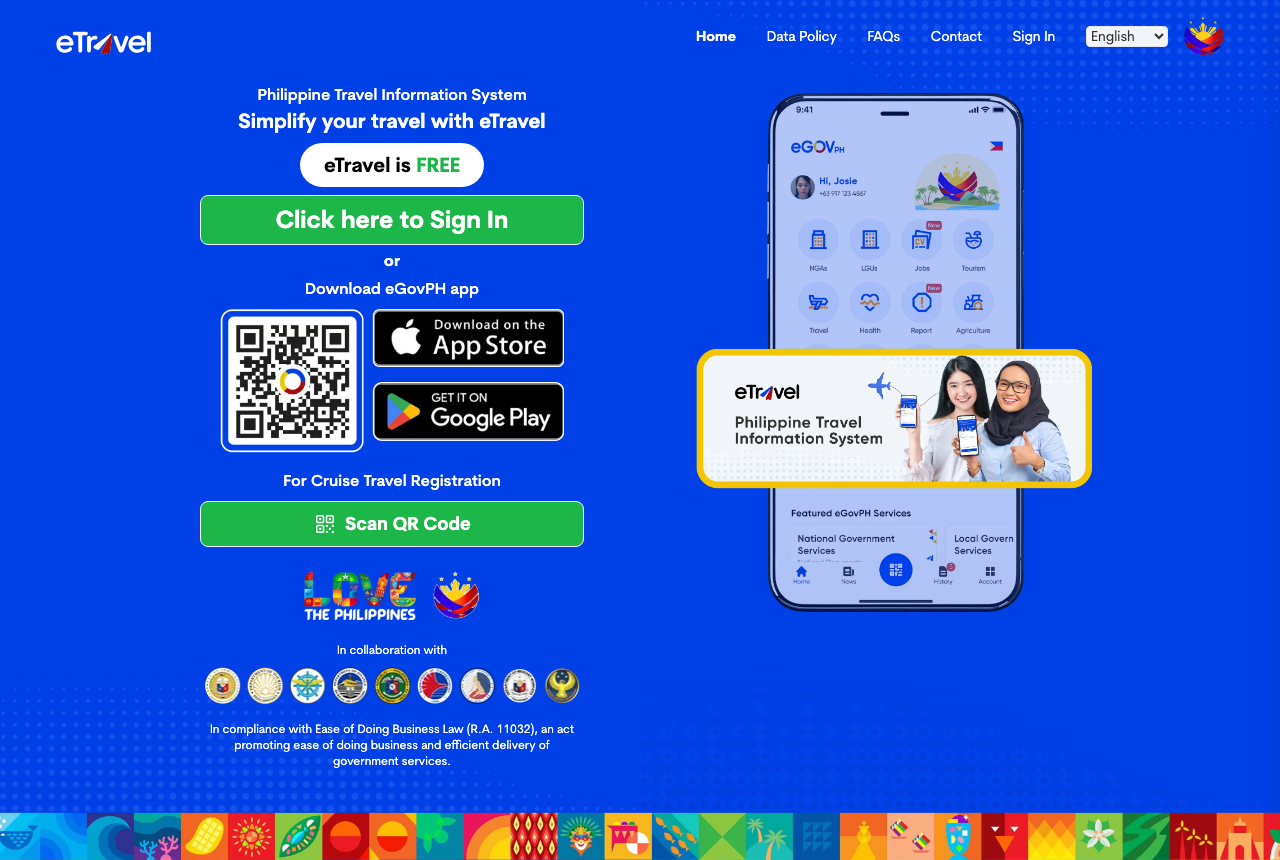
Registration is done on the official government portal, which clearly displays the "eTravel is FREE" notice. The platform lets you create a traveller profile, submit your declaration and retrieve the QR code, and is also accessible via the eGovPH mobile app.
To avoid the 72-hour filing window and last-minute stress, Visamundi handles this process on the official portal on your behalf and sends you your QR code by email.
The eTravel is an arrival declaration, not to be confused with a visa. Depending on your nationality, you may benefit from a visa exemption for a short tourist stay (often up to 30 days): an entry stamp is then issued on arrival by the immigration authorities (Executive Order 408), with an extension possible on site at the Bureau of Immigration. Other nationalities must obtain a visa beforehand.
In all cases, the eTravel remains mandatory, including for visa-exempt travellers. It does not replace the visa where one is required, and vice versa. Check the regime that applies to your nationality before departure.
02 · Eligibility
Registration on the eTravel platform is a regulatory obligation that applies to all international travellers crossing the borders of the Philippines, regardless of nationality. Whether for a temporary stay, a long-term move or a return home, the digital formality concerns foreigners and Filipinos alike.
Foreign tourists on short stays (all nationalities), business travellers, conference attendees, holders of a tourist visa or a visa on arrival.
International students and holders of a long-stay visa (work, investment, etc.) entering or returning to the Philippines.
Foreign nationals holding permanent resident status and returning to the Philippines.
The requirement applies individually: each child or infant must have a separate eTravel registration, completed by their parents or guardians.
The eTravel card is not reserved for foreigners. Filipino nationals must also register: citizens returning home from abroad, OFWs (Overseas Filipino Workers), and Balikbayan travellers (Filipinos who have lived abroad and return under the Balikbayan programme, without a visa).
03 · Exemptions
The Philippine government requires registration on the eTravel platform for the vast majority of travellers. A strict exemption is nonetheless granted to certain categories, based on their diplomatic or official status.
Conversely, the registration requirement always applies to the following profiles:
04 · The process
The journey on the eTravel platform is split into two phases: creating the traveller profile, then entering the trip-specific information. Once the profile is created, identity data does not need to be re-entered on subsequent trips.
Initial registration with a valid email address, the only reference required at this stage.
Surname, first name and contact details, taken from your passport. Have your travel document to hand.
A digital ID photo (Photo ID) is required to authenticate and finalise the account.
Purpose of the stay, full details of outbound and return flights and any layovers (by air) or cruise / ferry details (by sea).
Exact accommodation address in the Philippines, number of checked and cabin bags, health questionnaire. Since 10 May 2024, this form also integrates the Electronic Customs Baggage Declaration (e-CBDF) for dutiable goods, and the Electronic Currency Declaration Form (e-CDF) if you are carrying more than USD 10,000 or equivalent.
Once the application is validated, a confirmation email contains a unique QR code: the official proof to save or print, scanned at the border.
Registration can only be submitted within the 72 hours before arrival: the system technically blocks any earlier entry. To avoid departure stress, entrust the process to Visamundi as soon as your tickets are booked. We gather your information in advance and submit the file automatically as soon as the window opens, then send you your QR code by email.
"Using the eTravel is quick and easy" — official video from the Philippine Bureau of Immigration.
05 · Arrival
The platform identifies two modes of entry into Philippine territory: by air or by sea. The system covers all of the country's air entry points; when filling in the form, you select your exact airport of landing.
Arrival by air: you provide the purpose of the stay, full details of outbound and return flights and any layovers, your accommodation address and the number of checked and cabin bags. Prepare your flight tickets or bookings and your hotel confirmation.
Arrival by sea (cruise or ferry): you specify whether your arrival in the Philippines marks your disembarkation from the vessel, the date of the port call and the port, as well as the vessel name, the country and date of embarkation, and the ports of call (countries / ports and dates). Have the itinerary of your cruise or ferry journey to hand.
Whatever the mode of arrival, the traveller answers a health questionnaire covering their movements over the last 30 days and their current state of health: no symptoms, no contact or history of exposure to a person with an infectious or transmissible condition. The aim is to ensure the absence of any health risk.
06 · Before you go
The eTravel is a free, mandatory digital arrival card for all travellers entering the Philippines, to be completed within the 72 hours before arrival and materialised by a QR code. It is separate from the visa: many nationalities can stay without a visa for a short trip (often up to 30 days) but must still register, while nationalities subject to a visa must obtain one in addition. To avoid the last-minute constraint, Visamundi handles the process as soon as your tickets are booked and submits your file the moment the window opens.
07 · 30 to 59-day stays
Planning a trip to the Philippine archipelago is often easier than it seems. The Philippines already allow citizens of more than 157 countries to enter without a prior visa for a short stay, generally ranging from 14 to 59 days depending on nationality. If you plan to stay longer than the initial period granted on arrival, it is best to organise the formalities before you leave.
In addition to the mandatory eTravel arrival declaration, some nationalities that are normally visa-exempt for 30 days can apply online for a single-entry 59-day tourist visa. This makes it possible to land in the Philippines with authorisation to remain for 59 consecutive days from day one.
The eTravel is not a visa: it is a mandatory arrival registration for all international travellers. The 59-day tourist visa, by contrast, is for travellers who want to go beyond their initial visa-free allowance while completing everything before boarding.
| Continent | Region | Nationalities eligible for the 59-day visa |
|---|---|---|
| Africa | West & Central | Benin, Burkina Faso, Cameroon, Cape Verde, Congo, Côte d'Ivoire, Gabon, Gambia, Ghana, Guinea, Guinea-Bissau, Equatorial Guinea, Mali, Mauritania, Niger, Central African Republic, DR Congo, Sao Tome and Principe, Senegal, Chad, Togo |
| Africa | East & Southern | South Africa, Angola, Botswana, Burundi, Djibouti, Eritrea, Eswatini (Swaziland), Ethiopia, Kenya, Lesotho, Malawi, Mozambique, Namibia, Uganda, Rwanda, Tanzania, Zambia, Zimbabwe |
| Africa | North & Indian Ocean | Comoros, Madagascar, Morocco, Mauritius, Seychelles, Tunisia |
| Americas | North | Canada, United States, Mexico |
| Americas | Central & South | Argentina, Belize, Bolivia, Chile, Colombia, Costa Rica, El Salvador, Ecuador, Guatemala, Guyana, Honduras, Nicaragua, Panama, Paraguay, Peru, Suriname, Uruguay, Venezuela |
| Americas | Caribbean | Antigua and Barbuda, Bahamas, Barbados, Dominica, Grenada, Haiti, Jamaica, Dominican Republic, Saint Kitts and Nevis, Saint Lucia, Saint Vincent and the Grenadines, Trinidad and Tobago |
| Asia | Middle East | Saudi Arabia, Bahrain, United Arab Emirates, Israel, Kuwait, Oman, Qatar, Turkey |
| Asia | Central & South | Bhutan, Kazakhstan, Kyrgyzstan, Maldives, Nepal, Uzbekistan, Tajikistan, Turkmenistan |
| Asia | East & South-East | Brunei, Cambodia, South Korea, Indonesia, Japan, Laos, Malaysia, Mongolia, Myanmar, Singapore, Thailand, Vietnam |
| Europe | West & North | Germany, Austria, Belgium, Denmark, Estonia, Finland, France, Ireland, Iceland, Latvia, Liechtenstein, Lithuania, Luxembourg, Monaco, Norway, Netherlands, United Kingdom, Sweden, Switzerland |
| Europe | South, East & Balkans | Andorra, Bulgaria, Cyprus, Croatia, Spain, Greece, Hungary, Italy, Malta, Poland, Portugal, Czech Republic, Romania, Russia, San Marino, Slovakia, Slovenia, Vatican City |
| Oceania | Whole region | Australia, Fiji, Marshall Islands, Solomon Islands, Kiribati, Micronesia, New Zealand, Palau, Papua New Guinea, Samoa, Tuvalu, Vanuatu |
Nationalities usually exempt from a 30-day visa-free stay that may request a 59-day online tourist visa before departure.
Brazil and Israel: Brazilian and Israeli nationals automatically benefit from a 59-day visa exemption on arrival. For a stay of 59 days or less, they therefore do not need to apply for an e-Visa.
Indian citizens: since June 2025, two visa-free regimes apply. The first allows a 14-day stay for tourism or business, with a passport valid for 6 months, confirmed hotel booking, proof of sufficient funds, and a return or onward ticket. The second allows a 30-day stay, non-extendable and limited to tourism, for holders of a valid visa or residence permit for the United States, Japan, Australia, Canada, the Schengen area, Singapore, or the United Kingdom; on entry, only the passport and outbound ticket are required.
Chinese citizens: since January 2026, a 14-day visa-free entry has been announced for tourism and business, non-extendable and non-convertible. Travellers must present a passport valid for at least 6 months, confirmed accommodation, and a return or onward ticket. Visa-free entry is limited to Ninoy Aquino International Airport (Manila) and Mactan-Cebu International Airport. Chinese nationals transiting through the Philippines to a third country must obtain a transit visa, and no beneficiary of this exemption may have derogatory records with the Bureau of Immigration.
For a tourist stay of more than 30 days, the Philippines therefore combine two separate layers: the mandatory eTravel for entry, and depending on nationality, either a 59-day online tourist visa or an already extended visa exemption (Brazil, Israel, certain Indian and Chinese profiles). If you want to arrive with nearly two months already secured, it is best to apply before departure and prepare all supporting documents in digital format.
Safety
The vigilance level recommended by five foreign ministries, on a shared scale.
Average level
Crime, terrorism, unrest and kidnapping; typhoon season and several areas formally advised against.

US Department of StateAdvice dated September 1, 2026
Increased caution · Philippines - Level 2: Exercise Increased Caution

Global Affairs CanadaAdvice dated September 9, 2026
Increased caution · Philippines — Exercise a high degree of caution (with regional advisories)

German Federal Foreign OfficeAdvice dated September 4, 2026
Increased caution · Philippines: Travel and security information

UK Foreign Office (FCDO)Advice dated July 15, 2026
Reconsider travel · Philippines travel advice

France DiplomatieAdvice dated June 30, 2026
Increased caution · Philippines: Travel advice
Levels published by the ministries cited, reproduced unchanged. Visamundi is a private agency with no ties to these administrations.
FAQ