
Philippines opens e-Visa to U.S. residents and 19 Caribbean territories
From August 10, 2026, travelers residing in the U.S. or 19 Caribbean countries and territories will be able to apply for the Philippine e-Visa online at evisa.gov.ph, without a visa sticker in their passport.
The measure targets individuals who require a visa for short-term travel, regardless of their nationality. The e-Travel registration remains mandatory before departure.
Philippine e-Visa expanded to 20 jurisdictions
The Embassy of the Philippines in Washington announced on August 7, 2026 the launch of the e-Visa system starting August 10, 2026, across all jurisdictions under its cover: the United States, as well as Anguilla, Antigua and Barbuda, the Bahamas, Barbados, the British Virgin Islands, the Cayman Islands, Dominica, Guadeloupe, Haiti, Jamaica, Martinique, Montserrat, Saint Barthélemy, Saint Kitts and Nevis, Saint Lucia, Saint Martin, Saint Vincent and the Grenadines, Trinidad and Tobago, and the Turks and Caicos Islands.
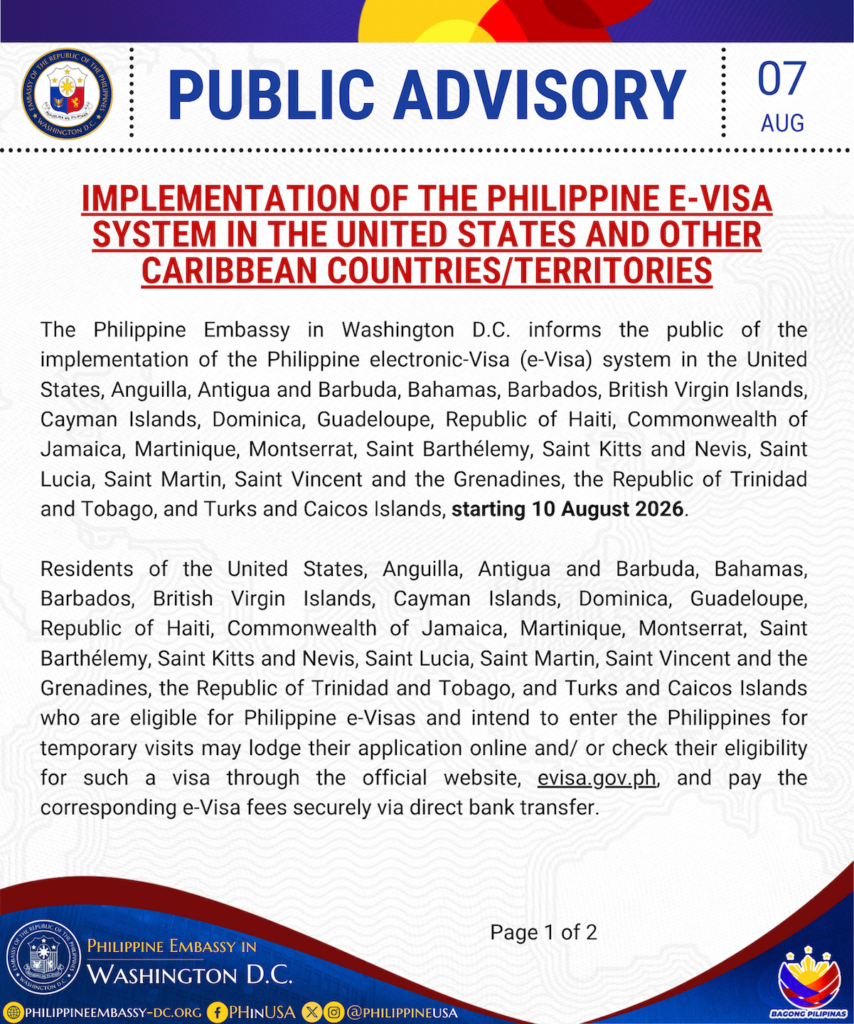
The eligibility criterion is based on place of residence, not nationality. An Indian citizen living in Miami, a Haitian resident in Port-au-Prince, or a Nigerian-based in Kingston all fall under the new system. Thailand’s Philippine consulates in the U.S. have confirmed the same implementation date of August 10, 2026 for residents of Illinois and the 11 other states under its jurisdiction.
For the French Caribbean, this marks a change in process: Guadeloupe, Martinique, Saint Barthélemy, and Saint Martin now fall under the Embassy of the Philippines in Washington, rather than Philippines missions in Europe. Residents in these territories who need a visa previously had to submit applications in person at these posts.
The Philippine e-Visa has rolled out in successive waves by nationality. As previously reported, the platform began with Asian nationalities before expanding to Europe. The addition of the U.S. and Caribbean jurisdictions adds one of the most populous residency zones in the Philippine consular network.
Who requires this visa
Only nationalities required to hold a visa for the Philippines are affected. Many passports—including those from most of Europe, the Americas, and East Asia—enjoy visa-free entry for short stays, and their status remains unchanged by the e-Visa rollout.
The system applies to non-exempt passport holders who reside in one of the 20 listed jurisdictions. Common cases in this zone include Haitian citizens, as well as nationals from several African and South Asian countries living in the U.S., or holders of Chinese or Indian passports who do not qualify for the limited exemptions available. The evisa.gov.ph portal includes an eligibility checker before proceeding with an application.
What the e-Visa covers—and what it does not
The e-Visa is the Philippine Temporary Visitor Visa, or 9(a), covering tourism, business, medical treatment, training, or conference attendance. The Embassy in Washington lists three variants: single entry, multiple entry valid for six months, and multiple entry valid for one year.
Two key restrictions apply immediately. The e-Visa is not convertible to another visa type once in the country, and authorized stays cannot be extended. Travelers anticipating longer stays must select the appropriate visa duration at application.
Employment, study, seafarer status, contractor-based commerce, foreign government officials, retirees (SRRV), or family immigration cases remain outside the system. Applicants in these categories must still submit a traditional sticker visa application through the embassy or consulate covering their jurisdiction.
Payment via bank transfer within 48 hours
e-Visa fee payment must be made via direct bank transfer, not by card. The Embassy in Washington also accepts money orders. In addition to the 9(a) visa fee, there is a 25 USD processing surcharge [vm_currency_convertor amount="25" currency="USD"], and any bank transfer fees are borne by the applicant.
A request left unpaid for 48 hours after submission is automatically canceled and must be resubmitted. All fees paid are non-refundable, including in the event of rejection.
Processing times vary by visa type: seven to twelve business days for a single-entry e-Visa and 15 to 21 business days for a multiple-entry e-Visa. The embassy notes that processing times remain identical to in-person 9(a) applications.
Each Philippine mission processes only residents of its assigned jurisdiction. The embassy warns that an application submitted to the wrong post will be canceled. The portal features a Consulate Finder tool to confirm the correct mission before completing any form.
No visa sticker, but the e-Travel remains mandatory
Approved e-Visas are no longer stamped or affixed in passports. Travelers must download their document upon approval and present it—digitally or in hard copy—during check-in and immigration. Authorities emphasize that an e-Visa does not guarantee admission; final entry decisions rest with the immigration officer at the point of arrival.
The e-Visa does not replace the mandatory e-Travel registration. All travelers to the Philippines—with or without a visa—must complete the form at etravel.gov.ph within 72 hours of departure. The two processes are separate, on two distinct platforms, and neither fulfills the requirements of the other. For Caribbean and U.S. resident applicants subject to visa requirements, the process remains three steps: submit the e-Visa on evisa.gov.ph several weeks before departure, make the bank transfer within 48 hours, then complete the e-Travel within the three days prior to flying.

A specialist in regulatory monitoring and a content destination expert, she analyzes daily changes in entry formalities to turn complex administrative processes into practical guides. Her role blends ground-level expertise with technical precision to ensure the reliability of the information provided to travelers.

Get our visa news first in your Google results: add Visamundi to your preferred sources.
