
Ivorian travelers still need a visa for Morocco despite the two-year deadline
The two-year exemption suspension for ordinary Ivorian passport holders expired on September 1, 2026, but no lifting decision has been published. Morocco's official eligibility questionnaire continues to require a visa.
The deadline has now passed since September 1, 2026, without any published decision to lift it. Tested by our team on September 8, 2026, the official eligibility questionnaire from Morocco’s Ministry of Foreign Affairs still shows that a visa is required. We therefore advise our Ivorian clients to apply for an e-Visa.
What the official portal says today
The official portalacces-maroc.ma, managed by Morocco’s Ministry of Foreign Affairs, hosts an eligibility questionnaire that enforces the current rule: « Do I need a visa to enter Morocco? ». When filled with Ivorian nationality, residency in Côte d'Ivoire, an ordinary passport, and a tourist stay, it confirms that the applicant must request a Moroccan visa.
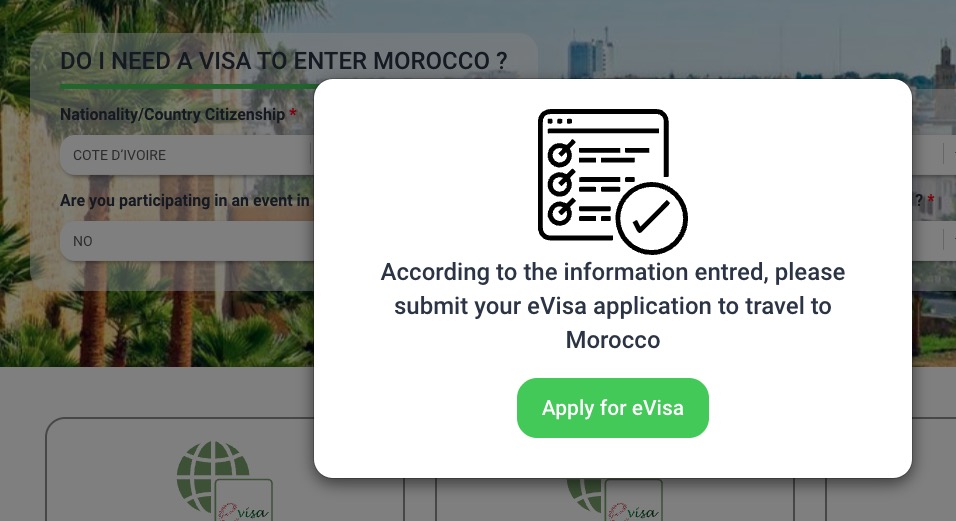
This is the critical point for a traveler: the questionnaire isn't an informational page left to gather dust for months; it’s the tool that directs you to the correct procedure when you’re preparing to travel. Until it points to waived entry, the visa regime remains in effect.
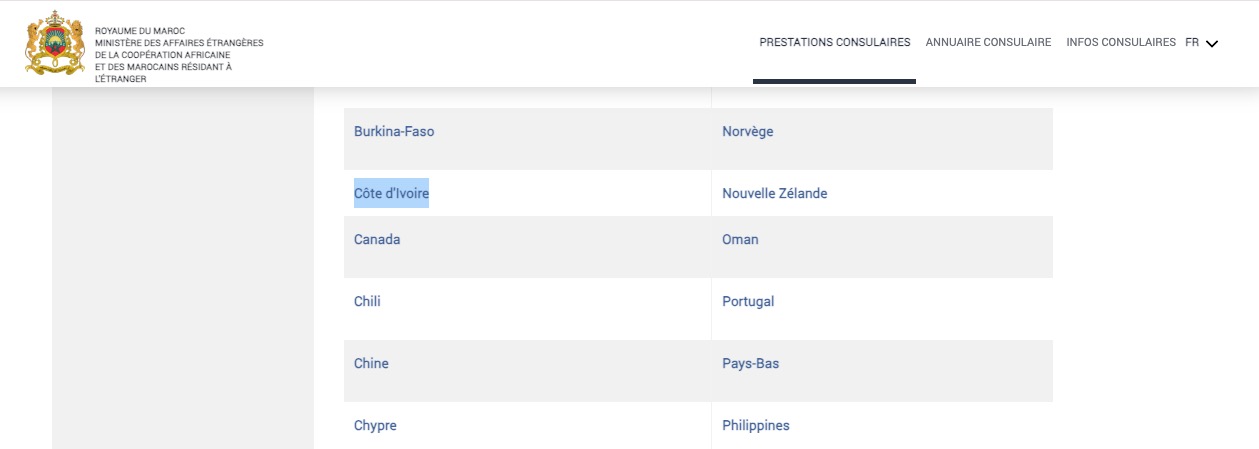
A key detail worth noting—one that can trap travelers checking independently—is that the static list of countries exempt from visas, published on the consular portal of the same ministry, still includes Côte d'Ivoire among those with visa-free access. That page hasn’t been updated to reflect the 2024 decision. If there’s a discrepancy between the two sources, it’s the eligibility questionnaire that reflects the actual procedure in force.
Why the two-year deadline hasn’t changed anything automatically
Morocco didn’t impose this measure—it was requested by Abidjan. In August 2024, the Ivorian Ministry of Foreign Affairs announced the reintroduction of entry visas for Morocco for holders of ordinary passports, effective from September 1, 2024. It was framed as a temporary suspension of visa-free access for a maximum experimental period of two years, with an evaluation to take place along the way.
The phrase « two-year maximum » doesn’t mean two years and then the situation automatically reverts. It was a ceiling, not an automatic return date to the former rules. Restoring exemptions requires a formal decision—and that decision must be published by either Rabat or Abidjan to be reflected at consular desks and on official portals. To this day, no such announcement has been made, and Morocco’s tools continue to apply the visa requirement.
Who remains exempt from visa requirements
Three situations remain outside the obligation, and they were never affected by the suspension:
Holders of Ivorian diplomatic or service passports continue to enter Morocco without a visa or digital travel authorization; the official questionnaire confirms this for both document types.
Those holding a valid Moroccan residence card are covered by their residency permit, not by the visa procedure.
Travelers in simple transit who do not leave the international zone of the airport or port are also unaffected.
Holders of Schengen, US, Canadian, or UK visas
An Ivorian traveling on an ordinary passport who already holds a valid visa for the Schengen Area, the United States, Canada, or the United Kingdom is not directed to the consulate. Instead, the official questionnaire will point them to the Moroccan e-Visa, to be applied for online via acces-maroc.ma. The same applies to holders of Australian, Irish, Japanese, New Zealand, and Norwegian visas, all of which appear on the form’s list.
<
The distinction is practical, not just administrative: the e-Visa can be requested from home, without an in-person appointment or passport submission, whereas the consular route requires a physical visit to the embassy. Travelers who already hold one of these visas should declare it in the questionnaire before making a wasted appointment.
Consular applications: documents vary by purpose
For those required to apply for a regular visa, Morocco’s consular portal lists the required documents, which differ depending on the reason for travel. A tourist application requires the application form, two color photos measuring 4 x 3 cm on a white background, a national ID card, the passport and a copy, plus a bank statement, a legalized sponsorship letter if visiting family, or a request from a licensed travel agency.
A second set of documents is only requested upon visa issuance—a detail too many applicants discover too late: travel insurance, confirmed hotel bookings or vouchers, and round-trip transport reservations.
Other travel purposes carry separate requirements. A study stay requires enrollment proof from a Moroccan institution, a work trip demands a verified employment contract, and a business visit needs an invitation or letter of recommendation, depending on the purpose.
One rule worth noting in advance: the consular portal states that changing visa types is not permitted after entry. A visitor who arrives on a tourist visa cannot later adjust status in-country. A student with a tourist visa would not be able to regularize their situation after arrival.
Nothing indicates today that the exemption will be restored in the short term—or, for that matter, that it has been formally extended. The status quo persists by default, leaving the situation subject to sudden change without advance warning.
There are two signals to watch for. From the Ivorian side, an announcement from the Ministry of Foreign Affairs, since it was Abidjan that requested the change. From the Moroccan side, look for changes to the eligibility questionnaire on acces-maroc.ma, which remains the most reliable point of verification because it reflects the rule actually applied—not the one displayed.

As CEO of Visamundi, I am dedicated to simplifying international travel by assisting our clients in obtaining visas worldwide. By staying at the forefront of ever-changing regulations, I ensure our agency remains a trusted pillar in the visa services industry.

Get our visa news first in your Google results: add Visamundi to your preferred sources.
