
Available travel documents
Choose the visa that fits your trip. Fully online process, real-time tracking.
Libya has remained for decades one of the most fascinating and least visited destinations in the Mediterranean: 1,800 kilometres of coastline, five UNESCO sites, the best-preserved Roman ruins outside Italy, the great Sahara and the Tuareg oases of Ghat and Ghadamès. Since 2024, the Libyan Ministry of Foreign Affairs has opened an official e-Visa channel, making this destination once again accessible to travellers from Europe, North America and much of the world. This guide covers everything you need to know: eligibility conditions, required documents, step-by-step procedure, processing times, entry rules and practical specifics on the ground.
01 · The essentials
Libya and its e-Visa: what changed in 2024
Since spring 2024, the Libyan e-Visa application is submitted, paid for and received entirely online — regardless of the visa type chosen.
The passport must be valid for at least 6 months after the intended entry date and must have at least two blank pages, for all options.
A letter of invitation from an approved Libyan operator or partner is required for every application, regardless of the option or purpose of stay.
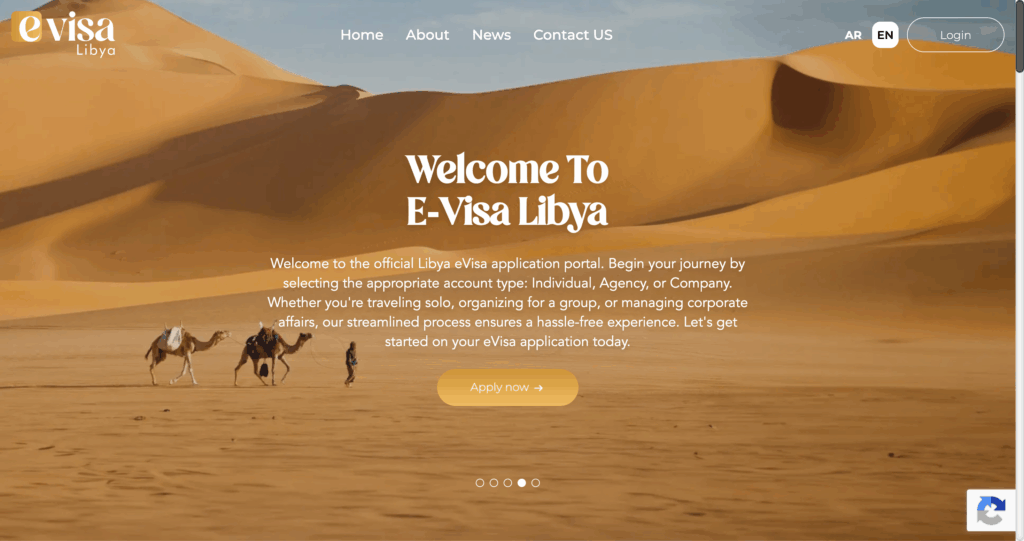
For decades, obtaining a visa for Libya was an arduous process: paper dossiers sent by post, embassy appointments, processing times of six to eight weeks — sometimes longer. The procedure discouraged both tourists and professionals alike.
Spring 2024 marked a turning point. The Libyan Ministry of Foreign Affairs officially launched the e-Visa system for foreign nationals, allowing for the first time the submission, payment and receipt of a Libyan visa 100% online. The officially announced processing time is 3 to 5 business days, compared to several weeks previously.
The Libyan e-Visa is a genuine electronic visa — it is not a simple travel authorisation like the American ESTA or the Canadian ETA. It is issued to nationals who normally require a visa to enter Libya, and obtaining it before departure is mandatory: there is no visa on arrival for tourism.
In June 2026 the Government of National Unity launched the second phase of the “Wafed” and “E-Visa Libya” digital platforms, designated as the only official channels for issuing electronic visas and for managing the entry and residence of foreign nationals. All previous e-visa types and categories have been discontinued. Around 6,000 electronic visas had been issued through the two systems as of the announcement.
The practical consequence: an authorisation obtained before that switchover, or through a third-party electronic channel, may no longer be recognised at the border. Check that your e-Visa was indeed issued through the official portal or through an intermediary that files there. If you have any doubt about a document issued before June 2026, have it verified before you buy tickets.
02 · Eligibility
Who can apply for the Libya e-Visa?
The vast majority of foreign nationals must obtain a visa before travelling to Libya. Visa exemption is very narrow: it covers nationals of Algeria and Tunisia, plus — subject to age and gender conditions — those of Egypt (men under 18 or over 45, and all women) and Türkiye (nationals under 16 or over 55) — in both cases for 3 months. Algerians may, however, only land without prior documentation at Tripoli-Mitiga and Misrata. Qatari nationals may enter only through five designated airports (Tripoli, Mitiga, Misrata, Benina and Sebha).
Since 2024, the e-Visa is the recommended channel for travellers from Europe, North America, Latin America, most countries in Asia, Oceania and the majority of sub-Saharan Africa.
All 27 EU member states, as well as Switzerland, Norway, Iceland and Liechtenstein, are eligible for the e-Visa.
United Kingdom, USA, Canada, Australia and New Zealand can apply for the e-Visa. Japan, South Korea, Singapore, Malaysia, Thailand, Philippines and Indonesia as well.
Brazil, Argentina, Chile, Mexico, Colombia and Peru are eligible. South Africa, Nigeria, Kenya, Ghana, Senegal and Ivory Coast as well.
India, Sri Lanka, Nepal, Turkey, Saudi Arabia, United Arab Emirates, Kuwait, Qatar, Oman, Bahrain, Jordan and Lebanon can also access the e-Visa.
Nationals of the following countries are currently subject to restrictions, conditions or a non-electronic procedure and must contact a Libyan embassy directly: Afghanistan, Bangladesh, Egypt, Iraq, Iran, Morocco, Pakistan, Sudan, Syria, Yemen.
Israeli passport holders: this is not a restriction but a complete ban. Entry to Libya is closed to Israeli nationals, including for mere airport transit. No approach to a Libyan embassy can waive it and no e-Visa can be issued.
Travellers with an Israeli stamp in their passport: an entry or exit stamp from Israel, or an Israeli visa affixed to the passport, constitutes grounds for refusal at the Libyan border. If your passport contains such a stamp, you must obtain a new passport before submitting your e-Visa application.
03 · Required documents
The e-Visa application: what you need to gather
The Libyan e-Visa application is more demanding than most standard tourist e-Visas. Each document is verified before submission to the Libyan authorities to avoid any non-compliance that could block or delay the procedure.
- Passport identity page
- Colour scan, four corners visible, valid for at least 6 months after the intended entry date, with at least two blank pages.
- Recent photo
- Colour, taken less than 6 months ago, white background, full face, no glasses, no headwear (except for religious reasons), minimum 600 × 600 pixels.
- Letter of invitation
- MANDATORY. Issued by an approved Libyan tour operator, a company or an NGO registered with the Ministry of Foreign Affairs. On headed paper, signed, stamped, with trade register number.
- Return flight ticket
- Proof of departure within 30 days of entry.
- Accommodation booking
- Address and reference number. For tourist visas, the operator's itinerary generally covers this point.
- Travel itinerary
- Day-by-day programme with cities visited, hotels and name of the licensed guide.
- Yellow fever vaccination
- Only if you are arriving from a country with a risk of yellow fever transmission.
- For business visas
- Letter of invitation from a Libyan company + mission letter from the employer specifying the purpose and duration of the trip.
This is the most important document in the Libyan e-Visa application. It must be issued by an entity physically registered in Libya. For a tourist stay, this is most often a tour operator approved by the Ministry of Tourism. For business travellers, it is the Libyan partner, client or contractual counterpart.
If you do not yet have a Libyan contact, matchmaking services with trusted operators can help you obtain this letter before putting together your application.
04 · The procedure
How to apply for the Libya e-Visa, step by step
- 1Complete the online form
Approximately 10 minutes. You enter your personal details, travel dates, planned cities and purpose of stay (tourism, business, family visit, transit, conference, NGO, student, religious or events).
- 2Pay securely
Libyan government fees settled in USD, EUR, GBP or another supported currency. All major bank cards are accepted, as well as a selection of digital wallets.
- 3Upload your documents
Passport scan, photo, invitation letter, itinerary and any supporting documents. The system immediately flags any obvious issues: low resolution, wrong format, expired passport.
- 4Compliance review by an advisor
A human checks every document, verifies the invitation letter and contacts you if anything needs to be corrected before submission.
- 5Submission to the Libyan authorities
The application is filed through the official channel and its progress is tracked in real time.
- 6e-Visa delivered by email
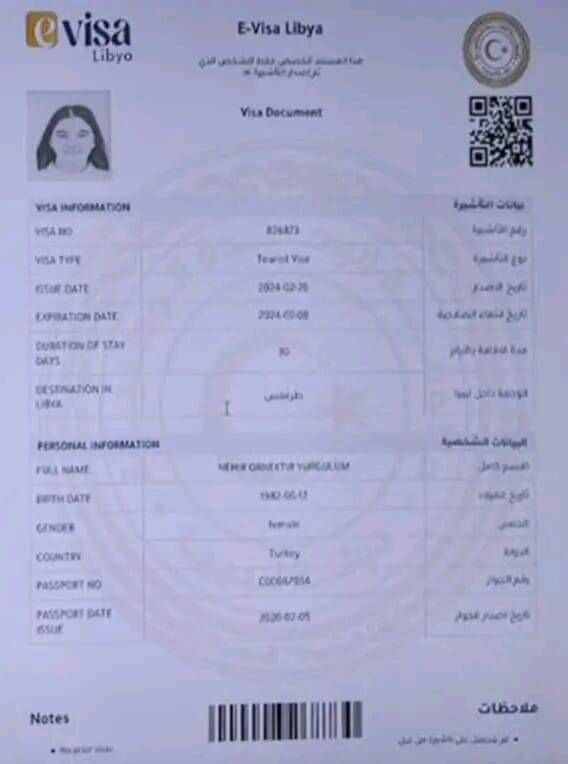
Once approved, you receive a PDF to print and present at the border. Allow 3 to 5 business days from the time the complete application is submitted.
How far in advance should you submit the application?
It is recommended to submit the application at least 3 weeks before departure. While the technical processing time is 3 to 5 business days, obtaining the invitation letter and having it validated by the Libyan operator may take longer.
This time frame is extended around Friday/Saturday weekends, Ramadan and Eid holidays — periods during which Libyan administrations operate at a reduced pace.
In the longest observed case — applications submitted in August, during Ramadan, or requiring an additional security check for journalists or dual nationals — processing can take up to 3 weeks.
05 · Validity & entry rules
Duration of stay, entry points and border formalities
- e-Visa validity
- 90 days from the date of issue (window to enter Libya)
- Maximum duration of stay
- 30 consecutive days from the date of border crossing
- Extension possible
- Yes, up to 30 additional days at the local Passport Directorate. Application to be submitted 72h before expiry.
- Visa on arrival
- Not available. By a circular dated 9 June 2026 (published on 11 June), the Government of National Unity suspended the issuance of visas on arrival at ALL Libyan airports AND at all land border crossings, with no end date announced: the measure runs until visa issuance mechanisms are overhauled, the Ministry of Interior and the Passports Authority having been given 30 days to propose a new framework. The e-Visa is not affected by this suspension and remains the route to favour.
- Funds required on arrival
- The equivalent of at least 1,000 Libyan dinars in foreign currency must be available for presentation to immigration. Travellers covered by a resident sponsor or by a tour package paid to a licensed operator are exempt.
The 30-day counter starts on the day you cross the border, not the day the visa is issued. This distinction is important compared to other African e-Visas (Egypt, Kenya, Tanzania) where validity and stay periods sometimes overlap.
The authorised entry points for Libyan e-Visa holders are as follows:
- Mitiga International Airport (MJI): Tripoli's main civil airport, under Government of National Unity control.
- Benina International Airport (BEN): Benghazi, in the east. ⚠️ The e-Visa issued by the Government of National Unity is not automatically recognized by the authorities controlling eastern Libya: a separate, paid entry authorization (several hundred euros per person) is generally required to enter through this region. Contact Visamundi before planning arrival via Benina.
- Misrata International Airport (MRA): central coast, under Government of National Unity control.
- Some seaports (Tripoli, Misrata) offer limited ferry links, mostly for freight, from Turkey or Italy; passenger capacity is limited and must be confirmed case by case.
The land crossing with Egypt (Musaid) is currently restricted to Libyan and Egyptian nationals only and is not accessible to other nationalities. The crossing with Tunisia (Ras Jedir) remains open but is subject to unpredictable closures depending on the security situation. ⚠️ No visa is issued there on the spot: the suspension of visas on arrival decided on 9 June 2026 covers land border crossings just as it covers airports. You must therefore hold a valid e-Visa before presenting yourself at Ras Jedir. In any case, land entry is not recommended as a primary option, regardless of nationality.
- Valid passportValid for 6 months or more, with blank pages.
- Printed copy of the e-Visa PDFA paper printout is mandatory — the digital visa alone on a phone is not always accepted.
- Original invitation letterSigned and stamped by the Libyan operator.
- Itinerary and proof of accommodationOften provided directly by the tour operator.
- Yellow fever vaccination certificateOnly if required based on your country of origin.
- Cash in USD or EURSufficient for the duration of the stay. International bank cards do not work in Libya.
- Proof of funds — 1,000 Libyan dinars minimumImmigration may require the equivalent of at least 1,000 LYD in foreign currency. Entry may be refused otherwise. Travellers on a paid tour package or covered by a resident sponsor are exempt.
06 · On the ground
Movement restrictions, business travel and practical information
Travelling in Libya involves movement constraints with no equivalent in neighbouring destinations. It is essential to understand these before planning your stay.
Independent tourism is not permitted. Foreign visitors must be accompanied at all times by a licensed local guide or the representative of the licensed operator. Vehicles are systematically provided with a driver.
Movement between Tripolitania (west) and Cyrenaica (east) may be restricted depending on the political context. Your guide has the up-to-date map of accessible areas.
Certain military zones, oil installations and border strips are entirely off-limits. Photography of military installations, government buildings, ports, airports and checkpoints is strictly prohibited.
Drones are banned for non-accredited civilian use (confiscated at customs). Satellite phones require prior authorisation. Professional photo/video equipment may require press accreditation.
Business travel in Libya
Beyond tourism, Libya is once again becoming a significant destination for international business — energy, construction, healthcare, logistics, engineering. The multiple-entry e-Visa is specifically designed for this audience.
Typical profiles: oil and gas professionals visiting NOC, AGOCO, Mellitah Oil & Gas subsidiaries or working with international operators; construction stakeholders involved in infrastructure programmes in Tripoli, Benghazi and Misrata; healthcare professionals under contract with Libyan ministries or humanitarian organisations; trade and logistics operators whose goods transit through Libyan ports; consultants and project managers on extended assignments.
For the business e-Visa, the invitation letter must be issued by a Libyan company with a valid trade register. It must specify the purpose of the trip, the dates, the contact person and the host's commitment to accommodating the traveller. The inviting company's credentials are verified before submission, in order to reduce the risk of refusal.
Work and long-term stay: the “Wafed” platform. The business e-Visa covers one-off trips (meetings, audits, site visits). As soon as it involves employing a foreign national in Libya, the Wafed platform applies: a national project for the electronic management of foreign labour, it connects companies, public bodies and the competent authorities, and centralises registration, hiring and residence-permit procedures for non-Libyan workers. A business e-Visa is neither a work permit nor a residence permit: the Libyan employer must start the Wafed process in parallel.
Companies that send several employees to Libya per year can open a corporate account giving access to consolidated billing, a dedicated advisor, a traveller dashboard and priority processing — practical when project schedules depend on visa availability.
Since September 2025 the Libyan Customs Authority has regulated the sums carried in and out of the country: above 200 Libyan dinars in local currency or 10,000 USD (or the equivalent in other currencies), a currency declaration must be completed and handed to customs officers. Failing to declare is a customs offence exposing the traveller to legal action.
These ceilings sit alongside the opposite obligation to hold, on arrival, the equivalent of at least 1,000 Libyan dinars in foreign currency — unless you are on a paid tour package or covered by a resident sponsor. Plan an amount sufficient for your stay but below the declaration threshold, or declare it formally.
Journalists, humanitarian workers and NGOs
Journalistic and humanitarian activities require additional accreditation from the Libyan Ministry of Foreign Affairs and, in some cases, the Ministry of Information. The e-Visa alone is not sufficient to carry out press or humanitarian field activities in Libya.
e-Visas do include an NGO purpose among eligible reasons, but this covers only short-term visits for meetings or institutional representation. For operational deployment, the parallel accreditation procedure is essential.
This is the obligation travellers most often overlook, and it depends on neither the visa type nor the nationality. Libyan Law No. 6 of 1987 on the entry and residence of foreigners requires every visitor to register their passport at the police station nearest to where they are staying, within 7 days of arrival. Both the British (FCDO) and Australian (Smartraveller) foreign ministries restate this formality in their travel advice.
The e-Visa does not exempt you from it: it authorises entry, not an undeclared stay. In practice, registration is almost always handled by the Libyan tour operator or partner who issued your invitation letter, who has the contacts and the language — but the responsibility remains the traveller’s. Always ask for written confirmation that the registration has been completed, and keep it with you throughout the stay.
What you risk otherwise: a fine imposed on departure, difficulties at exit control and, in some cases, a delayed boarding while the situation is regularised. Some sources report a shorter deadline, around 3 days depending on the city: deal with it within the first 48 hours to be safe.
⚠️ Libya is subject to the highest security alert levels issued by major Western foreign ministries. The French Ministry for Europe and Foreign Affairs classifies the entire Libyan territory as a red zone and formally advises against all travel to the country, for any reason. The U.S. State Department rates Libya at Level 4 "Do Not Travel" — the highest level, alongside Afghanistan, Yemen, Syria and Somalia — citing crime, terrorism, unexploded landmines and ordnance, civil unrest, kidnapping, and armed conflict.
Kidnapping, including of Western nationals, remains frequent, and clashes between rival armed groups have recently occurred in Tripoli and other cities (Misrata, Benghazi, Zawiya, Ajdabiya), sometimes with temporary airport closures, including Mitiga. There is no operational U.S. Embassy in Libya; U.S. consular assistance is provided through the U.S. Embassy in Tunis.
This service is intended for travelers who, fully informed and with reinforced security support, choose to travel to Libya regardless. Before any trip, be sure to check the latest official advisories and:
- Register with your embassy's traveller registration service (Ariane for French citizens, STEP for Americans) and notify your embassy of your trip.
- Take out comprehensive travel insurance including medical and political evacuation — standard tourist policies often exclude Libya.
- Follow the operator's instructions to the letter, avoid any travel outside the escorted itinerary, and avoid any political demonstrations.
07 · Before you leave
Preparation checklist and practical advice
A trip to Libya requires more careful preparation than most other destinations due to the number of documents to gather, the central role of the local operator and the logistical specifics on the ground. This checklist summarises the key points to anticipate.
- Check your nationality's eligibilityMake sure your nationality is eligible for the e-Visa. If in doubt, contact the Libyan embassy in your country directly.
- Check the passportValid for at least 6 months after the intended entry date, with at least two blank pages. No Israeli stamp should appear in it.
- Obtain the invitation letterThe key document in the application. Contact an approved Libyan tour operator or a Libyan business partner. Allow time: some operators may take several days to issue the letter.
- Prepare the ID photo to the required standardWhite background, full face, recent (less than 6 months), minimum 600 × 600 pixels. A non-compliant photo is one of the most common reasons for rejection.
- Gather the ticket and itineraryReturn ticket showing an exit within 30 days. Day-by-day itinerary provided by the operator with hotel and guide names.
- Check the vaccination recordIf you are arriving from a yellow fever risk country, the vaccination certificate is mandatory.
- Bring enough cash in USD or EURNo ATM or payment terminal accepts foreign cards. Budget for your entire stay in cash.
- Print the e-Visa PDFA paper printout is still required at the border. Do not rely on digital display.
- Keep the original invitation letter to handBorder agents may request it at the immigration checkpoint.
- Register with your embassyAriane (French citizens), STEP (Americans), or the equivalent register for your country. This enables quick contact in an emergency.
- Take out appropriate insuranceExplicitly verify that your insurance covers Libya and includes political evacuation — many standard policies exclude it.
- Do not photograph any sensitive infrastructureMilitary installations, ports, airports, checkpoints, government buildings. The ban is strictly enforced.
The Libya e-Visa represents a major step forward in opening the country to the outside world. Officially launched in spring 2024, it reduces the time to obtain a visa from several weeks to a few days. However, it retains serious documentary requirements — the invitation letter from an approved Libyan operator is non-negotiable — and accompanied tourism remains the only permitted form of visit. For business travellers, the multiple-entry e-Visa offers a solution suited to repeat assignments, provided processing times linked to security checks are anticipated for certain profiles.
Once you are there: the e-Visa authorises entry, not an undeclared stay. Have your passport registered with the police within 7 days of arrival (Law No. 6 of 1987) — in practice through your inviting operator, but the responsibility is yours, on pain of a fine on departure.
Essential reminder: Libya remains classified at the highest risk level by major Western foreign ministries (red zone per the French MEAE, Level 4 "Do Not Travel" per the U.S. State Department). Any decision to travel must be made fully informed, after checking the latest official advisories and with reinforced security support.
Safety
Travel advisories for Libya
The vigilance level recommended by five foreign ministries, on a shared scale.
Average level
Armed conflict, terrorism, kidnapping, crime and landmines; Tripoli, Benghazi, Al-Bayda and Derna are advised against.
- Read the advice

US Department of StateAdvice dated August 31, 2026
Do not travel · Libya - Level 4: Do Not Travel
- Read the advice

Global Affairs CanadaAdvice dated October 6, 2026
Do not travel · Libya — Avoid all travel
- Read the advice

German Federal Foreign OfficeAdvice dated August 31, 2026
Do not travel · Libya: Travel and Security Information
- Read the advice

UK Foreign Office (FCDO)Advice dated July 21, 2026
Reconsider travel · Libya travel advice
- Read the advice

France DiplomatieAdvice dated September 15, 2026
Do not travel · Libya: Travel Advice
A destination under advisory still issues its visas and authorisations. Before applying, check that your travel insurance covers it.
Levels published by the ministries cited, reproduced unchanged. Visamundi is a private agency with no ties to these administrations.
FAQ
Frequently asked questions
