
Available travel documents
Choose the visa that fits your trip. Fully online process, real-time tracking.
Business e-Visa (multiple entries)
Visamundi service: €39 incl. VAT
Consular fee: ≈ €265(296.80 USD)
Electronic visaBusiness e-Visa (single entry)
Visamundi service: €39 incl. VAT
Consular fee: ≈ €245(273.48 USD)
Electronic visae-Visa Visit to family and acquaintances
Visamundi service: €39 incl. VAT
Consular fee: ≈ €245(273.48 USD)
Electronic visaLeCard
Visamundi service: €29 incl. VAT
Arrival cardTourism e-Visa
Visamundi service: €39 incl. VAT
Consular fee: ≈ €245(273.48 USD)
Electronic visaTransit e-Visa
Visamundi service: €39 incl. VAT
Consular fee: ≈ €245(273.48 USD)
Electronic visaSince 1 May 2025, Nigeria has entered the digital age by launching a fully online e-Visa system: no more consular appointments, no more sending your passport by post. Whether you are travelling to explore Lagos, build business relationships or visit family, the entire application is completed online, from the comfort of your home. This guide covers everything you need to know about Nigeria's genuine electronic visa — eligibility requirements, required documents, processing times, and the step-by-step procedure — so you can travel with complete peace of mind.
01 · The essentials
Nigeria goes digital: the e-Visa explained
Since 1 May 2025, all Nigeria e-Visa applications are completed entirely remotely, with no consular visit or passport mailing required.
Regardless of the visa category chosen, your passport must be valid for at least 6 months after your intended return date from Nigeria.
The yellow fever vaccine is a legal requirement to enter Nigeria: your international vaccination booklet is checked at the airport for every traveller.
The Nigerian e-Visa is a genuine electronic visa — not a simple travel authorisation or an ETA. Once approved by the Nigerian authorities, it is sent to you as a PDF by email. You must print it in colour and present it upon arrival, together with your passport.
The system covers several travel purposes: tourism, business, transit and family visits. Designed to simplify access to Nigeria for short stays, it allows consular officers to focus on complex cases while offering travellers significant time savings.
Biometric data is collected only at the port of entry, at the airport. The entire process is therefore remote until your arrival on Nigerian territory.
- Document type
- e-Visa (genuine electronic visa — non-renewable, non-extendable)
- Travel purposes covered
- Tourism, business (single or multiple entries), transit, family visit
- Processing time
- 24 to 48 hours under the Nigeria Immigration Service 2026 service level agreement; up to 5 business days at peak periods — allow at least 15 days before departure
- Visa validity
- 90 days from the date of approval
- Authorised length of stay
- Up to 30 consecutive days
- Entry type
- Single entry (tourism, transit, visit) — single or multiple (business)
- Format received
- PDF by email, must be printed in colour
- Passport required
- Valid for at least 6 months after the return date
- LeCard (landing and exit card)
- Free of charge, to be completed separately before boarding, on entry and on exit — airside transit excluded
- Health declaration
- Mandatory NCDC form before arrival at the official portal — including for transit
- Visa on arrival
- Abolished on 1 May 2025 — no visa is issued at the border
- Overstay
- US$15 per day since 1 September 2025; 5-year ban beyond 3 months, permanent ban beyond 12 months
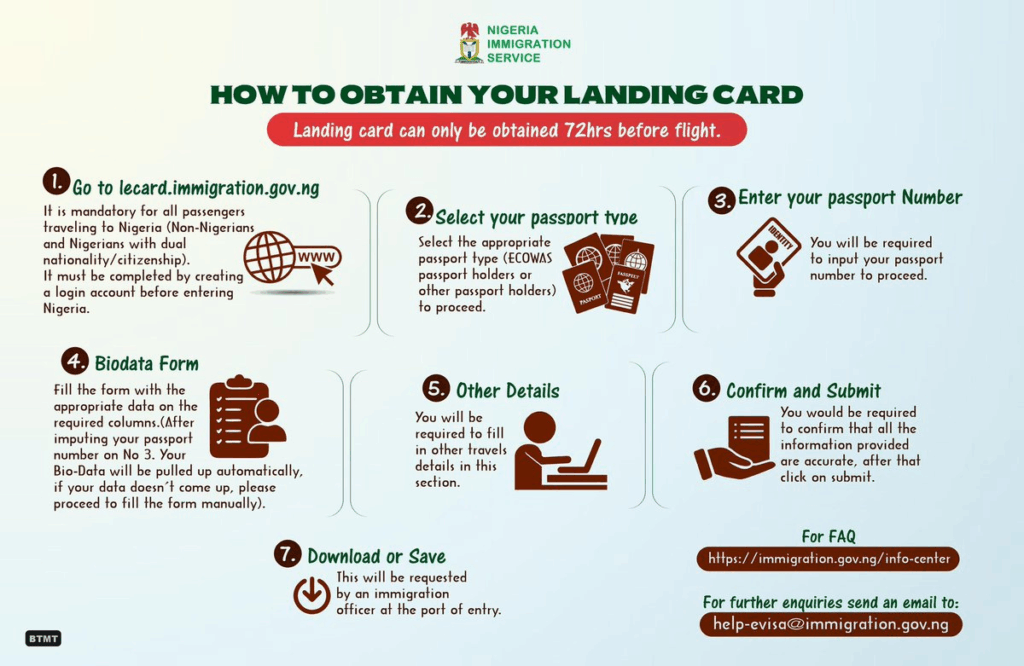
Nigeria has also introduced a digital arrival and departure card: the LeCard. Available free of charge on the official platform, it is required in addition to the e-Visa and applies to every traveller, including visa-exempt nationals (ECOWAS, Burkina Faso, Mali, Niger, bilateral agreements), both on entry and on exit. It must be completed before boarding: airlines check it at departure, and not having it leads to refusal of entry or of departure at the immigration checkpoint. Passengers in airside transit, who do not cross the border, are not concerned.
A third formality is often overlooked: the online health declaration of the Nigeria Centre for Disease Control (NCDC), to be completed at the official portal before arrival — including for a simple transit. Thermal screening and travel-history checks may be carried out on arrival. The e-Visa, the LeCard and the health declaration are three separate steps: all three are mandatory.
02 · Eligibility
Who can apply for the e-Visa? Nigeria's entry rules
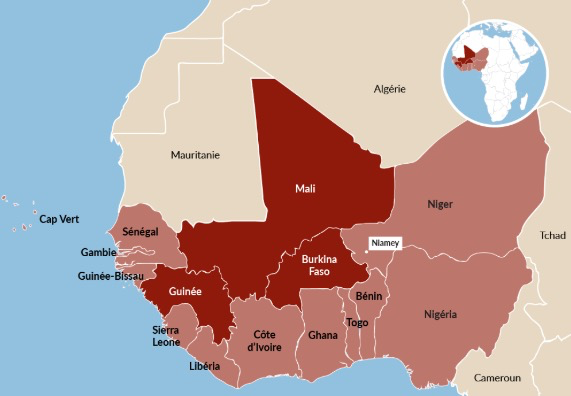
The Nigerian e-Visa is accessible to the vast majority of nationalities. If you are a citizen of the European Union (France, Belgium, Luxembourg, Switzerland…), Canada, the United States, the United Kingdom or the great majority of countries in the world, you are eligible and can submit your application online.
Citizens of ECOWAS member countries (Economic Community of West African States) and certain countries with bilateral agreements benefit from a visa exemption to travel to Nigeria. These nationals may enter freely, without any prior formalities. They may nonetheless submit an e-Visa application if they wish.
The 11 other ECOWAS member states (excluding Nigeria) are: Benin, Cape Verde, Gambia, Ghana, Guinea, Guinea-Bissau, Ivory Coast, Liberia, Senegal, Sierra Leone, Togo. Burkina Faso, Mali and Niger withdrew from ECOWAS on 29 January 2025, bringing the organisation down to 12 members — but their nationals remain visa-exempt: in its communiqué of 29 January 2025, ECOWAS asked member states to continue granting them, « until further notice », the right of movement, residence and establishment without visas, and to keep recognising their passports bearing the ECOWAS logo. This transitional regime may change: check that it still applies before you travel.
Under separate bilateral agreements, Cameroon and Chad (non-ECOWAS members), as well as Saint Kitts and Nevis (90 days) and Seychelles (90 days), also benefit from a visa exemption for Nigeria.
Eligible for the Nigeria e-Visa. The application is completed entirely online before departure.
Free entry with no prior formalities for nationals of the 11 ECOWAS member states, of Burkina Faso, Mali and Niger (exemption maintained by ECOWAS until further notice) and of certain countries with bilateral agreements. The e-Visa application remains optional, but the LeCard and the health declaration are still mandatory.
Nigeria allows group applications for all e-Visa categories. Government fees are charged per applicant.
Consular fees vary according to the traveller's nationality. Nigeria applies a strict reciprocity rule, resulting in differentiated rates depending on the diplomatic agreements in force.
Nigeria's Visa on Arrival scheme was abolished in the reform of 1 May 2025. Approvals issued before that date were only honoured during a short transitional period; those issued afterwards are no longer recognised. If you used to travel to Nigeria with a VOA pre-approval collected at the airport, that route no longer exists: the e-Visa must be obtained before boarding.
Nationalities not eligible for the e-Visa: the reform opens the e-Visa to around 177 countries, but 15 nationalities remain excluded: Afghanistan, Iran, Iraq, Libya, Micronesia, Montenegro, North Korea, Palestine, Russia, Samoa, Somalia, South Sudan, Sudan, Türkiye and Yemen. Their nationals must apply for a standard visa at a Nigerian embassy or high commission. That list, based on reciprocity and security considerations, may change without notice: check whether your nationality is eligible with the Nigerian authorities before starting any application or booking flights.
Under the Nigeria Immigration Service regulations, there must be a minimum delay of 3 days between the date of e-Visa application submission and the intended arrival date on Nigerian territory. In other words, you cannot depart less than 3 days after submitting your application — even if processing is fast. Plan accordingly.
03 · The procedure
Obtaining your Nigeria e-Visa: the step-by-step process
The Nigeria e-Visa procedure takes place entirely online. Unlike the previous consular system, you no longer need to travel or send your passport by post. Here is how the steps unfold, from preparing your file to receiving your official document.
- 1Prepare your documents
Gather all required documents (passport, identity photo, flight tickets, proof of accommodation, bank statement). Check that each document is legible, complete and meets the requirements — an incomplete file is the main cause of delays or refusals.
- 2Complete the online form
Access the application form (via the official portal or our simplified form in English). Enter your personal details, travel information, purpose of stay and arrival and return dates. It takes less than 5 minutes.
- 3Upload your supporting documents
Upload legible scans or photos of your documents to the secure platform. Each document is checked for compliance before submission to the Nigerian authorities. A non-compliant document may result in refusal and loss of fees.
- 4Wait for processing
The Nigeria Immigration Service 2026 service level agreement sets the processing time at 24 to 48 hours; allow up to 5 business days at peak periods. During this period, your file is reviewed by the Nigeria Immigration Service. If additional documents are required, you will be notified by email.
- 5Receive your e-Visa by email
If approved, you will receive your official approval document in PDF format by email. You must print it in colour: it will be required at the airport, together with your passport.
- 6Arrival in Nigeria
Present your colour-printed e-Visa, your passport and your international vaccination booklet (yellow booklet with the yellow fever vaccine) to immigration officers upon arrival. Biometric data is collected at this stage.
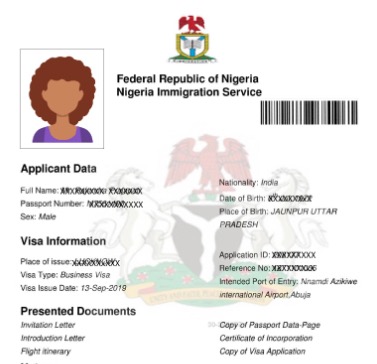
The Nigerian e-Visa is visually distinguished by a unique barcode that allows immigration officers to quickly verify the authenticity of the document. This barcode is generated upon approval and contains all the information from your file.
Colour printing is mandatory: officers are trained to detect black-and-white printouts, which are not accepted. Plan to print several copies in case of loss or damage to the document during your trip.
From your personal account on the platform, you have access to the form, document uploads, file tracking, messaging to contact us, as well as downloading your e-Visa and invoice.
The slightest error in the official form can lead to refusal and loss of consular fees. Carefully re-read each field, particularly the travel dates, passport number and accommodation address. These three elements are the most frequent sources of error.
04 · Required documents
Your complete file: the documents to prepare without fail
Nigeria has chosen the path of digitalisation: no more sending your passport by post. You simply need to provide us with legible photos or scans of your documents. Here is a full list of the documents to gather to constitute a complete and compliant file.
- Valid passportValid for at least 6 months after your return date. The personal data page must be legible and intact.
- Recent identity photoRecent, clear, on a white background. Ensure the face is clearly visible, without glasses or headwear.
- Proof of flightYour round-trip flight tickets confirming the entry and exit dates from Nigerian territory.
- Proof of accommodationHotel booking confirmation or invitation letter from your host, with full address.
- Proof of financial resourcesRecent bank statement (covering the last 180 days) demonstrating that you can cover your expenses during the stay. This document is strictly required.
The yellow fever vaccine is a strict requirement to enter Nigeria, without exception. Your international vaccination booklet — the "yellow booklet" — will be requested by immigration officers at the airport, along with your e-Visa and passport. Absence of this document may result in denial of entry. If you are not up to date, make an appointment with your doctor or an international vaccination centre well before your departure.
The Nigeria e-Visa system is broadly accessible, but the bank statement covering 180 days and the proof of accommodation are strictly required. Any incomplete or inconsistent file (dates not matching the ticket, missing accommodation address…) will be rejected, resulting in loss of fees. Prepare each document carefully before starting your application.
For business e-Visa applicants, additional documents may be required depending on the profile and nature of the professional assignment. It is advisable to anticipate and prepare any documents related to the host company or entity in advance of the application.
The e-Visa categories available through our platform cover: tourism (F5A, single entry), transit (F3B, single entry), business with single entry (F4A) or multiple entries (F4B), and family or acquaintance visit (F6A, single entry). Other categories exist (academic exchange, humanitarian, journalist, medical, religious…) but require processing at the embassy.
05 · Validity & fees
Length of stay, visa validity and the tariff reciprocity rule
The validity structure of the Nigerian e-Visa is based on distinct concepts that should not be confused. The e-Visa is valid for 90 days from its date of approval: this means you must enter Nigerian territory within that period. Once entered, you are authorised to stay for a maximum of 30 consecutive days.
The tourism, transit and family visit e-Visas are issued as single-entry: only one border crossing is permitted. The business e-Visa exists in two versions: single entry (F4A) or multiple entries (F4B), allowing you to leave and re-enter Nigeria during the validity period.
Nigerian e-Visas cannot be extended. If you need to stay beyond 30 days, you must leave the country and submit a new application. No extension is possible on the territory.
Since 1 September 2025, every day of overstay costs US$15. An overstay of 3 months or more triggers a 5-year entry ban; from 12 months, the ban becomes permanent and comes with blacklisting.
Nigeria applies a strict reciprocity rule: consular fees vary according to your nationality. They also fluctuate based on exchange rates, as they are set in US dollars (USD).
There must be a minimum delay of 3 days between the date of submission of your application and your intended arrival date in Nigeria.
To stay more than 30 days or reside long-term, consider a work permit, student visa or investor visa — these categories require embassy processing (approximately 10 business days).
Since 1 September 2025, Nigeria has enforced an automated penalty regime for visa overstays, announced by the Minister of Interior on 11 April 2025 and implemented by the Nigeria Immigration Service. An amnesty window allowed foreign nationals with expired visas to leave without penalty until 1 August 2025; it is now closed.
The announced penalties are as follows:
- USD 15 per day of overstay, payable from the first day beyond the authorised stay;
- overstay of 3 months or more: daily fine plus a 5-year entry ban;
- overstay of one year or more: daily fine, blacklisting and a permanent entry ban.
The system is synchronised with the visa processing centre and the digital landing and exit cards (LeCard): overstay is calculated automatically and penalties are applied on departure. Since the e-Visa allows a maximum stay of 30 consecutive days and is neither renewable nor extendable in-country, build in a margin and leave before the deadline. Some official communications have quoted slightly different tiers: confirm the current amounts and durations with the Nigeria Immigration Service before you travel.
The fees displayed by our agency include both the basic consular fees imposed by the Nigerian authorities and the service fee (verification, submission, file tracking). The consular fees alone amount to 273 USD €243.68 for the nationalities concerned. If you are unsure about the fee applicable to your nationality, do not hesitate to contact us before starting your application.
06 · Before you go
Nigeria: preparing your trip and avoiding common mistakes
Nigeria is a destination that leaves no one indifferent. The cultural and economic heart of West Africa, it offers a unique blend of ancestral traditions and vibrant modernity. Lagos, the world capital of Afrobeats, boasts a thriving arts scene, the Nollywood film industry and the beaches of Victoria Island. Inland, the Yankari Game Reserve is home to hundreds of elephants, while Zuma Rock and the canopy of the Lekki Conservation Centre delight nature lovers.
But to ensure your trip goes smoothly, a few points of vigilance are essential. Here are the most common mistakes and tips for avoiding them.
Nigeria is subject to travel warnings from several governments. The US State Department rates Nigeria at Level 3 – Reconsider Travel (updated 12 June 2026), citing criminal violence, terrorist activity and kidnapping. On 8 April 2026 it authorised the departure of non-emergency staff from its embassy in Abuja and extended its "Do Not Travel" list to Plateau, Jigawa, Kwara, Niger and Taraba states, on top of Borno, Yobe, Adamawa and the other states already at Level 4. The French Ministry of Foreign Affairs classifies several Nigerian regions as areas to avoid except for compelling reasons. An attack in Maiduguri on 16 March 2026 caused civilian casualties. Kidnapping risk now extends beyond the north: the French foreign ministry reports massacres in the villages of Woro and Nuku (Kwara State) on 3 February 2026 and the abduction of 39 students and teachers in Oyo State (south-west) in May 2026, attributed to terrorist groups. Avoid road travel at night, unorganised intercity journeys and posting your itineraries on social media. Always check your own foreign ministry's travel advice before departure and stay informed about how the security situation develops.
- Leaving it too late. The official processing time is 24 to 48 hours, but it can stretch to 5 business days at peak periods, on top of the mandatory 3-day delay between the submission date and the arrival date. Not counting any Nigerian administrative delays. Submit your application at least 15 days before departure.
- Forgetting the yellow fever vaccine. This is not a recommendation — it is a legal requirement. The yellow booklet is physically checked at the airport. Without this document, entry may be denied.
- Printing in black and white. The e-Visa must be printed in colour. A black-and-white document will not be accepted by Nigerian immigration officers.
- Omitting the bank statement. Proof of financial resources (statement covering the last 180 days) is strictly required. Its absence results in systematic rejection of the file.
- Overstaying the authorised period. Since 1 September 2025, any overstay is penalised automatically: USD 15 per day, then a 5-year entry ban beyond 3 months and a permanent ban beyond one year. As the e-Visa cannot be extended in-country, leave before the 30-day deadline.
- Confusing the e-Visa and the visa exemption. If you are not a national of a visa-exempt country (current ECOWAS members or bilateral agreement countries), you need an e-Visa to enter Nigeria, regardless of your purpose of travel.
- Travelling with a passport close to expiry. The 6-month residual validity rule is strictly enforced. Check your passport's expiry date even before starting your application.
- Check passport validityAt least 6 months after the intended return date from Nigeria.
- Check eligibility statusVerify that your nationality is not among the visa-exempt countries (current ECOWAS members or bilateral agreement countries), then submit your e-Visa application.
- Yellow fever vaccine up to dateBook an appointment at an international vaccination centre if not yet done. Keep the yellow booklet to present on arrival.
- Prepare a bank statement covering the last 180 daysStrictly required document to prove sufficient financial resources.
- Obtain proof of accommodationHotel booking confirmation or invitation letter from your host with full address.
- Book round-trip flight ticketsDates must correspond exactly to the information declared in the e-Visa application form.
- Submit the e-Visa application at least 15 days before departureTo allow enough time in case of a request for additional documents or extended administrative delays.
- Print the e-Visa in colourUpon receipt of the PDF by email. Print several copies in case of loss or damage. Check the barcode is legible.
- Complete the LeCard (digital arrival card)Available free of charge on the official portal or via our simplified form. To be done before arrival.
Launched on 1 May 2025, the Nigerian e-Visa marks a clear break from the previous consular system. The procedure is now entirely online, fast and accessible to the vast majority of nationalities worldwide — except for nationals of visa-exempt countries (current ECOWAS members and bilateral agreement countries) who do not need one. The visa is valid for 90 days and authorises a maximum stay of 30 consecutive days; it is non-renewable and non-extendable. Two absolute imperatives never to overlook: the yellow fever vaccine (a legal requirement, checked at the airport) and printing the PDF document in colour. By submitting your application at least 15 days in advance and putting together a complete and consistent file, entry to Nigeria is perfectly accessible to all travellers worldwide.
Safety
Travel advisories for Nigeria
The vigilance level recommended by five foreign ministries, on a shared scale.
Average level
Crime, terrorism, civil unrest, kidnapping and inconsistent healthcare; some regions formally advised against or advised against except for essential travel.
- Read the advice

US Department of StateAdvice dated June 12, 2026
Reconsider travel · Nigeria - Level 3: Reconsider Travel
- Read the advice

Global Affairs CanadaAdvice dated October 9, 2026
Reconsider travel · Nigeria — Avoid non-essential travel (with regional advisories)
- Read the advice

German Federal Foreign OfficeAdvice dated September 29, 2026
Increased caution · Nigeria: Travel and Safety Information
- Read the advice

UK Foreign Office (FCDO)Advice dated September 28, 2026
Reconsider travel · Nigeria travel advice
- Read the advice

France DiplomatieAdvice dated September 15, 2026
Increased caution · Nigeria: Travel advice
A destination under advisory still issues its visas and authorisations. Before applying, check that your travel insurance covers it.
Levels published by the ministries cited, reproduced unchanged. Visamundi is a private agency with no ties to these administrations.
FAQ
Frequently asked questions
