ETIAS vs. EES: Key Differences Explained
Discover the critical differences between the EU’s ETIAS and EES border management systems launching in 2025, and how they’ll affect your European travels.
·
As the year draws to a close, let’s unpack the key differences between two major European border-management initiatives slated for rollout in 2025: the European Travel Information and Authorisation System (ETIAS) and the Entry/Exit System (EES).
Both will reshape travel to Europe for the 27 Schengen-area countries plus Bulgaria, Cyprus and Romania.
What are ETIAS and EES?
ETIAS requires visa-exempt travellers to obtain a travel authorisation in advance, similar to the U.S. ESTA and soon the U.K. scheme. It is not a visa and does not change travellers’ visa-free status. ETIAS will log both visa-free visitors and short-stay visa holders when they enter the EU. A fee of about €7 per traveller is expected.
The EES, which is free of charge, applies to everyone—including EU citizens—and replaces manual passport stamps at external borders. It automatically records each traveller’s entry and exit when crossing these borders.
Together, these systems aim to modernise border controls, boost security across the Schengen area and prepare Europe for today’s migration and security challenges.
Five key contrasts between ETIAS and EES
While both systems seek the same goal—safer, smarter borders—they operate in entirely different ways.
1. What ETIAS requires
Applicants (likely based on existing global models) will supply personal details such as home address, passport data, current occupation and any past travel to conflict zones or any criminal convictions.
2. What EES collects
EES augments standard travel-document data with facial images and four fingerprints. It logs every entry and exit on the continent for travellers processed through its gates.
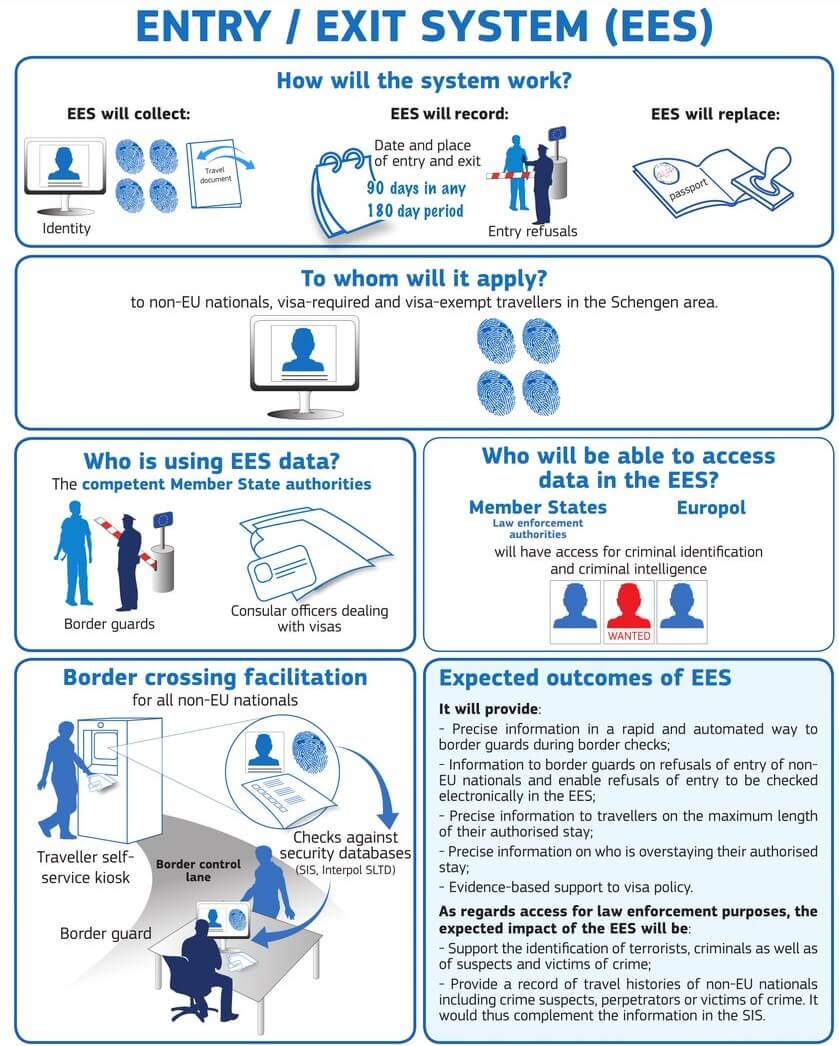
EES explained in one infographic
Do I need to give fingerprints?
Yes. EES relies on biometric capture1: four fingerprints taken at the first checkpoint and matched against stored EES or VIS records. First-time visitors trigger a new EES file.
Travellers are advised to secure their ETIAS authorisation well ahead of departure. EES registration happens on the spot when you reach the external border of any of the 29 participating countries.
Impact on future Europe trips
With EES launching in 2024 and ETIAS following in 2025, both systems promise faster, more efficient—and safer—travel into and around the Schengen zone. By harnessing cutting-edge technology, they’ll give authorities a sharper, real-time picture of short-term visitor movements, reinforcing Europe’s border defences without slowing the passenger experience.
Bottom line: ETIAS and EES share the same destination—tighter, tech-driven borders—but take very different routes to get there.

As CEO of Visamundi, I am dedicated to simplifying international travel by assisting our clients in obtaining visas worldwide. By staying at the forefront of ever-changing regulations, I ensure our agency remains a trusted pillar in the visa services industry.
Get our visa news first in your Google results: add Visamundi to your preferred sources.
