Europe is deeply modernising its border controls with two complementary systems that are transforming the experience of non-European travellers: the EES (Entry/Exit System), already operational since 10 April 2026, and ETIAS (European Travel Information and Authorisation System), whose launch date is no longer set — the last-quarter-2026 target was removed from the official EU pages in July 2026. These are not visas: the EES records your biometric data when you cross the border, while ETIAS is an electronic travel authorisation you must obtain before departure. Together, they affect hundreds of millions of travellers worldwide.
01 · The essentials
EES and ETIAS: two systems, two different logics
Every non-EU traveller is affected by at least one of the two systems: the EES (biometric registration at the border, operational since 10 April 2026) and/or ETIAS (pre-departure electronic authorisation, launch date not yet set).
The two systems do not have the same scope. The EES is operated by the 29 Schengen states only; ETIAS will be required by 30 countries (the 29 Schengen states + Cyprus). Ireland applies neither, and the micro-states (Andorra, Monaco, San Marino, Vatican) appear on neither list.
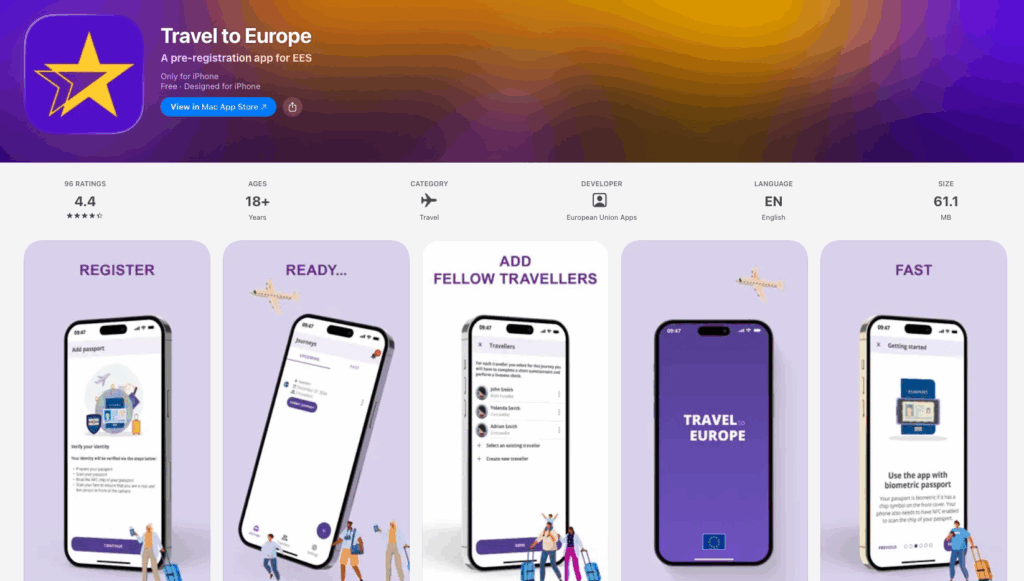
The official Travel to Europe app (iOS and Android) allows all non-EU travellers to pre-register their EES data up to 72 hours before arrival at participating airports.
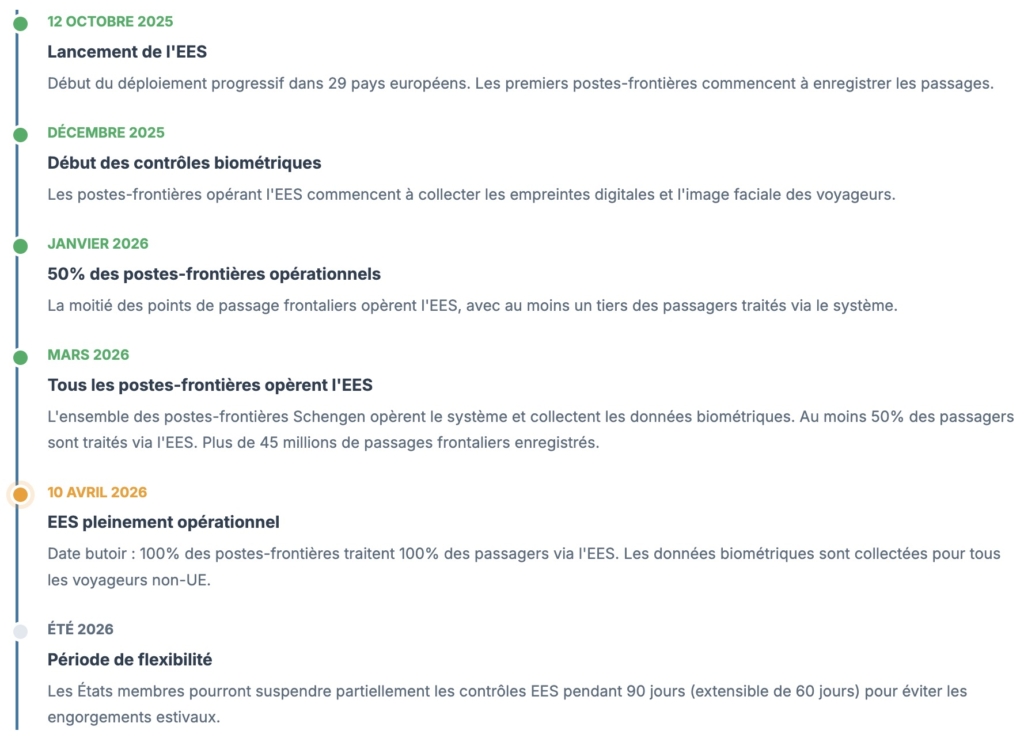
Since 10 April 2026, crossing an external border of the Schengen area has changed for all non-European travellers. The EES (Entry/Exit System) is now fully operational in the 29 countries participating in the scheme. It is not a formality to be completed before your trip: the EES is triggered automatically at every border crossing and replaces the old manual stamping of your passport.
The ETIAS (European Travel Information and Authorisation System) more closely resembles the American ESTA or the Canadian eTA. It is a pre-departure electronic travel authorisation: you obtain it online before boarding, and it remains valid for three years or until the expiry of your passport. Its launch date, however, is no longer set: the last quarter of 2026 target was removed from the European Union's official pages in July 2026, and a revised timeline is expected after the eu-LISA management board meeting of September 2026.
A fundamental point: neither the EES nor ETIAS is a visa. The EES is a border control system; ETIAS is a travel authorisation reserved for nationals of the 59 nationalities currently exempt from the Schengen visa. Travellers subject to a standard Schengen visa are not concerned by ETIAS and will continue to apply for a visa at an embassy.
- Nature
- Biometric registration system
- When
- At the time of border crossing
- Who
- All non-EU travellers
- Cost
- Free
- Status
- Operational since 10/04/2026
- Comparable to
- Replaces passport stamps
- Nature
- Pre-departure electronic authorisation
- When
- Before departure (online)
- Who
- 59 visa-exempt nationalities only
- Cost
- €20 (free for under 18s and over 70s)
- Status
- Launch date not set
- Comparable to
- ESTA (United States), eTA (Canada)
02 · The EES in detail
The new biometric system at the borders of the Schengen area
The Entry/Exit System (EES) is a digital system that replaces the manual stamping of passports with an electronic biometric registration. Launched on 12 October 2025 with a phased rollout across 29 European countries, the EES automatically records every entry and exit of non-European citizens crossing an external border of the Schengen area.
In practice, on your first crossing of a European border after the EES deployment, border authorities will collect your biometric data and the information from your travel document. This information, retained for 3 years (and up to 5 years where no exit record is created, i.e. in the event of a presumed overstay), will replace the physical stamps in the passport and allow authorities to more easily detect overstays (the 90 days in 180 days rule), combat identity theft and strengthen border security.
Authorities collect 4 fingerprints at your first border crossing. These biometric data are then stored in the European system for 3 years.
A photograph of your face is recorded via facial recognition to identify you on subsequent crossings at Schengen area borders.
The information from your travel document (number, expiry date, nationality) is integrated into the system in order to associate your biometric data with your official identity.
The date and place of each border crossing are recorded automatically, making it possible to calculate in real time the cumulative length of your stay in the Schengen area.
The EES applies to third-country nationals travelling for a short stay (90 days in any 180-day period) who cross an external border of the Schengen area, whether they are subject to a Schengen visa requirement (short-stay visa) or exempt from a visa. It is triggered at every border crossing, whether by air, land or sea. The EES therefore affects a far larger number of travellers than ETIAS.
One essential point that is often left out: not every non-European traveller is registered in the EES. The regulation provides for several permanent exemptions, which notably cover the millions of third-country nationals living in Europe.
Nationals of EU member states, as well as of Iceland, Liechtenstein, Norway and Switzerland, are not registered in the EES.
Third-country nationals holding a residence permit or a long-stay visa issued by a country that operates the EES are exempt. One exception to be aware of: residence permits and long-stay visas issued by <strong>Cyprus or Ireland</strong> do not exempt you — their holders are registered in the EES.
A third-country national who is a family member of an EU, Icelandic, Liechtenstein, Norwegian or Swiss citizen is exempt if they hold a residence card or residence permit — whether or not they travel with that family member. Without that document, they are registered in the EES.
Nationals of Andorra, Monaco and San Marino, as well as holders of a passport of the Vatican City State or the Holy See, are exempt from EES registration.
03 · Deployment difficulties
Queues and technical problems: what you need to know
The rollout of the EES has not been without difficulties. Since its launch, several European airports have experienced significant queues and major technical problems. In Lisbon, the airport had to suspend the EES for 3 months following serious deficiencies in border control, with waiting times reaching 7 hours. In Geneva, queues of 5 to 6 hours were observed for biometric registration alone.
In Brussels, checks took up to 2 hours on arrival for non-EU passengers in March 2026. On 6 and 7 February 2026, a software failure disabled all 24 electronic gates in the non-Schengen terminal, causing 90 minutes of queuing. At Paris CDG, the automatic Parafe gates are not yet all compatible with British and American passports.
On average, border checks take up to 70% longer at some locations, with peaks of 3 hours during busy periods. The Czech Republic even asked its agents to collect biometric data manually, due to a lack of operational self-service kiosks.
04 · ETIAS in detail
The European electronic travel authorisation: who is affected?
ETIAS (European Travel Information and Authorisation System) is a pre-departure electronic travel authorisation, comparable to the American ESTA or the Canadian eTA. It is not a visa, but a security check carried out before travel for nationals of countries exempt from the Schengen visa.
ETIAS will allow European authorities to verify, before boarding, that visa-exempt travellers pose no security risk to the European Union. The information provided (identity, nationality, address, level of education, professional experience, travel history, etc.) will be cross-checked against security databases such as Europol, Interpol or the Schengen Information System.
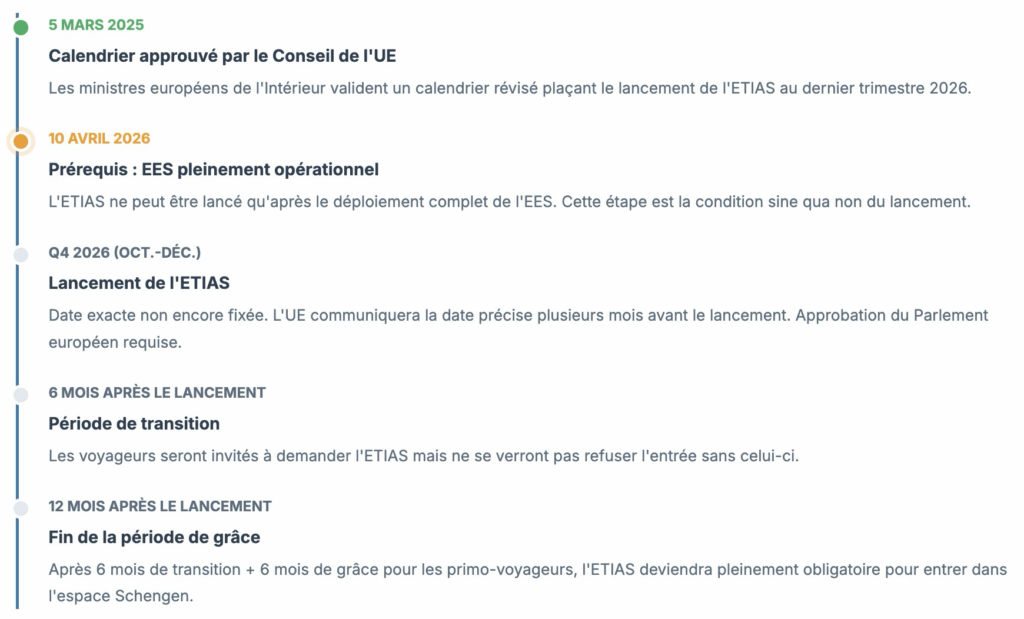
ETIAS has been postponed many times since its initial announcement: originally planned for 2021, then pushed back to 2023, 2024 and 2025, it was until recently targeting the last quarter of 2026. That target has been dropped: in July 2026 the reference to the fourth quarter of 2026 was removed from the European Union's official pages, which now state only that the date will be announced several months before the system goes live. eu-LISA, the agency building the system, has acknowledged that a launch by the end of 2026 is no longer feasible, and a revised timeline is expected after its management board meeting of September 2026. The Financial Times reports a postponement to 2027.
- Launch
- Date not set — the Q4 2026 target was removed from the official EU pages in July 2026; a revised timeline is expected after the eu-LISA management board meeting of September 2026
- Fee
- €20 per application (free for under 18s and over 70s)
- Validity
- 3 years or until passport expiry
- Nationalities concerned
- 59 Schengen visa-exempt countries (~1.4 billion potential travellers)
- Authorised length of stay
- 90 days in any 180-day period
- Entries
- Multiple and unlimited during validity
- European countries covered
- 30+ countries (Schengen area + EFTA countries)
- Travel purposes
- Tourism, business, transit, medical reasons
- Transition period
- 6 months without entry refusal + 6-month grace period for first-time travellers
ETIAS will affect nationals of 59 countries currently exempt from a visa for the Schengen area. Among the most affected nationalities in the Americas: the United States, Canada, Mexico, Brazil, Argentina, Colombia, Chile, Peru, Uruguay, Costa Rica, Panama, Honduras, Guatemala, El Salvador, Nicaragua, Paraguay and Venezuela. In Asia-Pacific: Japan, South Korea, Australia, New Zealand, Singapore, Malaysia, Brunei, Taiwan, Hong Kong and Macao. In Europe outside Schengen: the United Kingdom, Ukraine, Moldova, Georgia, Bosnia-Herzegovina, Montenegro, North Macedonia, Albania and Serbia. In the Middle East and elsewhere: the United Arab Emirates, Israel and various island nations.
Important: citizens of the European Union, the European Economic Area (EEA) and Switzerland are not affected by ETIAS. Travellers subject to a Schengen visa requirement (short-stay visa) are not affected either: they will continue to apply for a standard visa at an embassy or consulate.
05 · Countries covered
Which European countries will require ETIAS?
ETIAS will be required to enter 30 European countries. The geographical scope is not that of the European Union: it covers the Schengen area, plus Cyprus — and it is not the same as the EES scope either, which is operated by 29 countries only.
The 29 countries of the Schengen area (25 EU member states and 4 EFTA states) are included: Germany, Austria, Belgium, Bulgaria, Croatia, Denmark, Spain, Estonia, Finland, France, Greece, Hungary, Iceland (EFTA), Italy, Latvia, Liechtenstein (EFTA), Lithuania, Luxembourg, Malta, Norway (EFTA), the Netherlands, Poland, Portugal, the Czech Republic, Romania, Slovakia, Slovenia, Sweden and Switzerland (EFTA).
Added to these is Cyprus, the only non-Schengen country on the ETIAS list — 30 countries in total. Cyprus is not yet part of the Schengen area: on 14 July 2026 the European Commission adopted a positive assessment of its readiness, and the decision now rests with the Council of the EU, which takes it up in September 2026 — no vote had yet been scheduled there at the start of the month, and unanimity among the EU's Schengen members is required. Until accession takes effect, Cyprus keeps its own border checks and its national visa, and does not operate the EES: passports there are still stamped manually.
Three points that are often misunderstood. Ireland, an EU member state with a Schengen opt-out, operates neither the EES nor ETIAS: its entry rules are unchanged, and travel between Ireland and the United Kingdom falls under the Common Travel Area (CTA). The micro-states — Andorra, Monaco, San Marino and the Vatican — appear on neither list: they have no controlled border with the Schengen area, so it is your entry into the Schengen area (via France, Spain or Italy) that triggers the EES, and ETIAS in due course.
One last special case, often overlooked: Gibraltar. Since 15 July 2026, the date on which the treaty between the European Union and the United Kingdom began to apply provisionally, the territory has followed the Schengen short-stay visa policy: a Schengen visa opens the door, while a British visa or residence permit no longer does. Passport checks have gone from the land frontier with Spain; they now take place at Gibraltar's airport and port, where the Spanish authorities carry out the Schengen entry check — EES registration included — after the Gibraltarian one. ETIAS will be required there as soon as it goes live. The practical consequence for your planning: days spent in Gibraltar count towards the 90-days-in-180 allowance, exactly like a stay in Seville or Lisbon.
the 29 Schengen states + Cyprus — neither Ireland nor the micro-states
The two systems — EES and ETIAS — are complementary. ETIAS checks travellers before their arrival in Europe, while the EES registers them at the time of the border crossing. Together, they will allow the EU to reliably track entries and exits, detect overstays and strengthen security without compromising the flow of travel.
For travellers, whether or not they are required to apply for a Schengen visa, these systems will mean simplicity and fluidity in the medium term, despite the initial deployment difficulties. In 2024, Europe welcomed 747 million international visitors according to UN Tourism, confirming its position as the world's leading tourism region. ETIAS and the EES aim to manage this influx more efficiently and securely.
06 · Before you leave
Preparing effectively for these new requirements
The now-completed entry into force of the EES and the future arrival of ETIAS — whose date has not yet been set — are concretely changing how travellers prepare for a trip to the Schengen area. Whether you are currently subject to a standard visa or exempt from a visa, here are the key points to anticipate in order to avoid unpleasant surprises at the borders.
If you are a national of a Schengen visa-exempt country (one of the 59 nationalities concerned by ETIAS), you will absolutely need to obtain your electronic travel authorisation before boarding from the moment the system goes live — a date still to be announced. A 6-month transition period is planned, during which no entry refusal will be issued for lack of ETIAS, but it is better to anticipate and avoid last-minute uncertainties.
If you are subject to a standard Schengen visa, your process does not change fundamentally: you will continue to obtain your visa from the competent embassy or consulate. However, the physical border crossing will be modified by the EES, which will collect your biometric data on your first crossing.
- 1Check your situation
Determine whether you are subject to a Schengen visa or exempt from a visa. Nationals of 59 visa-exempt nationalities will need to obtain ETIAS from its launch, the date of which is still to be announced. Others will continue to apply for a standard visa.
- 2Check the validity of your passport
Your passport must be valid for the entire duration of your stay and preferably several months beyond. Make sure it has sufficient blank pages for checks and any annotations.
- 3Prepare your ETIAS application in advance (as soon as it opens)
As soon as the ETIAS platform opens, submit your online application well in advance of your trip. Have your personal information, address, travel history and professional situation to hand.
- 4Allow extra time at borders
Due to the deployment difficulties of the EES, expect longer waiting times at border posts, particularly at major airports. Allow sufficiently long connections and arrive early at the airport.
- 5Download the Travel to Europe app
This official EU app (iOS and Android) allows you to pre-register your EES data up to 72 hours before arrival in countries where it is available: Sweden (full pre-registration) and Portugal (questionnaire only); the pilots announced in France, Italy and the Netherlands are not yet open.
- 6Comply with the 90/180-day rule
With the EES, the 90 days in 180 rule is now calculated and checked automatically at every border crossing. Plan your stays accordingly to avoid any overstay situation, whose consequences can be severe.
- Valid passportCheck your passport's expiry date well before your departure. It must be valid for the entirety of your stay in the Schengen area. With the EES, your passport is linked to your biometric data: any inconsistency may cause problems at border control.
- ETIAS (for the 59 visa-exempt nationalities) — from its go-liveSubmit your electronic travel authorisation application online before booking your ticket or as soon as the platform is open. ETIAS is valid for 3 years with multiple entries. Under-18s and over-70s are exempt from fees.
- Schengen visa (if your nationality requires it)If you are a national of a country not exempt from the Schengen visa, submit your visa application to the competent embassy or consulate with sufficient lead time. Processing times may vary by season and country.
- Prepare for EES biometric controlOn your first crossing of an external Schengen border since October 2025, your fingerprints and facial image will be collected. This is a mandatory and automatic step: no prior action is required on your part for the EES.
- Proof of accommodationBring a hotel booking confirmation, an invitation letter or any other proof of your place of stay. This document may be requested at border control.
- Proof of sufficient fundsBorder authorities may verify that you have sufficient financial resources for your stay. Bring recent bank statements or a bank card with an appropriate limit.
- Travel insuranceAlthough not systematically required, travel insurance covering medical expenses and repatriation is strongly recommended for any stay in the Schengen area. It may be required when applying for a Schengen visa.
- Return or onward ticketPrepare proof of your intention to leave the Schengen area at the end of your stay (return ticket or ticket to the next destination outside Schengen). This document may be required at border control.
Europe does not require a visa from nationals of the 59 exempt nationalities, but will soon require an ETIAS electronic travel authorisation (20 €, valid for 3 years) to be obtained before any departure to the Schengen area. For all non-European travellers, the border crossing process has changed since 10 April 2026 with the EES: your biometric data (fingerprints, facial image) are now recorded electronically at each crossing, replacing the old passport stamps. Expect longer waiting times at major airports, pre-register your data via the Travel to Europe app when possible, and check the validity of your passport before booking your trip.
FAQ
Frequently asked questions
