
Missed the India e-Visa dates? What to do if you applied too early
Planning a trip to India? Avoid expired e-Visas by applying at the right time. Learn when to request your 30-day or 1-year India e-Visa to prevent travel delays.
·
The sheer diversity of India’s landscapes and cultures draws millions of visitors every year, making careful travel planning essential. To ensure a smoother entry, the Indian government introduced the e-Visa system—convenient, fast, and designed to keep wait times minimal at airports. But the rules are specific, and overlooking them can lead to avoidable setbacks during your journey.
The 30-Day e-Visa: Timing Your Application Matters
The 30-day tourist e-Visa remains a top pick for short trips to India. Yet timing your application correctly is key. The visa’s validity begins the moment it is issued—not on the date you plan to enter the country. Once granted, you must arrive in India within 30 days of that issuance date, regardless of what entry date you listed in your application.
Many travelers, wanting to be extra prepared, submit their applications too far in advance. When they do, the 30-day e-Visa expires before the trip even begins—and resubmitting for a new 30-day e-Visa isn’t permitted until the current one has fully expired.
Applying too early can leave you with an expired e-Visa that never matches your travel dates. That can derail plans, trigger costly changes, and add unwanted stress weeks—or even days—before departure.
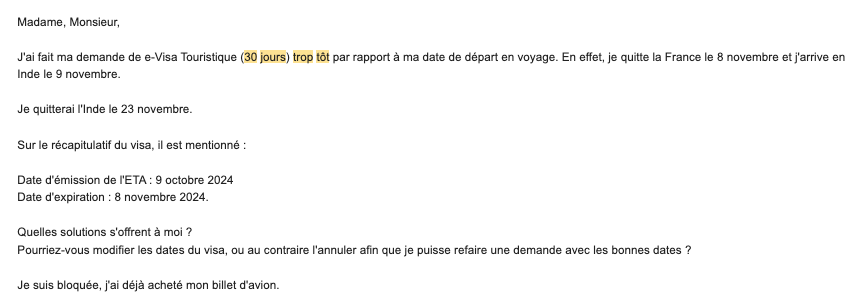
Example of a traveler who applied for a 30-day India e-Visa well ahead of her trip.
Solution: Upgrade to the One-Year e-Visa
The simplest fix is to switch to a one-year e-Visa, which offers far more flexibility than the 30-day version. While it costs more, this visa is valid for one year from the date of issue and allows multiple entries with stays of up to 90 days each time.
When filing the new application, include your existing 30-day e-Visa number. Authorities may reach out to confirm the change—respond promptly and honestly, simply clarifying you misjudged your travel dates.
Fallback Option: Traditional Visa in Passport
If the one-year e-Visa isn’t suitable, the traditional consulate sticker-style visa remains an option. It involves an embassy or consulate visit and an appointment, making it slower and more involved. Still, for travelers planning longer stays or with specialized itineraries, it can prove the more reliable route.
Clarifying the Confusion Around 30-Day e-Visa Validity Windows
The persistent mix-up around the 30-day e-Visa stems from travelers comparing printed dates against their actual itinerary. Don’t panic—that discrepancy is usually perfectly normal.
Here’s how it actually works:
You apply for a 30-day e-Visa on 14 October 2024, listing travel dates from 29 October to 20 November 2024.
The Indian authorities approve and issue the e-Visa the next day, 15 October 2024. The document lists DATE OF ISSUE OF ETA: 15/OCT/2024 and DATE OF EXPIRY OF ETA: 14/NOV/2024.
You might think the e-Visa is invalid because you leave India on 20 November instead of 14 November. But those dates aren’t your departure window—they’re your entry window.

The dates shown on your e-Visa mark the last day you are legally allowed to enter India. Once you enter, the 30-day clock starts on your passport stamp, not the e-Visa expiry. In the above case, you can enter India any time between 15 October and 14 November 2024. After passing immigration on, say, 29 October, you’ll receive a passport stamp valid until 28 November—even though the e-Visa itself shows an expiry of 14 November. Since you depart on 20 November, everything falls neatly in place.

As CEO of Visamundi, I am dedicated to simplifying international travel by assisting our clients in obtaining visas worldwide. By staying at the forefront of ever-changing regulations, I ensure our agency remains a trusted pillar in the visa services industry.

Get our visa news first in your Google results: add Visamundi to your preferred sources.
