One ID and Digital Travel Credentials: The Future of Airport Formalities
How new digital identity solutions like IATA’s One ID and ICAO’s Digital Travel Credential aim to replace boarding passes, streamline check‑in, and accelerate border crossings by 2028—with pilots already showing big reductions in processing times.
·
The International Civil Aviation Organization (ICAO) has laid the groundwork for a radical transformation of air travel with its Digital Travel Credential (DTC). The initiative seeks to phase out traditional boarding passes and potentially simplify or even eliminate check-in procedures.
By enabling travelers to store verified passport data on their smartphones, the United Nations body aims to smooth passage through control points using facial recognition and digital identity verification. Described as the “biggest disruption to aviation in 50 years,” the announcement ushers in a new era of travel, while raising questions about integration, governance and data protection.
British Airways, Air France-KLM, Finnair and Saudia are among the airlines currently studying implementation of the new technology.
IATA’s One ID solutions promise a contact-free journey from trip planning to arrival—essentially a practical rollout of the DTC. Learn more |
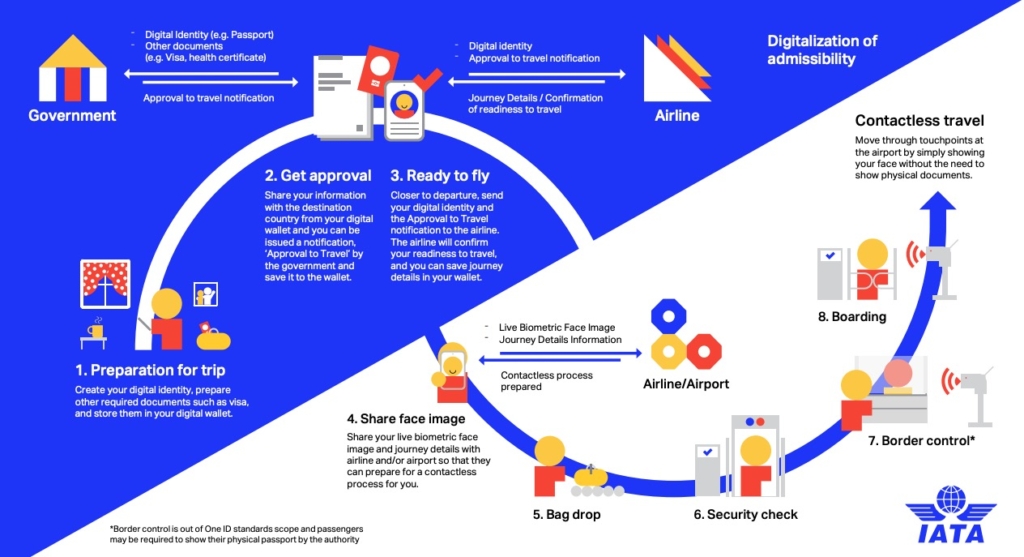
IATA’s One ID concept
When booking a flight, passengers would download a “journey pass” that updates automatically if the itinerary changes. At the airport, identity checks would run via facial scans at entry points, bag drops and boarding gates, and airlines would be alerted to passengers’ presence without any physical or online check-in. Pilot trials have already shown the technology can reduce border-processing times significantly. ICAO’s goal is large-scale adoption by airports and airlines by 2028.
The transition to digital travel promises multiple benefits. Border crossings could become faster and less cumbersome thanks to the advance sharing of information and automated controls. Eliminating paper documents such as boarding passes would lead to a smoother and potentially greener travel experience. In the event of disruptions, the “journey pass” would update automatically, easing stress and uncertainty for travelers.
A major investment in airport infrastructure will be required to install facial-recognition and mobile-reader systems. Global system interoperability across airports and airlines is another key hurdle. Accessibility concerns have also been raised, especially for travelers without smartphones or biometric identity documents.
The protection of personal and biometric data remains central to the debate. While ICAO and industry stakeholders assert that data will be deleted shortly after each interaction, critics still question the security and management of these sensitive details.
The European Union is also developing its own digital travel app. Proposed by the European Commission, the “EU Digital Travel Application” would let EU and non-EU travelers create and store digital travel credentials on their phones and submit them in advance for pre-border screening. Planned for launch from 2030, it could integrate with the European Digital Identity Wallet (EUDI Wallet). The EU initiative focuses on passports and national ID digitization to enhance both Schengen border efficiency and security. With so many initiatives underway, will travelers find their way? |
Amid this digital travel transformation, our travel-documentation service stands at a strategic crossroads. The arrival of DTC and the EU app creates fresh opportunities to expand our offerings and guide travelers through this shift. We could position ourselves as an enabler of these new technologies by providing:
Support for advance travel-information submission for pre-border checks (under the EU scheme) to cut wait times.
Enhanced services that might include digital identity verification and management of digital travel credentials, and even delivery of documents within those solutions.
By anticipating these shifts and adapting our services, we can not only continue helping clients obtain traditional travel documents but also become a key player in smoothing their transition to digital travel.
A Goode Intelligence report forecasts that by 2029 some 1.27 billion people will use digital travel identities.

As CEO of Visamundi, I am dedicated to simplifying international travel by assisting our clients in obtaining visas worldwide. By staying at the forefront of ever-changing regulations, I ensure our agency remains a trusted pillar in the visa services industry.
Get our visa news first in your Google results: add Visamundi to your preferred sources.
