
Available travel documents
Choose the visa that fits your trip. Fully online process, real-time tracking.
Sri Lanka — the emerald island to the south-east of India, heir to ancient Ceylon — welcomes more than two million travellers each year who come to explore its ancient temples, beaches and tea-covered landscapes. For most nationalities, entry does not require a traditional visa but an ETA (Electronic Travel Authorization): an entirely online travel authorisation issued within a few days on simple presentation of passport details. The ETA is not an e-Visa in the strict sense: it is the document reserved for nationals already exempt from a traditional visa. Understanding how it works, its conditions and its limits will allow you to prepare your departure with peace of mind.
01 · The essentials
Sri Lanka ETA: the electronic authorisation for visa-exempt travellers
The ETA can no longer be requested at an embassy: the entire procedure is carried out online only, regardless of the option chosen.
The passport must be valid for at least 6 months after the intended arrival date in Sri Lanka — a requirement for all travellers, across all ETA types.
Only passport details are needed to complete the application; no additional photos or invitation letter are required.
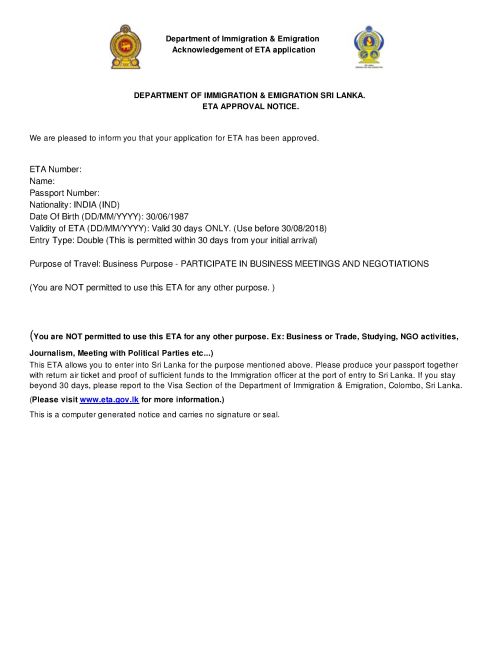
The ETA (Electronic Travel Authorization) is the electronic travel authorisation introduced by Sri Lanka for nationals exempt from a traditional entry visa. It is not an e-Visa as such: it is the specific document for exempt nationalities wishing to enter Sri Lanka for tourism, business or a short transit.
After briefly attempting to implement an electronic visa (e-Visa) system, Sri Lanka reinstated the ETA in September 2024. This document is now the only one to use for the nationalities concerned: it is no longer possible to obtain this type of authorisation from the embassy. The entire procedure is carried out online.
In early October 2025, the authorities briefly announced that the ETA would become mandatory before departure for all short-stay travellers, with effect from 15 October 2025; this requirement was revoked on 30 October 2025 by the Department of Immigration. Since then, the ETA is again required before arrival in Sri Lanka for all eligible nationalities — as entry policy has changed several times in a short period, it is advisable to always check current requirements before departure.
Must it really be obtained before departure? Yes. The official portal still mentions a limited facility to obtain the ETA on arrival at Bandaranaike International Airport (BIA) in Colombo, at a higher fee and for tourism only (never for business). But since 25 May 2026, the Department of Immigration and Emigration and Sri Lankan diplomatic missions have been reminding travellers that the ETA must be obtained before arrival: do not rely on that facility, as an airline may deny boarding without a valid ETA.
Once the ETA is approved, you have 6 months to make your first entry into Sri Lanka. The length of stay begins from your actual arrival in the country, not from the date the document was issued. The ETA will be sent to you in PDF format: print it in colour and keep it with you throughout your stay.
- Nature of document
- ETA — Electronic Travel Authorization (not an e-Visa)
- Permitted purposes
- Tourism / Business / Transit
- Tourism ETA
- Stay up to 30 days — 2 entries (the 30 days run from the first arrival: the second entry only grants the remaining balance)
- Business ETA
- Stay up to 30 days — multiple entries
- Transit ETA
- Stay up to 2 days — 1 entry
- Validity after approval
- 6 months to make the first entry
- Extension
- Possible online or at the Department of Immigration — through successive extensions, up to ~270 days in total
- Recommended application lead time
- At least 2 days before arrival (preferably 15 days in advance)
- Delivery format
- PDF by email — to be printed in colour
- Embassy application
- Not possible — 100% online procedure
- Passport required
- Valid for at least 6 months after the intended arrival date
- Children under 12
- Free Tourism ETA for up to 30 days, whatever the nationality (an individual application is still required)
- Bilateral agreements
- Singapore and Seychelles: 30 days; Maldives: 90 days — the ETA is still required before arrival
- Mandatory status
- Mandatory before arrival in Sri Lanka for all eligible nationalities
02 · Eligibility
Who can travel to Sri Lanka with an ETA — and who needs one?
The ETA is the entry document for Sri Lanka for nationals of countries already exempt from a traditional consular visa. It is essentially the minimum formality replacing a straightforward exemption, enabling the Sri Lankan authorities to check arrivals in advance.
The ETA covers three travel purposes:
- Tourism and family visits: stay up to 30 days with the possibility of entering twice during the authorisation's validity period;
- Business: stay up to 30 days with multiple entries permitted during the 6-month validity;
- Transit: stay up to 2 days (48 h) for travellers with an onward connecting flight to a third country — single entry only. This transit visa is issued free of charge.
If you plan an international transit without leaving the airport terminal, check with your airline whether an ETA is required in your specific case.
Are minors included?
Yes. Every traveller, regardless of age, must have their own ETA. Minors cannot be included on a parent's ETA. The application must be made individually for each member of the family group. A French child travelling without both parents must also carry an exit authorisation (autorisation de sortie du territoire — AST).
Do you need to have booked flights before applying for the ETA?
No. Flight tickets are not mandatory when submitting the ETA application. However, you will need to present a return ticket to immigration upon arrival.
The Tourism/Family ETA allows two entries into Sri Lanka. The 6-month validity is the window within which to make the first entry; the authorised length of stay is a maximum of 30 days, counted from your actual arrival. Note: the official portal states that on the second entry only the <em>balance</em> of the 30 days is granted — leaving and coming back does not reset the counter.
The Business ETA permits unlimited return trips during the 6-month validity. Each stay must not exceed 30 days. Information about the inviting company in Sri Lanka may be requested during the application.
Intended for transit travellers with an onward connecting flight who stay up to 48 hours in Sri Lanka, the Transit ETA is valid for a single entry and is issued free of charge.
Minors must have their own ETA, independent of that of their parents. French minor nationals travelling without a legal guardian must also carry an exit authorisation. Good news: the Tourism ETA (30 days) is free for children <strong>under 12, whatever their nationality</strong> — an individual application is still required, and fees apply if the stay is extended beyond 30 days. Depending on your country of nationality, additional exit formalities may apply: check the rule in force where you live.
Numerous fraudulent websites offer Sri Lanka ETAs at exorbitant prices and do not always meet their stated processing times. Before submitting your application, verify that the website you are using is trustworthy. If in doubt, consult specialist travel forums and guides. The Sri Lanka embassy no longer issues ETAs — any embassy procedure is now obsolete. Only use the official government portal or a recognised provider: in 2024, Sri Lanka's Supreme Court suspended the outsourcing of the platform to a private contractor, before the return to the Department of Immigration's official portal.
A small number of nationalities cannot obtain the ETA through the standard online procedure and must apply through the Department of Immigration and Emigration with additional documents (source: official alerts on the portal):
- Cameroon, Nigeria, Ivory Coast, Ghana and Afghanistan: the application must be supported by a request letter from a Sri Lankan sponsor and accompanied by the applicant's police clearance report.
- Syria: application to be lodged through a Sri Lankan sponsor at the head office of the Department of Immigration, with a police clearance report.
- Taiwan (China) and Kosovo: application to be lodged through a Sri Lankan sponsor at the head office of the Department of Immigration (police clearance not required).
Nationals of these countries therefore cannot simply use the standard online ETA form. Check the requirements in advance with the Sri Lankan Department of Immigration and allow extra time to gather the required documents.
03 · The procedure
How to obtain your Sri Lanka ETA: steps and required documents
The Sri Lanka ETA application is entirely paperless. It is completed online from any country, before your departure. Here are the items to gather before you begin:
- The biographical page of your passport (valid for at least 6 months after your intended arrival date in Sri Lanka);
- For a Business ETA: the name, address and phone number of the inviting Sri Lankan company;
- Your detailed address in Sri Lanka (hotel, family, etc.).
Flight tickets and hotel reservations are not mandatory for the online application, but may be requested by immigration on arrival.
- 1Determine your purpose of stay
Identify the type of ETA you need: Tourism (up to 30 days, 2 entries), Business (up to 30 days, multiple entries) or Transit (up to 2 days, 1 entry). The choice matters as the document type and information required vary.
- 2Gather your passport details
Have your passport, valid for at least 6 months after the intended entry date, to hand. Note the number, expiry date and personal details exactly as they appear on the document. Any error may result in the application being rejected.
- 3Complete the online form
Fill in the application form with your personal details, passport data, your address in Sri Lanka and your travel details. For a Business ETA, provide the full contact details of your Sri Lankan counterpart.
- 4Submit your documents
Once the form is completed, submit the required documents (copy of your passport, where applicable). The information is then verified before being forwarded to the Sri Lankan authorities.
- 5Pay the fees online
Payment is made by bank card. Fees vary depending on the type of ETA and the applicant's nationality. From 25 May 2026, under a regulation approved by the Sri Lankan Parliament on 7 May 2026, nationals of 40 countries — including several European countries (including France), British, American, Canadian, Australian and New Zealand citizens, as well as Japanese, Chinese, Indian, Russian and Gulf nationals — benefit from a fee waiver for the Tourism ETA. The ETA itself remains mandatory for these nationalities: only the consular fee is waived.
- 6Await validation
The standard processing time is 48 h, but it may occasionally be slightly longer depending on the period and volume of applications. It is advisable to submit your application at least 15 days before departure to avoid any last-minute stress.
- 7Receive your ETA by email and print it
Once approved, your ETA is sent to you in PDF format by email. Print it in colour and also keep a digital copy. You will need to present it at check-in and at immigration upon arrival in Sri Lanka.
04 · Documents & immigration
What you will need to present at the Sri Lankan border
Obtaining the ETA is not enough: on arrival in Sri Lanka, you will need to present yourself at immigration with a set of documents. The immigration officer has the final say on whether you are actually admitted to the territory, even if your ETA has been approved.
- ETA printed in colourThe PDF document received by email must be printed in colour. Also keep a digital copy in case of loss.
- Passport valid for at least 6 months after arrivalThe same passport used for the ETA application. No other identity document will be accepted at immigration.
- Return or onward ticketA return flight ticket or any transport document justifying your planned departure from the territory may be requested by immigration officers.
- Proof of sufficient fundsA recent bank statement or letter from your bank proving that you have the funds required to cover your stay. This document may be checked at the border.
- Address in Sri LankaName and address of the hotel or planned accommodation. Having a booking confirmation to hand is recommended.
- Arrival card completed online (optional, free)The Department of Immigration lets you complete the arrival card online free of charge within the 3 days before travel, to speed up immigration clearance. It is not a visa: the ETA is still required. Otherwise, the card is filled in on arrival.
Vaccinations and health
No vaccinations are mandatory to enter Sri Lanka, with one exception: yellow fever vaccination is required for nationals arriving from countries where the disease is endemic (Angola, Argentina, Benin, Bolivia, Brazil, Burkina Faso, Burundi, Central African Republic, Chad, Colombia, Ecuador, Equatorial Guinea, Ethiopia, French Guiana, Gabon, Gambia, Guinea-Bissau, Liberia, Mali, Mayotte, Niger, Panama, Peru, Rwanda, São Tomé and Príncipe, Senegal, Sierra Leone, Somalia, Sudan, Suriname, Tanzania, Togo, Uganda, Venezuela, Democratic Republic of the Congo).
Although not mandatory, several vaccinations are strongly recommended by health authorities for travel to Sri Lanka: tuberculosis, typhoid fever, hepatitis A and B, Japanese encephalitis and rabies. Consult your doctor or an international vaccination centre before departure.
It is also advisable to take out travel insurance covering hospitalisation costs abroad and medical evacuation. Health conditions and risks can change: check the current recommendations from your country's health authorities before departure.
Sri Lanka has amended its entry policy several times in recent years — switching to an e-Visa, reverting to the ETA in September 2024, briefly announcing a mandatory pre-departure ETA in October 2025 (quickly revoked), then introducing a fee waiver for 40 countries in May 2026. It is essential to check the most up-to-date information with the Sri Lankan authorities before your departure, as conditions may change without much notice.
05 · Fees & validity
Fees, lengths of stay and ETA extension
Sri Lanka ETA fees vary depending on the type of document chosen and the applicant's nationality. Official fees for nationalities that do not benefit from the waiver:
- Tourism ETA (30 days, 2 entries): 50 USD €44.64 — 20 USD €17.85 for South Asian (SAARC) countries, notably Bangladesh and Bhutan;
- Business ETA (30 days, multiple entries): 55 USD €49.1 — 30 USD €26.78 for South Asian countries;
- Tourism ETA issued on arrival (limited facility at Colombo airport): higher fee of 60 USD €53.56 — 25 USD €22.32 for South Asian countries. No Business ETA is issued on arrival.
From 25 May 2026, under a regulation approved by the Sri Lankan Parliament on 7 May 2026, nationals of 40 countries benefit from a waiver of tourist ETA fees (30-day stay, double entry). This measure applies notably to citizens of several European countries (including France), the United Kingdom, the United States, Canada, Australia, New Zealand and Japan, but also China, India, Russia and several Gulf states. The ETA remains mandatory for these nationalities: only the consular fee is waived, and any service fees charged by the chosen provider remain payable.
The Transit ETA, intended for travellers with an onward connecting flight to a third country (maximum stay of 48 hours), is issued free of charge.
The 40 countries whose Tourism ETA is free of charge
The official portal publishes the full list of nationalities covered by the fee waiver in force since 25 May 2026. Here it is, in alphabetical order:
Australia, Austria, Bahrain, Belarus, Belgium, Canada, China, Czech Republic, Denmark, Finland, France, Germany, India, Indonesia, Iran, Israel, Italy, Japan, Kazakhstan, Kuwait, Malaysia, Nepal, Netherlands, New Zealand, Norway, Oman, Pakistan, Poland, Qatar, Russia, Saudi Arabia, South Korea, Spain, Sweden, Switzerland, Thailand, Türkiye, United Arab Emirates, United Kingdom and United States.
If your nationality is not on this list, the ETA remains chargeable — this is the case for most Latin American and African countries, and for several European countries not named above. Three bilateral arrangements sit alongside the scheme: Singapore and Seychelles (30 days) and the Maldives (90 days). In every case, the ETA must be obtained before arrival, free of charge or not.
One more rule that matters to families: children under 12 obtain the Tourism ETA free of charge, whatever their nationality, for a stay of up to 30 days. Beyond that, the usual extension fees apply. The application remains individual: a child cannot be added to a parent's ETA.
Extension of stay
The tourist stay can be extended several times: a first extension takes the stay to 90 days, and further extensions can bring it up to around 270 days in total. This is now done online via the immigration e-services portal or, in person, at the Department of Immigration and Emigration (in Battaramulla, within the Colombo area). Apply before your authorised stay expires; the exact conditions and fees should be confirmed with immigration, as they may change.
If your travel dates change before departure and your ETA has already been issued, please note that it is not possible to amend an ETA once issued. In that case, a new ETA application is required.
06 · Before you go
Sri Lanka in practice: history, culture and travel tips
Nicknamed the 'Pearl of the Indian Ocean', the island of Sri Lanka is a territory of extraordinary cultural and natural density. Nestled to the south-east of India, at the tip of the subcontinent, it covers approximately 65,000 km² — barely larger than Ireland — yet concentrates a biodiversity and heritage that rival those of far larger countries.
Sri Lanka's history is both ancient and complex. The earliest traces of human civilisation date back more than 30,000 years. The Kingdom of Sinhala, founded in the 5th century BCE according to Buddhist chronicles, makes Sri Lanka one of the cradles of Theravada Buddhism, the religion still practised by the majority on the island today. European colonisation began in the 16th century with the Portuguese, followed by the Dutch in the 17th century, then the British who renamed the island Ceylon and made it a Crown possession until independence in 1948. It was not until 1972 that the country reclaimed its ancestral name: Sri Lanka.
This layering of cultures — Sinhalese, Tamil, Malabar, Malay, Burgher (of European descent) and Muslim — gives Sri Lanka a unique culinary, architectural and linguistic richness. Sinhala and Tamil are the two official languages, while English remains widely used in tourism and business.
The Cultural Triangle (Anuradhapura, Polonnaruwa, Sigiriya, Kandy) brings together the island's greatest archaeological and religious sites. The sacred city of Kandy is home to the Temple of the Tooth, which houses a relic of the Buddha — one of the most revered sites in South Asia.
Sri Lanka is one of the world's 36 biodiversity hotspots. Its national parks (Yala, Minneriya, Wilpattu) are home to elephants, leopards, crocodiles and hundreds of bird species, many of them endemic to the island.
The Hill Country region, around Nuwara Eliya and Ella, is the heart of Ceylon tea production — one of the most renowned in the world. Mountain roads wind between lush plantations in a setting of mist and cool air.
Sri Lanka has more than 1,500 km of coastline. Depending on the season, the choice of coast (west and south, or east) is crucial: the monsoon affects both sides at different times of year. Mirissa, Unawatuna and Arugam Bay are among the most popular beaches with travellers.
Getting around and logistics
Sri Lanka is served from Europe via Bandaranaike International Airport in Colombo (CMB), the country's main air entry point. Direct or connecting flights are available from major European cities.
On the ground, transport options are varied: scenic train journeys (notably the Kandy–Ella route, reputed to be one of the most beautiful in Asia), tuk-tuks, buses and car hire with driver. The road network is generally reasonable, but distances can feel long due to the terrain and traffic density on certain routes. Allowing more travel time than expected is advisable.
The local currency is the Sri Lankan rupee (LKR). Bank cards are accepted in hotels and tourist restaurants in major cities, but it is advisable to carry cash for rural areas and local markets. ATMs are available in all main towns.
Sri Lanka is a safe destination for the vast majority of visitors, but several states maintain caution advisories. The US Department of State places the country at Level 2 — Exercise Increased Caution (advisory of 14 October 2025) because of civil unrest and terrorism risks, and flags unexploded ordnance and landmines in some rural areas of the Northern and Eastern provinces: do not stray from well-used roads, tracks and paths there.
Demonstrations linked to the economic and political situation can happen without warning and turn violent; avoid gatherings. Travel advice is issued by each government and differs from one country to another: check the advice of your country of nationality and residence before booking, along with the exclusion clauses of your travel insurance.
- ETA approved and printed in colourCheck that the type of ETA matches your travel purpose (Tourism, Business or Transit). Also keep a digital copy.
- Passport valid for at least 6 months after arrivalThe same passport used for the ETA application. Without this requirement being met, entry to the territory may be refused.
- Return or exit ticketMay be requested at immigration on arrival. Having your reservation or ticket accessible makes border crossing easier.
- Proof of funds for the duration of the stayRecent bank statement or bank letter. This document may be checked at immigration in addition to the ETA.
- Each traveller has their own ETAApplications are individual, including for children. Do not include minors on an adult's ETA.
- Exit authorisation for French minors travelling aloneThis form is available online at service-public.fr and must be signed by one of the holders of parental authority, accompanied by a copy of their identity document.
- Vaccinations up to date according to health recommendationsYellow fever vaccination mandatory if arriving from an endemic country. Typhoid fever, hepatitis A and B, Japanese encephalitis vaccinations recommended depending on your itinerary.
- Travel insurance covering medical costs and evacuationHospital costs abroad can be high. Appropriate travel insurance is strongly recommended for any stay in Sri Lanka.
- Check the latest entry conditionsSri Lanka's entry policy has changed several times recently. Consult official sources or a trusted provider before departure.
The Sri Lanka ETA is an electronic travel authorisation — not an e-Visa in the strict sense — intended for nationals exempt from a traditional consular visa. It is mandatory before arrival in Sri Lanka for all eligible nationalities (a brief measure announced in mid-October 2025, which was to make the ETA mandatory before departure, was revoked on 30 October 2025, returning to the previous procedures). It covers tourist stays (30 days, 2 entries — the second entry only granting the balance of the 30 days), business stays (30 days, multiple entries) and airport transits (2 days, 1 entry, free of charge). Children under 12 obtain it free of charge whatever their nationality, on an individual application. The application is entirely online, quick and requires only your passport details. Validity is 6 months from approval for the first entry; the length of stay begins on actual arrival. From 25 May 2026, under a regulation approved by the Sri Lankan Parliament on 7 May 2026, nationals of 40 countries — including several European countries (including France), British, Americans, Canadians, Australians, New Zealanders, Japanese, Chinese, Indians, Russians and nationals from Gulf states — benefit from a fee waiver for the Tourism ETA (the ETA remains mandatory; only the consular fee is waived). Apply in advance: at least 15 days before departure is recommended to avoid any processing delays.
Safety
Travel advisories for Sri Lanka
The vigilance level recommended by five foreign ministries, on a shared scale.
Average level
Civil unrest, terrorism and landmines; heavy rainfall, flooding and landslides.
- Read the advice

US Department of StateAdvice dated October 14, 2025
Increased caution · Sri Lanka - Level 2: Exercise Increased Caution
- Read the advice

Global Affairs CanadaAdvice dated October 13, 2026
Increased caution · Sri Lanka — Exercise a high degree of caution
- Read the advice

German Federal Foreign OfficeAdvice dated October 13, 2026
Normal precautions · Sri Lanka: Travel and Security Warnings
- Read the advice

UK Foreign Office (FCDO)Advice dated September 21, 2026
Normal precautions · Sri Lanka travel advice
- Read the advice

France DiplomatieAdvice dated September 27, 2026
Increased caution · Sri Lanka: Travel Advice
Levels published by the ministries cited, reproduced unchanged. Visamundi is a private agency with no ties to these administrations.
FAQ
Frequently asked questions
