
Turkey scraps visa rules for 6 countries, including US and Canada
Turkey eliminates visa requirements for US, Canadian, and four Gulf-state passport holders, allowing stays up to 90 days in any 180-day period from late December 2023.
·
On 22 December, the Republic of Turkey’s presidency announced that visa requirements had been lifted for passport holders from six countries—namely the United States, Canada, Bahrain, the United Arab Emirates, Saudi Arabia and Oman.
How to enter Turkey visa-free
Under the new rules, ordinary-passport holders from these six states may now stay in Turkey up to 90 days within any 180-day period without obtaining a visa.
Previously, all six nationalities had been required to obtain an e-Visa for tourist and business travel. Under Article 18 of Turkey’s Law on Foreigners and International Protection, the Turkish president has the unilateral power to waive visa requirements for specific nationalities, introduce facilitative visa measures and set permitted lengths of stay.
The move follows pressure from the European Union—already visa-exempt under identical terms—where Brussels urged Ankara to make it easier for high-potential source markets to visit.
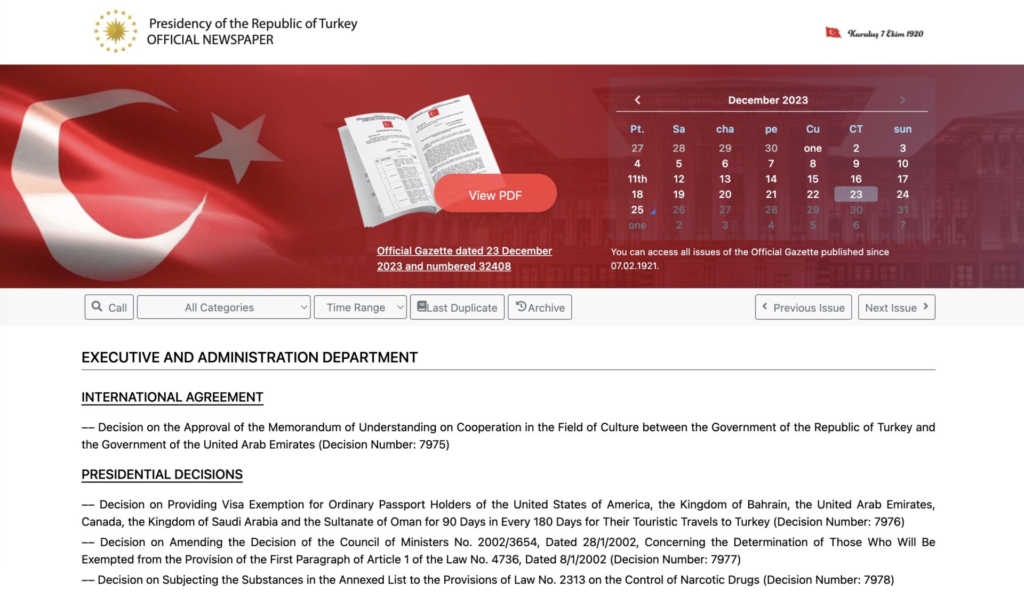
The presidency’s official portal confirms Turkey has waived entry requirements for the new list of countries.
Turkey’s digital e-Visa system
Since 2013, Turkey has operated an online e-Visa scheme that lets travellers apply, pay and receive their authorisation by email once it is approved. This made the country an early adopter of digitalised entry policies.
The latest waivers align with an international trend toward softer visa policies designed to boost tourism, labour mobility and cross-border exchange. Ukraine and APEC-card holders have also seen recent Turkish relaxations.
Turkey welcomed more than 59 million foreign tourists in 2023, an increase of 23.5 % year-on-year, while tourism revenue rose 27.5 % to reach US $56.4 billion.

As CEO of Visamundi, I am dedicated to simplifying international travel by assisting our clients in obtaining visas worldwide. By staying at the forefront of ever-changing regulations, I ensure our agency remains a trusted pillar in the visa services industry.

Get our visa news first in your Google results: add Visamundi to your preferred sources.
