Uruguay fixes error making naturalised citizens' passports unusable
Uruguay has corrected a decades-old administrative error that left naturalised citizens with unusable passports, preventing international travel due to incorrect nationality designations.
For years, Uruguay🇺🇾 stood alone with a unique—and costly—administrative practice that stripped thousands of naturalised citizens of usable travel documents: their Uruguayan passports were invalid for international travel due to an error in the nationality designation.
Misinterpreting international rules
The root of the problem was a misreading of International Civil Aviation Organization (ICAO) guidelines. Uruguay listed the country of birth—not the new Uruguayan nationality—on passports issued to naturalised citizens. In some cases, the "nationality" field was left blank entirely, especially for people who had lost their original citizenship upon naturalisation in countries where dual nationality is not permitted.
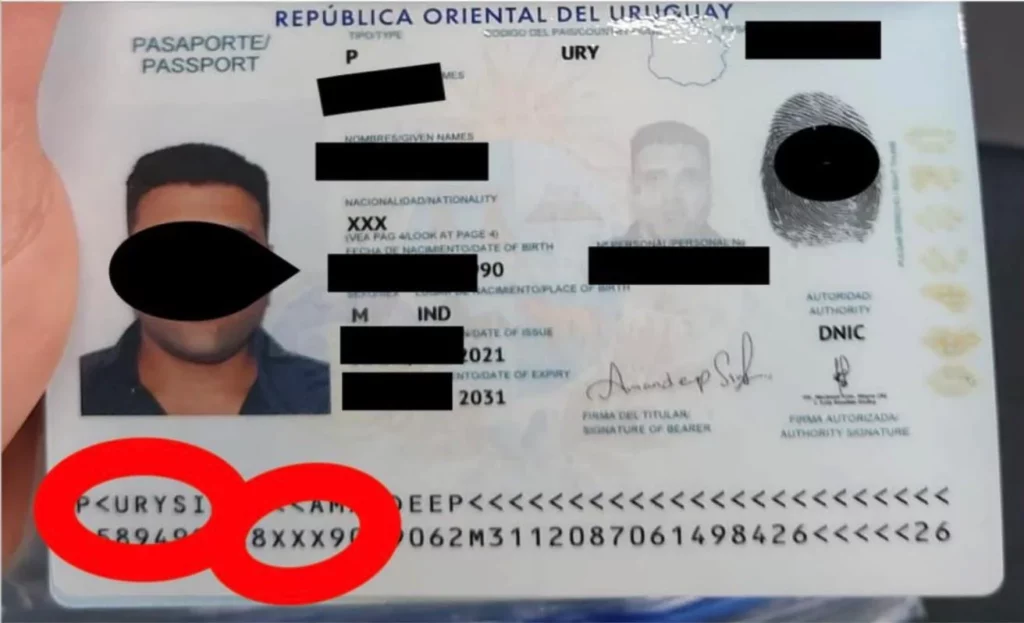
No nationality listed—neither on the passport nor in the MRZ zone
This arose from a literal reading of the Spanish translation of ICAO Document 9303, which uses "nationality" where the English version says "citizenship." As a result, full Uruguayan citizens were effectively barred from travel, as many destination countries—including France and Switzerland—required passports from the country of origin.

In this case, the passport retains the previous Greek nationality while supposedly being Uruguayan
Unforeseen consequences
Approximately 16,000 naturalised citizens were affected, with about 1,500 new cases each year. The case of Gulnor Saratbekova, who came to Uruguay from Tajikistan more than 20 years ago, highlights the severity of the issue. Once she lost her Tajik citizenship (the country does not recognise dual nationality), she could neither travel on a Tajik passport nor use her Uruguayan one to leave the country or enter another state.
"I felt like I was from two places, yet from nowhere at all. … It was like having a father and a mother, neither of whom would acknowledge me as their legitimate child."
Gulnor Saratbekova
Beyond travel bans and visa requirements, the situation led to detentions at borders and was taken up by the Inter-American Commission on Human Rights, which saw it as a potential violation of the right to nationality and identity.
Administrative correction now in place
Under mounting pressure, Uruguay’s Ministry of the Interior has corrected the anomaly this month. The "Nationality" field now reads "Nationality/Citizenship" with the code « URY » for all citizens, born or naturalised. The "Place of birth" field has also been removed, in line with current ICAO recommendations.
The first recipient of the revised passport was Gulnor Saratbekova, who received it on 16 April 2025, ending years of administrative limbo and restrictions on her freedom of movement.
While this reform resolves immediate travel issues, a deeper question remains: the Uruguayan Constitution still distinguishes between "citizens by birth" (born in Uruguay or to Uruguayan parents) and "legal citizens" (naturalised). The national human-rights institution is planning to convene a meeting with Parliament to push for a constitutional amendment.