US Expands Social Media Checks to New Visa Categories
The U.S. government is dramatically expanding mandatory social media checks across virtually all visa categories, including work, student, and family visas. Learn which categories are affected and how to prepare for an audit of your online history.
·
The days when U.S. consular officers simply stamped passports after a glance at payslips are long gone. Today, America’s borders aren’t just physical—they’re digital.
At Visamundi, our inboxes swell with messages from travelers and expats caught off guard by stricter screening of online histories. What was once reserved for "high-risk" profiles has snowballed into a near-universal requirement: a full audit of your digital footprint. Gone are the days when a routine check sufficed; now, applicants must demonstrate total transparency of their online personas.
Massive expansion: new visa categories now scrutinized
If you assumed only complex immigration cases faced social media scrutiny, think again. The U.S. Department of State has rolled out a sweeping, three-phase rollout of enhanced social media vetting, adding new populations in rapid succession.
Students in the crosshairs (June 2025) The expansion launched last summer with F, M, and J visas for international students and exchange participants. Alarmed by political developments on U.S. campuses, the State Department instructed consular agents to flag any conduct deemed "hostile" to American culture or governance.
Global workforce under scrutiny (December 2025) The second wave ensnared high-skilled professionals. Since mid-December 2025, H-1B holders and their H-4 dependents have been required to surrender access to their online profiles. Gone are the days of a simple paper application: agents now cross-check DS-160 details against LinkedIn. A mismatch in job title or hire date triggers immediate administrative processing—or the dreaded 221(g) refusal.
Watershed expansion (March 2026) The most sweeping change arrives this spring. Effective March 30, 2026, social media screening now targets an exhaustive list that includes:
Fiancé(e)s of U.S. citizens (K-1, K-2, K-3 visas).
Religious workers (R-1, R-2).
Household staff of diplomats (A-3, C-3, G-5).
Trainees and cultural-exchange visitors (H-3, Q).
Even survivors of human trafficking or qualifying crimes who seek protection (T and U visas).
Public mode only: the privacy trap
One of the most disruptive elements of the new policy is the demand for full public access.
A State Department directive now instructs applicants to configure all social media accounts to "public" or remove privacy locks. Closed profiles are interpreted as attempts to conceal information, potentially triggering extra scrutiny or outright refusal.
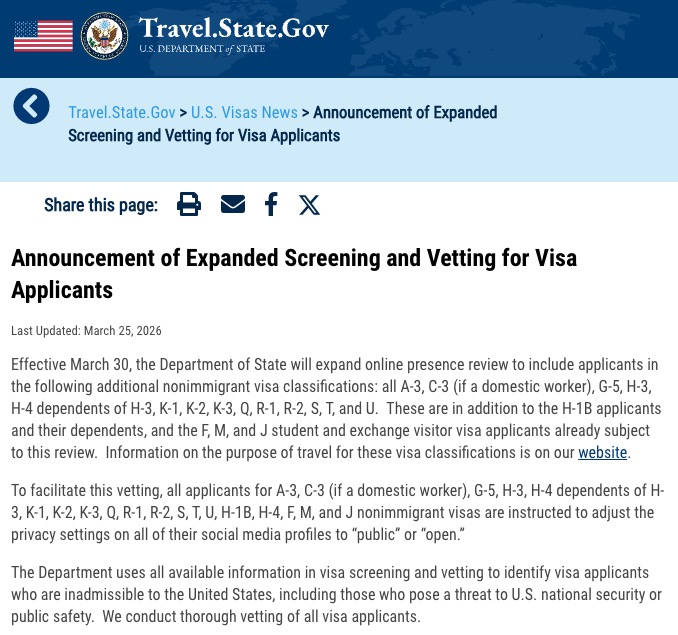
U.S. State Department website.
Worse, a total absence of social media activity can backfire. Official guidance warns that deleting old profiles or suddenly going dark raises red flags as possible evidence of evasion. Applicants must be prepared to explain any lack of digital footprint credibly.
What consular officers now seek
Screeners are no longer hunting only for terror links. Using algorithmic analysis tools, they systematically evaluate:
Professional consistency: For work visas, skills listed on a LinkedIn profile that do not appear on the official CV can derail an H-1B application.
Relationship authenticity: On K-class visas for fiancé(e)s, photographs, interactions, and timeline of a couple’s online life are mined for evidence of marriage fraud.
Prior immigration violations: Even a check-in photo suggesting unauthorized employment during a past tourist stay can scuttle re-entry chances.
Ideological alignment: The government is actively hunting "hostile" attitudes toward the U.S. or discriminatory speech—broad criteria that give screeners wide latitude.
How to secure your application (Visamundi’s advice)
With these requirements in place, improvisation carries severe risks. Rushing to erase an Instagram feed the night before an embassy interview is an immediate red flag; instead, clean up accounts logically and well in advance.
Key steps:
Cross-audit everything. Hold your DS-160 and LinkedIn side by side; job titles, dates, and employer names must match verbatim.
Don’t erase—rectify. Frantic cleanups before interview day look like cover-ups and invite extra questions or refusal.
Mind your household’s posts. H-4 dependents’ social activity can sway the primary H-1B petition; screening is now a family affair.
Build extra time into your schedule. With massive data volumes to review, consulates have cut daily appointment quotas, extending wait times and multiplying administrative holds. Never book non-refundable travel before visa issuance.
Your digital footprint has become an integral part of your passport. Complex work visas, family reunification cases, or an atypical online history demand expert foresight. At Visamundi, we anticipate consular queries so your interview is nothing more than a formality.
As CEO of Visamundi, I am dedicated to simplifying international travel by assisting our clients in obtaining visas worldwide. By staying at the forefront of ever-changing regulations, I ensure our agency remains a trusted pillar in the visa services industry.
Get our visa news first in your Google results: add Visamundi to your preferred sources.
