U.S. Threatens to End Visa Waiver for Europeans in Privacy Standoff
The U.S. has set a 2027 deadline for Europe to share biometric data or risk losing its Visa Waiver Program (ESTA), forcing travelers to revert to costly visas.
·
If you routinely cross the Atlantic for business or pleasure, you’re familiar with the drill: fill out an online form, pay about $40, and within 72 hours (often less), your ESTA lands in your inbox. But did you know that this convenience—one we’ve taken for granted for nearly 15 years—is now in jeopardy?
Washington has issued a clear ultimatum to European capitals: by 2027, U.S. authorities must gain access to European citizens’ biometric data. If not, the Visa Waiver Program (VWP) could be suspended—with immediate consequences for your future travels.
Biometric Data: The New Cost of Entry
Up to now, trust has been the foundation of transatlantic travel. U.S. officials relied on European biometric passports and travelers’ sworn statements ("Have you ever been arrested?" or "Are you a terrorist?"). But the Department of Homeland Security (DHS) no longer considers this sufficient.
Under a new initiative called Enhanced Border Security Partnership (EBSP), the U.S. now demands direct access to European police databases, including fingerprints and facial recognition. Every ESTA applicant or arriving traveler would be vetted against local police records—even for offenses that never appear in Interpol databases.
The deadline is firm: the U.S. expects these systems to be operational by the end of 2026 for full implementation in 2027.
The Worst-Case Scenario: Revert to B1/B2 Visas
For travelers used to ESTA’s simplicity, the stakes couldn’t be higher. If the EU resists—and privacy advocates argue these demands are overly intrusive—the U.S. has warned it will remove non-compliant countries from the Visa Waiver Program.
That means saying goodbye to the $40 ESTA and hello to the B1/B2 visa process, a bureaucratic ordeal requiring a DS-160 form, an in-person embassy interview with fingerprinting, fees near $185, and waiting periods that can stretch from weeks to months.
Lessons from Israel: A Preview of What’s Ahead
To see how this might play out, look at Israel, which joined the program in late 2023. Before gaining access, the Israeli government passed a law allowing U.S. authorities to query its fingerprint databases. Travelers must now use biometric passports to qualify for ESTA; those with older or temporary passports are excluded entirely and relegated to the visa route. Screening is also far more stringent.
What Could Change for You
Even if a last-minute deal is reached—and economic pressures make that likely—ESTA users should brace for stricter controls, including facial-recognition match-ups and mandatory mobile app verification.
The Privacy Battle
Why hasn’t this happened already? Because Europe’s General Data Protection Regulation (GDPR) is the world’s tightest data-protection regime. The European Data Protection Supervisor has already called the U.S. proposal a "serious" infringement of fundamental rights.
Brussels is negotiating for a "hit/no-hit" system—where the U.S. receives only a yes/no alert rather than sweeping access to Europol-linked data. Washington, however, is insisting on routine, automated access.
Pro tip: If you’re planning a trip to the U.S. in the next year or two, you’re likely safe. But watch 2026 and 2027 closely. The era when travelers could book a spontaneous weekend in New York may soon hinge on whether Brussels and Washington can plug their policing systems together. |
Meanwhile, Europe’s ETIAS: Quiet Reciprocity
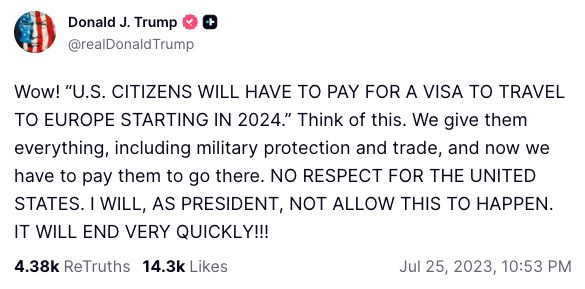
Europe isn’t standing still. Its ETIAS system—often called the EU’s "ESTA"—will require American visitors to register online and pay a €7 fee starting in 2026-2027 before stepping on the continent.
The U.S. State Department has quietly updated travel advice for Americans, tacitly endorsing the EU’s long-overdue reciprocity. While in 2023 the Administration threatened to block ETIAS for U.S. citizens, recent developments suggest that stance may have softened.
Screenshot
Here the asymmetry is striking: Europe asks American tourists to fill out a declarative form, while the U.S. demands wholesale access to European biometric and police data. One offers procedural convenience; the other, systemic surveillance.

As CEO of Visamundi, I am dedicated to simplifying international travel by assisting our clients in obtaining visas worldwide. By staying at the forefront of ever-changing regulations, I ensure our agency remains a trusted pillar in the visa services industry.

Get our visa news first in your Google results: add Visamundi to your preferred sources.


