Indonesia Requires Travelers to Complete Mpox Health Pass Before Arrival
Indonesia mandates the SATUSEHAT Health Pass for all international travelers to curb Mpox spread. Learn how to complete it and what to expect upon arrival.
Indonesia’s government has introduced a new entry requirement to help prevent the spread of mpox (monkeypox). From 27 August 2024, all international travelers—both Indonesian and foreign nationals—must complete the SATUSEHAT Health Pass (SSHP), an electronic self-declaration health form.
Why the SATUSEHAT Health Pass matters
The SATUSEHAT Health Pass is an electronic form designed to collect travelers’ health and recent travel history. Travelers must submit this information before arriving in Indonesia to help health and immigration authorities assess potential risks and implement Mpox prevention measures at international entry points.
Complete the SATUSEHAT Health Pass
How to complete the Mpox health form
The official SATUSEHAT Health Pass can be accessed via: https://sshp.kemkes.go.id. Once submitted, the form generates a QR code containing the traveler’s health and itinerary data, which must be shown upon entry.
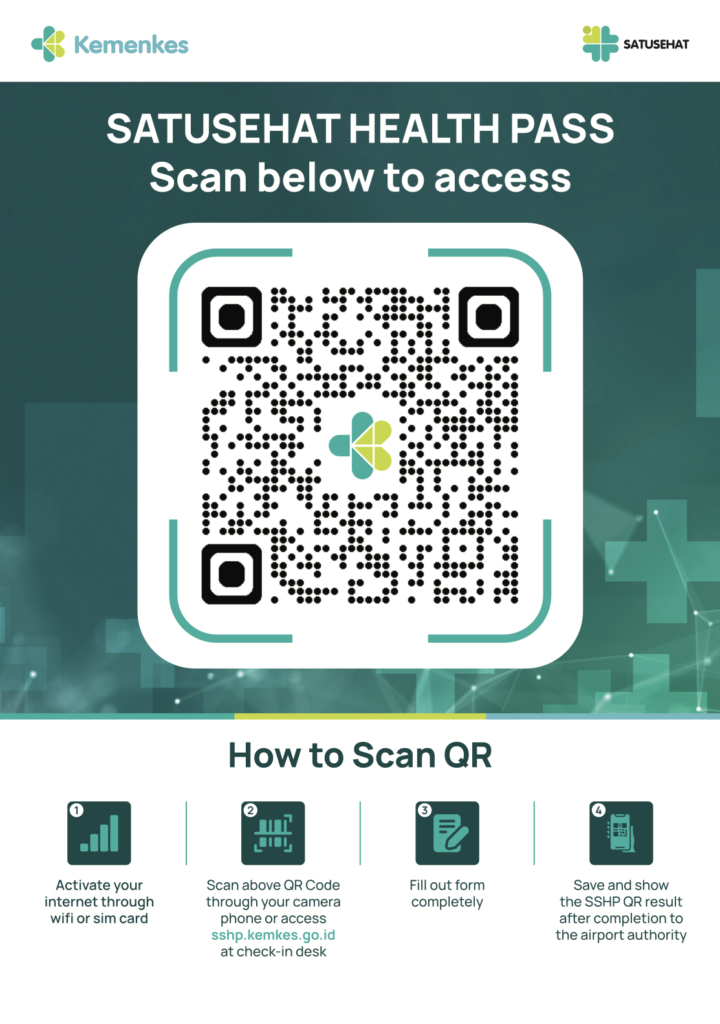
Information required on the form
Travelers must enter the following details in the SATUSEHAT Health Pass:
Full name
Mobile phone number
Arrival airport
Flight number
Seat number
Departure country
Potential transit stops
Visits to other countries within 21 days prior to arrival in Indonesia
Regulatory background
The Indonesian Ministry of Transportation approved and enacted this rule through the Directorate General of Civil Aviation (Direktorat Jenderal Perhubungan Udara, DJPU). The relevant regulation is Circular DJPU Number 5 of 2024, ensuring the use of the SATUSEHAT Health Pass for foreign travelers.
Additional screening measures
Upon arrival, travelers will undergo temperature checks in addition to providing their SATUSEHAT QR code. Those with a temperature over 37.5°C may be subject to further health screening.
Indonesia follows the World Health Organization (WHO), which declared mpox a Public Health Emergency of International Concern (PHEIC) on 14 August 2024. Since 2022, Indonesia has reported 88 confirmed mpox cases, mostly in Java and the Riau Islands.
Mpox case distribution in Indonesia
Region | Cases | % of total |
|---|---|---|
Jakarta | 59 | 67.05% |
West Java | 13 | 14.77% |
Banten | 9 | 10.23% |
East Java | 3 | 3.41% |
Yogyakarta | 3 | 3.41% |
Riau Islands | 1 | 1.14% |
Total | 88 | 100% |
Travelers who develop symptoms within 21 days of arrival should consult a doctor and present their SATUSEHAT QR code.
Indonesia’s ongoing Mpox response
To bolster prevention efforts, the Indonesian government is procuring additional mpox vaccines. Health Minister Budi Gunadi Sadikin confirmed the arrival of 1,600 extra doses to restock near-depleted supplies.
Prevention and surveillance measures
Indonesia’s Ministry of Health has deployed a multi-layered strategy:
Point-of-care surveillance in health facilities
Epidemiological studies in partnership with community groups and people living with HIV/AIDS
Establishment of 12 national reference laboratories for mpox testing
Whole-genome sequencing (WGS) of mpox samples
Spécialiste de la veille réglementaire et experte en contenus destinations, elle analyse quotidiennement l’évolution des formalités d’entrée pour traduire la complexité administrative en guides pratiques. Son rôle combine expertise terrain et précision technique afin de garantir la fiabilité des informations délivrées aux voyageurs.