Somalia’s e-Visa breach accelerates transition to eTAS amid regional outcry
Somalia’s federal government moves to the stricter eTAS system after a massive data breach and Somaliland’s outright refusal to recognize Somali visas, effective 27 November 2025.
·
The Federal Government of Somalia (FGS) is rolling out a revamped immigration policy that culminates in the full switch from its e-Visa system to an Electronic Travel Authorization Somalia (eTAS) platform effective 27 November.
This reform comes after serious concerns over digital security and outright rejection by neighboring factions such as Somaliland.
End of Visa on Arrival and rise of eTAS
While the visa-on-arrival rule was introduced in September for most travelers, the 27 November transition does not alter visa policy; it updates the technology used to process permits. From this date, Somalia will fully migrate from its e-Visa system to eTAS (Electronic Travel Authorization Somalia), described by federal officials as stricter than its predecessor.
The Somali eTA has been available since 21 September via https://etas.gov.so.
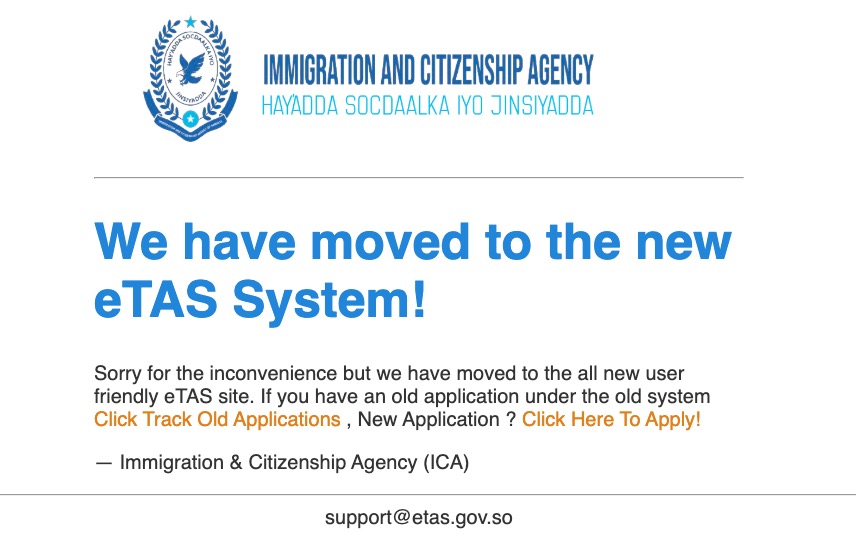
The former site https://evisa.gov.so/ now redirects to the new eTAS portal.
All passengers traveling to Somalia must secure federal authorization before boarding. The eTA platform will be directly integrated with airlines’ systems—including API (Advance Passenger Information) and PNR (Passenger Name Records). Airlines will be unable to issue boarding passes to travelers lacking an eTA, giving Mogadishu authorities access to personal and travel data pre-departure and tightening federal immigration controls.
Massive data leak hits legacy e-Visa platform
The move to eTAS follows a major digital security breach. The initial e-Visa system—which eTAS is meant to replace—suffered a large-scale leak exposing thousands of user records. Over 35,000 personal data entries from the official Somali e-Visa platform were compromised.
Users raised urgent concerns over data security, noting malfunctions on the site and indications of a possible hack. Analysts have since questioned the reliability and safety of the Somali government’s digital visa infrastructure.
De facto non-recognition by regional neighbors
The FGS’s effort to centralize border control via eTAS has met fierce resistance from autonomous regional entities.
The government of Somaliland—which asserts its independence—formally announced on 9 November 2025 that it will no longer recognize e-visas issued by the Federal Government of Somalia.
Somaliland has banned entry by land, air, or sea using Somali e-visas. Travelers must instead obtain a visa specifically issued by Somaliland authorities, sometimes available on arrival.
“Visa or travel documents issued by Somalia are not valid for entry into the Republic of Somaliland. Travelers planning to visit Somaliland may obtain a visa on arrival at Hargeisa Egal International Airport (HGA) or Berbera International Airport (BBO), or apply through the nearest Somaliland embassy, mission, or consulate.”

Somaliland’s formal directive barring Somali-issued visas.
Somaliland’s Minister of Aviation, Fuad Ahmed Nuh, said that orders enabling the ban took effect on 10 November 2025; any aircraft without Somaliland Aviation Authority clearance will be denied entry into its airspace. Airlines refusing to comply risk being diverted.
The timing of Somaliland’s rejection—shortly after the e-Visa data leak—has been interpreted as both a sovereignty assertion and a move to distance itself from the perceived risks of Somalia’s system.
Analysts also noted that the legacy e-visa platform—preceding eTAS—had already been rejected by “both regions,” alluding to Somaliland and reportedly Puntland, underscoring the FGS’s difficulty in enforcing a unified immigration policy across Somali territory.

As CEO of Visamundi, I am dedicated to simplifying international travel by assisting our clients in obtaining visas worldwide. By staying at the forefront of ever-changing regulations, I ensure our agency remains a trusted pillar in the visa services industry.

Get our visa news first in your Google results: add Visamundi to your preferred sources.

