
South Africa’s new online traveller declaration: mandatory from July 2026
South Africa will require all travellers to submit a mandatory online customs declaration from 1 July 2026. Here’s what the new South African Traveller Management System means for international visitors and how to comply.
As of 1 July 2026, South Africa is imposing a new requirement for all travellers arriving or departing to submit an online customs declaration before crossing its borders. Gone are the days of hastily jotting down answers on a paper card in flight: the country is transitioning to a fully digital system called the South African Traveller Management System (SATMS), operated by the South African Revenue Service (SARS).
Key points in 30 seconds
• The online declaration is mandatory for everyone, regardless of nationality, on arrival and departure by air, land, sea or rail.
• You must submit it no earlier than 24 hours before the departure of your final direct flight (or journey) to or from South Africa.
• It is a customs formality only: SATMS neither replaces your visa, passport nor the upcoming South African ETA.
What exactly is the SATMS declaration?
The new Customs Online Traveller Declaration replaces the paper customs card that travellers previously—when they bothered—filled out mid-air. Managed by the South African Revenue Service (SARS), the system has been running on a voluntary basis at the country’s major international gateways—Johannesburg-OR Tambo, Cape Town and Durban-King Shaka, among others—since late 2022. From 1 July 2026 every point of entry and exit comes under the scheme: airports, seaports, land border posts and rail links.
SARS says its goals are twofold: to smooth the passage of passengers through customs and to improve the tracking of goods and currency movements. For the traveller, it mirrors the digital arrival card systems already in use in Singapore, Thailand and, more recently, Taiwan—everything happens online before you board.
Who must complete the declaration?
The rule applies universally. Everyone entering or leaving South Africa must lodge a declaration, including:
• foreign tourists and business travellers regardless of passport;
• South African citizens and permanent residents;
• children and infants—an adult accompanying traveller must file on their behalf.
There is one notable exception: passengers in airside or maritime transit who do not clear immigration remain exempt. If your connection requires immigration clearance (airport change, baggage reclaim), the declaration becomes mandatory once again.
When and how should I submit?
The critical point: you cannot file weeks in advance. SARS only allows submission within the final 24 hours before departure of the last leg into (or out of) South Africa. For a Paris–Johannesburg flight routed via Doha, the 24-hour countdown starts when your final sector lifts off. Add it to your pre-departure checklist alongside online check-in.
Where can the declaration be submitted?
• the SARS web portal, accessible at sars.gov.za/travellerdeclaration;
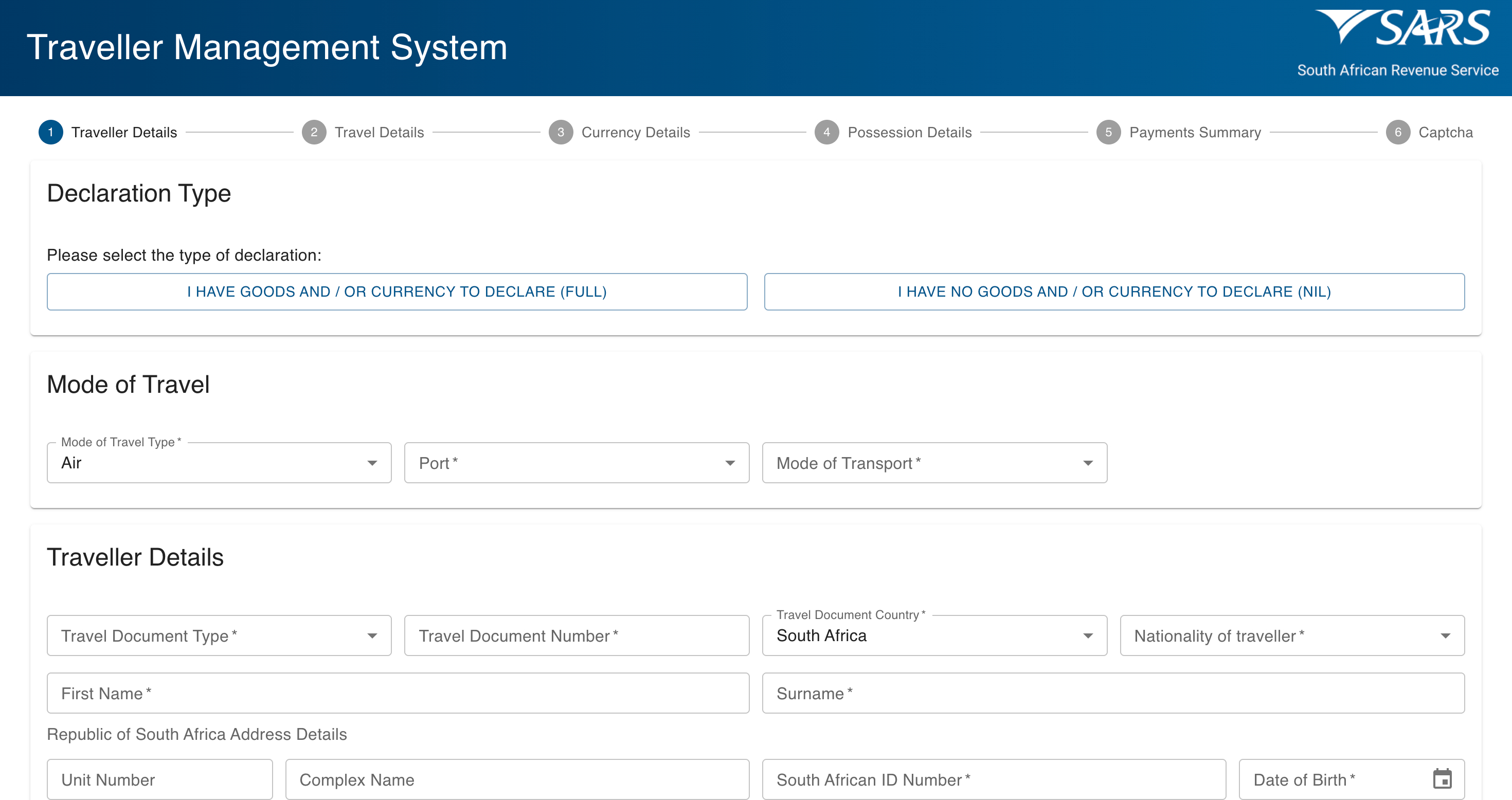
• the SATMS mobile app, available on iOS and Android;
• QR codes displayed at airports and border posts;
• self-service kiosks installed at all major entry points.
The form offers two tracks. Travellers carrying nothing out of the ordinary simply file a “Nil” declaration—a process that takes about two or three minutes. If you are carrying currency above the limits, commercial samples, or goods that exceed duty-free allowances, you must complete the full declaration. In both cases SARS sends an instant email or SMS confirmation: keep it on your phone or printed as your customs receipt.
What needs to be declared?
Your personal effects (clothing, camera, laptop intended for your own use during the trip) do not need to be declared. SARS focuses on anything else:
• Currency and negotiable instruments: cash carried must be declared above the permitted threshold, which SARS sets at 100,000 South African rand (about US$5,600) per traveller; anything beyond that must be declared.
• Duty-free allowances on goods: each traveller enjoys a 5,000 rand (≈US$280) duty-free allowance plus another 20,000 rand at a flat-rate duty. Above 25,000 rand (≈US$1,400) standard duty and VAT apply. These allowances are individual and cannot be pooled across family members.
• Commercial goods: samples, stock or goods intended for resale must always be declared in full, with supporting documents.
Our agency advises travellers carrying high-value professional equipment (drones, high-end cameras, video gear) to declare these both on departure from your home country and on arrival in South Africa. This prevents VAT-related disputes on re-entry and gives you documentary proof via your SATMS receipt.
What happens if I forget to declare before arrival?
SARS has stressed that no one will be refused entry or exit solely because of a missing declaration. Agents and self-service kiosks will be on hand at ports of entry to help you file on the spot, and paper filing remains possible if the online system or connectivity fails.
Do not mistake forgetfulness for fraud. Failing to declare restricted currency or goods, or filing a false declaration, can lead to delays, seizure or confiscation of items, and financial penalties. The leeway announced applies to the channel, not the substance of the declaration.
Mistake one rule for another: customs declaration ≠ visa
The most common confusion since the announcement has been the belief that SATMS replaces entry formalities. It does not. The declaration remains a customs matter managed by SARS:
• travellers from many countries (including France, Belgium, Switzerland and Canada) remain exempt from visa requirements for short tourist stays;
• nationalities that do require a visa must still obtain it before travel;
• South Africa is simultaneously rolling out its Electronic Travel Authorisation (ETA), a separate process administered by the Department of Home Affairs.
Think of it this way: passport and visa govern immigration, while the SATMS declaration covers customs. Confirm what rules apply to your nationality before you fly.
South Africa goes digital at the border
This digital shift comes as South Africa’s tourism industry gathers pace: according to L’Écho Touristique, the country welcomed a record 10.48 million international visitors in 2025—up 17.6 % year-on-year—with France ranking fourth among non-African source markets with more than 135,000 visitors. By digitising customs formalities ahead of the ETA rollout, South Africa is keeping company with destinations such as New Zealand, the United Kingdom and South Korea—rolling out ever-more digital border regimes in which the bulk of the paperwork is handled before boarding.
Quick answers to common questions
Is there a fee for the SATMS declaration?
No. Filing online is free, regardless of platform. Any duty or VAT payable on declared goods is settled separately.
Do children need their own declaration?
Yes. Every traveller, including infants and minors, must be covered by a declaration filed by a parent, guardian or accompanying adult on their behalf.
I’m in transit at Johannesburg—do I need to declare?
Transit passengers who remain airside in the international zone are exempt. If your connection requires you to clear immigration (airport change, baggage reclaim), the declaration becomes mandatory.
Can I file a week before departure?
No. SARS only accepts submissions within the last 24 hours before departure on the final leg into (or out of) South Africa.
Does this declaration replace the visa or ETA?
No. It is an additional requirement that sits alongside your immigration formalities, which are unchanged and still depend on your nationality.

As CEO of Visamundi, I am dedicated to simplifying international travel by assisting our clients in obtaining visas worldwide. By staying at the forefront of ever-changing regulations, I ensure our agency remains a trusted pillar in the visa services industry.
Get our visa news first in your Google results: add Visamundi to your preferred sources.
