TSA Weighs Ending Liquid Rules for Carry-On Bags
US officials are considering lifting limits on carry-on liquids to ease airport security checks. New tech and EU discussions on liquid scanners could soon relax rules for travelers.
·
The US Department of Homeland Security (DHS) has hinted it may remove restrictions on the amount of liquids allowed in carry-on bags during airport security screenings. Speaking at a press conference hosted by The Hill, Secretary Kristi Noem described such a change as “the next big announcement” in the ongoing review of Transportation Security Administration (TSA) policies.
New security screening procedures under discussion
This potential shift follows a series of recent rule adjustments, including the TSA’s decision to no longer require travelers to remove their shoes, expanded perks for military personnel, and dedicated family lanes in some airports.
Currently, passengers are limited to containers of about 100ml of liquids in a clear plastic bag. However, the TSA has not specified whether the policy would be fully scrapped or simply adjusted to allow larger volumes. According to Forbes, some limits may remain, or no changes could occur if the review does not yield results.
Secretary Noem expressed optimism, stating that emerging technologies may soon allow the TSA to maintain high security standards while streamlining procedures, making the traveler experience smoother and less cumbersome.
EU exploring new liquid detection technology
Discussions are underway between the European Commission and the European Civil Aviation Conference (ECAC) to deploy advanced screening equipment designed to ease security checks before passengers reach the gate. Since 2006, EU rules have restricted liquids in carry-on luggage to 100ml containers, except for medications, baby food, or special dietary products.
An easing of these rules is expected with the introduction of innovative scanning technology capable of analyzing larger containers. Tests were conducted in June 2025 at Rome and Milan airports. If approved by the European Union, the new equipment will be rolled out across other European airports.
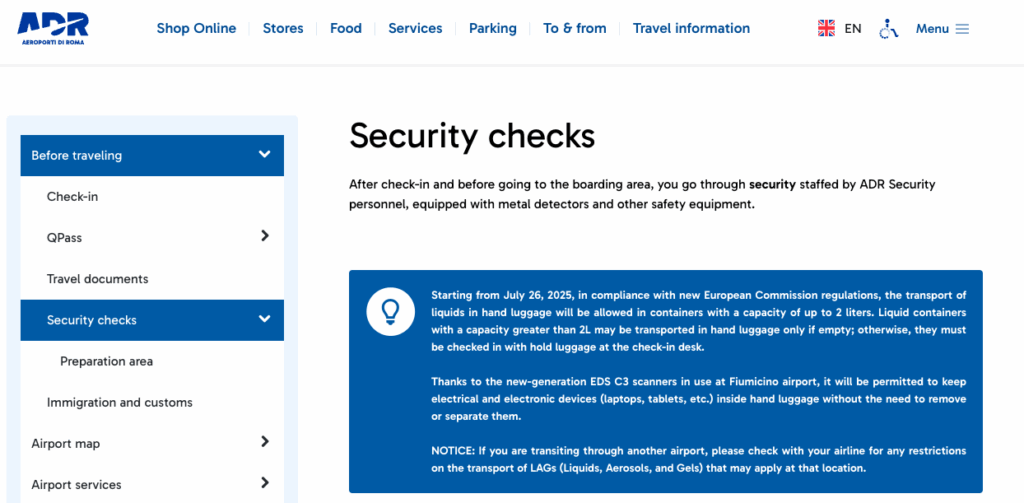
Implementation at Rome Fiumicino Airport Leonardo da Vinci
Ahead of any rollout, travelers should verify eligibility for the new procedures by checking the airport’s official website or contacting their airline, as the measures do not apply to all flights to or from the destination.
Get our visa news first in your Google results: add Visamundi to your preferred sources.
