
US ESTA Under Threat: Will Americans Require Visas Again Soon?
The US could reinstate visa requirements for EU travelers by the end of 2026 if Brussels fails to meet Washington’s demand for expanded border-security data sharing via the EBSP.
Is the era of frictionless travel to the United States reaching its finale for European Union citizens? The Biden administration has issued a stark ultimatum to Brussels: sign up to the Enhanced Border Security Partnership (EBSP) by 31 December 2026, or lose access to the Visa Waiver Program (VWP) and the ESTA travel authorization that currently streamlines transatlantic trips.
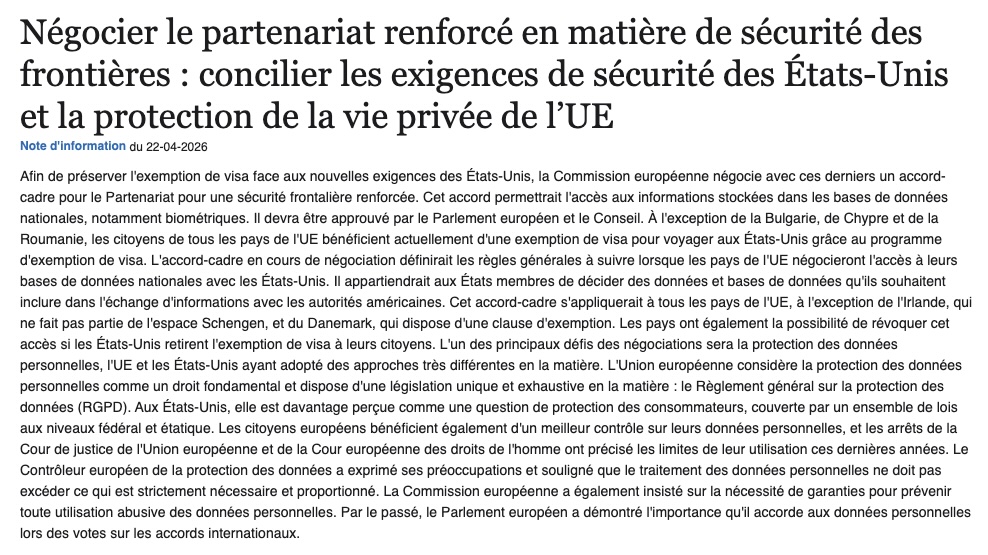
Official European Parliament document
What is the EBSP and why is the US demanding it?
Under the current U.S. Visa Waiver Program, passport holders from 24 EU countries can enter the United States for tourism or business without applying for a full visa. Instead, they simply complete the quick online ESTA form, paying a $21 fee and obtaining approval within minutes in most cases.
Washington now wants the EU to sign the Enhanced Border Security Partnership (EBSP). The core of the demand is direct, algorithmic access for U.S. Customs and Border Protection (CBP) to the national police databases of every participating EU member state.
If the agreement proceeds, CBP officers would be able to cross-reference ESTA applicants with:
biometric data (fingerprints and facial-recognition images)
national criminal records
broader “look-out” watch-lists that include mere suspects or persons of interest—not just those convicted of crimes
Deadline: 31 December 2026. Should no bilateral deal be in place by then, the ESTA route could be suspended for any European state that refuses to share data under the EBSP framework.
Data-protection clash: EU vs. EBSP
The U.S. proposal collides head-on with Europe’s GDPR landscape. Wojciech Wiewiórowski, the European Data Protection Supervisor (EDPS), and independent watchdog groups such as Statewatch warn of three concrete risks:
Unprecedented biometric sharing: This would be the first time EU governments would be compelled to export personal data on such a scale to a third country for border-control purposes.
Automated decision-making: The U.S. intends to use algorithmic “risk-profiling” systems that could blanket or block travelers with little or no human oversight.
Political chilling effect: Activists, campaigners or individuals with dissenting views could find themselves blacklisted without robust redress mechanisms.
The end of ESTA: what it means for travelers
If Brussels and Washington fail to resolve their differences, European visitors face a sharp regression in travel logistics after the 2026 deadline.
Euroscheules’ senior analyst: “Moving from the nearly instant ESTA clearance to a full B1/B2 visa isn’t an administrative footnote—it dismantles same-day business travel and spontaneous holiday plans across the Atlantic.”
The practical fall-out would be sweeping:
Cost: ESTA costs $21; standard B1/B2 visas run $185.
Timing: Visa applicants must complete the lengthy DS-160 form and attend in-person interviews at U.S. embassies or consulates—creating weeks- or months-long backlogs.
Transits: Even a simple lay-over in the U.S. (heading on to Canada, Mexico or Latin America) could suddenly require a visa.
Europeans are not the only ones who will feel the pinch. Our agency serves countless international travelers (Africa, Asia, the Middle East, Latin America). Those who already need visas may think the ESTA saga does not affect them, but they are mistaken: if tens of millions of Europeans lose ESTA access they will flood local U.S. consulates (Paris, Brussels, Geneva, Berlin…) Result: consular appointment queues that already stretch to weeks or months could explode for every international applicant regardless of nationality.
This episode also underscores a wider global shift toward biometric border hardening. Recall that Europe is rolling out its own Entry/Exit System (EES) today and is set to launch ETIAS—essentially a European ESTA—from late 2026. The age of border crossing based solely on a physical passport is definitively over.
Action plan: preparing for a post-ESTA reality
The 31 December 2026 window still offers breathing space. Practical steps to future-proof trips right now:
Check current ESTA validity: Once granted, ESTAs are usually valid for two years. Authorizations approved before any possible shutdown could remain valid—but only at the discretion of the U.S. Department of Homeland Security.
B1/B2 applicants: Do not wait. If you must renew or obtain a U.S. visitor visa from a European capital, start the process immediately; service capacity is already strained.
Reroute your itineraries: Any upcoming trips that include even a transit stop in the U.S. should be reviewed. Explore overland or Middle-East routing options to avoid the risk of U.S. transit complications.
👉 Visit our Americas news blog for updates as this situation evolves.
En tant que chargée de relation client, mes missions sont la gestion et le suivi des demandes de visas. Je reste informée des actualités concernant les nouvelles formalités de voyage ainsi que les spécificités des nouveaux visas.
