Venezuela after Maduro’s capture: what travelers need to know
Cascading flight cancellations, locked airspace, and passport uncertainty: here’s what to expect after Nicolás Maduro’s capture and the escalating crisis in Venezuela.
·
The U.S.-led military operation that resulted in the capture and exfiltration of Venezuelan President Nicolás Maduro and his wife Cilia Flores has thrown travel formalities to and from Venezuela into disarray and heightened danger.
Cancellations snowballing into revoked airspace, questionable passport validity, and closed consulates — this is what anyone planning a trip to the region needs to know right now.
Venezuela’s airspace: a de-facto no-fly zone
If you had a ticket to Caracas this week, expect to stay home. Within hours of the operation, aviation authorities worldwide moved swiftly to sever Venezuela from international flight paths.
The aviation blackout
Immediately after the news broke, the FAA banned all U.S. carriers from entering Venezuelan airspace (Maiquetía FIR), citing severe security risks. Europe quickly aligned: the European Union Aviation Safety Agency (EASA) issued alert bulletin CZIB 2026-01, urging European airlines to avoid the area due to the risk of misidentification by air-defense systems.
Tumbling commercial flights
Passengers are paying the price:
Air France canceled all Caracas flights, triggering knock-on cuts to connections via the Antilles (Fort-de-France, Pointe-à-Pitre).
Copa Airlines, a key hub for Central-American transfers via Panama, suspended operations, leaving many stranded without viable alternatives.
Spanish carriers Iberia and others grounded aircraft serving Venezuela overnight.
The ripple across the Caribbean: the problem extends beyond Venezuela itself. Because regional airspace is contiguous, major tourist hubs like Aruba, Puerto Rico and Curaçao saw hundreds of cancellations over the weekend—planes unable to traverse normal secured corridors.
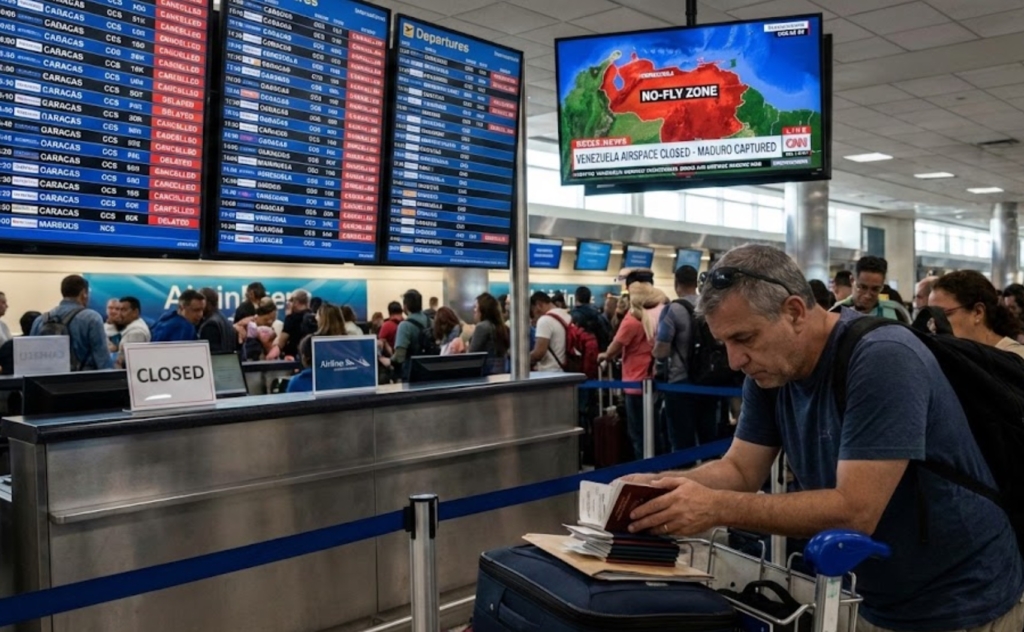
Screenshot: restricted airspace over Venezuela
Land borders: tight lockdown now in effect
What’s closed in the sky is mirrored on the ground: Venezuela’s historically porous yet conflict-rife land borders are now militarized choke points.
Colombian side: Activity across the Simón Bolívar international bridge—an emblem of Colombian-Venezuelan relations—has fallen to record lows. Authorities in Bogotá have deployed extra troops ordered by President Gustavo Petro, while the situation inside Venezuela remains volatile; the crossing has effectively shut.
Brazilian side: Brazil has activated contingency plans along its northern frontier, anticipating migrant surges or spill-over threats.
Travel advisory: Do not attempt to cross Venezuela’s land borders by any means—official or unofficial. The famous “trochas” (illegal paths) now lie in active war-zone-style danger given elevated military alert levels.
Are Venezuelan travel documents still valid?
Presidential change often throws legal recognition of official documents into flux.
Passports: a moving target
For dual nationals or Venezuelans living in Europe, passport validity has become a moving target:
United States: Washington recognizes Venezuelan passports as valid for 10 years past the printed expiration date, pursuant to a standing decree.
Panama: A 2025 decree (Decree No. 20) extends expired passports through February 2026.
Europe/France: Exercise extreme caution. Absent formal guidance post-3 January, carriers retain the right to deny boarding if your passport is past expiry—even in countries that previously tolerated overdue passports.
U.S. visas: total freeze
The Trump administration, hours after the operation concluded, issued Presidential Proclamation 10998 (effective 1 Jan 2026) suspending visas such as B-1/B-2, F, and J for Venezuelans until further notice. Embassies have suspended operations or are non-operational, rendering new U.S.-bound visas impossible for now.
Consulates: “Closed for business”
The French Embassy in Caracas instructs citizens to stay home until further notice. Routine consular services are halted. Equally, do not rely on Venezuelan missions abroad (for example, the mission on Rue Copernic in Paris) for urgent paperwork: loyalties are shifting, and documents issued today may be void tomorrow.
Travel insurance and the “act of war” clause |
As CEO of Visamundi, I am dedicated to simplifying international travel by assisting our clients in obtaining visas worldwide. By staying at the forefront of ever-changing regulations, I ensure our agency remains a trusted pillar in the visa services industry.
Get our visa news first in your Google results: add Visamundi to your preferred sources.
