Venezuela Launches E-Visa: Who Is Eligible?
Breakthrough e-Visa system eliminates consular red tape for Venezuela-bound travelers—here’s who qualifies, how it works, and hidden pitfalls to avoid.
For eleven years, securing a Venezuela visa was a Herculean task. An American had to fly to Mexico. A Canadian waited six weeks. A Peruvian bounced between shuttered consulates, phantom appointments, and a paper form that looked straight out of the previous century. Then, on April 9, 2026, Venezuela’s Ministry of Foreign Affairs quietly launched an online portal called Cancillería Digital. In a few clicks, a country once famed for Latin America’s most inaccessible visa became a fully digital model overnight.
It’s a development that has flown beneath the radar of major travel outlets—because it concerns a destination to which most Western governments still advise caution. Yet for the first time since 2015, tens of thousands of travelers—businesspeople, journalists, members of the Venezuelan diaspora, humanitarian workers, and intrepid tourists—can finally apply for a visa without relying on an embassy that, in many cases, no longer exists.
Here’s everything you need to know: what the official communiqués do and don’t cover, plus what our team uncovered after dissecting the new system.
The problem this e-Visa fixes
To grasp the change you must first understand the past. Since 2015, Venezuela progressively imposed visas on citizens of countries with strained diplomatic ties: the United States (March 2015), Panama (2017), Guatemala (2018), Canada, Peru, Chile, and Ecuador (2019).
Officially, a consular process existed; in reality, many of those consulates closed or operated at a crawl. Venezuela’s embassy in Washington, for instance, has lacked operational consular staff for years. U.S. travelers were redirected to Mexico, sometimes Bogotá, with waits that could stretch past two months.
Result: a Houston-based executive or a journalist heading to cover an election in Caracas often had no realistic option but to cancel. The 2026 e-Visa doesn’t remove every risk of traveling to Venezuela, but it removes one formidable hurdle: the administrative wall.
What the decree actually says
Operation sits with the Ministerio del Poder Popular para Relaciones Exteriores (MPPRE)—not Venezuela’s immigration authority SAIME—for now channeled through a single gateway: cancilleriadigital.mppre.gob.ve.
The key figures, corroborated by immigration consultancy Fragomen and specialist media VisaVerge:
Available categories: tourist and business visa
Validity: 1 year
Entries: multiple
Maximum stay: up to 90 days per entry, at the discretion of the immigration officer
Processing time advertised: ~15 days (down from six weeks under the old system)
Expected fee: ~180 USD (€156.01) up from the previous ~60 USD
Format: downloadable PDF with embedded QR code sent by e-mail
No physical sticker is placed in the passport. Applicants print a color copy and save a digital file; the QR code is scanned at check-in by the airline and again by Venezuelan immigration on arrival.
Who actually needs it?
Precision matters. Venezuela runs an asymmetrical visa policy that can catch travelers off guard.
No e-Visa required: most of Europe (EU, UK, Switzerland, Norway), Mercosur countries (Argentina, Brazil, Uruguay, Paraguay, Bolivia, Mexico, Colombia), parts of Asia (Japan, South Korea, Malaysia, Indonesia), plus Australia, New Zealand, Russia, Turkey, the Gulf states, and those on short-stay waivers for up to 90 days without pre-travel formalities.
E-Visa required for:
United States (since 2015)
Canada (since 2019)
Peru (since 2019)
Chile (since 2019)
Ecuador (since 2019)
Panama (since 2017)
Guatemala (since 2018)
Taiwan
African nationals
Other nationalities previously subjected to consular visas
If your passport isn’t on the white list and isn’t in the list above, verify before booking. Rules can flip overnight according to regional diplomacy.
Step-by-step guide
The portal interface is in Spanish. An English module exists but is incomplete; critical buttons remain in Spanish. Use a translator if Spanish isn’t your strong suit.
1. Create an account on cancilleriadigital.mppre.gob.ve.The e-mail address becomes your dossier identifier; avoid shared mailboxes.
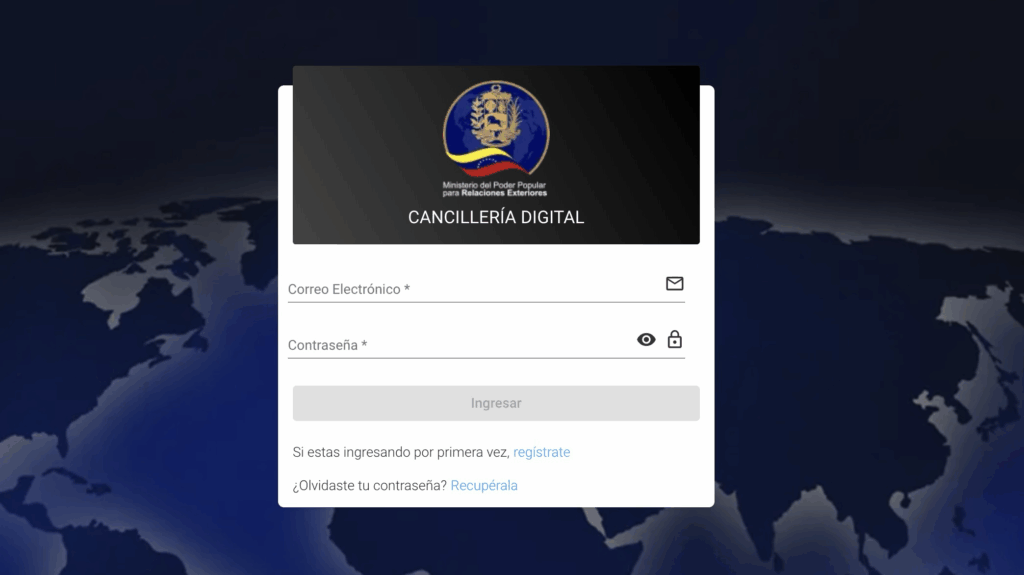
2. Select Turista (Tourism) or Negocios (Business). The form adapts itself. A corporate invitation letter bearing a Venezuelan RIF number (the local SIRET equivalent) is mandatory for business visas.
3. Complete the form. Every field must match your passport exactly. One typo in passport number or birth date invalidates the final document; no editing is permitted after issuance.
4. Upload supporting documents:
Scanned biometric passport page (minimum six months’ validity beyond return date, two blank pages)
Recent passport-style photo, white background
Hotel reservation or host letter
Outbound or onward ticket
Travel itinerary
Business trips: official invitation letter
Proof of funds (bank statements)
Travel insurance (strongly recommended, sometimes checked on arrival)
5. Pay the fee of ~180 USD via the built-in checkout. Fees are non-refundable even if the application is refused. Proofread twice—or use an accredited advisor like Visamundi.
6. Wait.The advertised turnaround is 15 days. Volume in the first weeks swung from 72 hours to three weeks; budget a full month’s buffer before departure to stay calm.
7. Receive the PDF, print in color, keep both a paper copy and a smartphone version. The airline verifies the QR code at check-in; without it, boarding is denied.
Communiqués don’t mention these blind spots
Three often-overlooked issues can turn a smooth application into a logistical nightmare.
Entry is never guaranteed. The immigration officer at arrival—typically Simón Bolívar International Airport in Maiquetía—holds final say. Bring original hotel and return-flight documents plus financial proof, and be ready to explain your trip concisely. U.S. citizens report especially thorough interviews, sometimes extended detentions.
The QR code is your new weak link. Digital-only visas mean any hiccup at the verification terminal can strand you at boarding. Print on two color pages. Keep two digital backups (cloud + phone). Travelers in the first month had scan failures when printouts were black-and-white or low quality.
International payments fail more often than you think. The gateway accepts global cards, yet many North American banks auto-block transactions to Venezuelan entities for sanctions-compliance reasons. Notify your bank before retrying and log the transaction reference—the single most-frequent friction point reported to date.
The elephant in the room: security
No honest travel guide to Venezuela skirts the security paragraph. At the time of writing, virtually every major Western government advises against non-essential travel. The U.S. State Department lists Venezuela at Level 4 (“Do Not Travel”) and flags the risk of arbitrary detention of American citizens. Canada has suspended most consular assistance on the ground. The UK and Australia mirror these sentiments.
Security realities are uneven: acute political tensions, high urban crime, intermittent fuel rationing, sudden border closures and airspace restrictions. Several carriers have reduced or suspended service.
Read the latest official advisories before hitting “pay”:
If you proceed, secure travel insurance that explicitly covers Venezuela—including medical evacuation. Most standard policies exclude it.
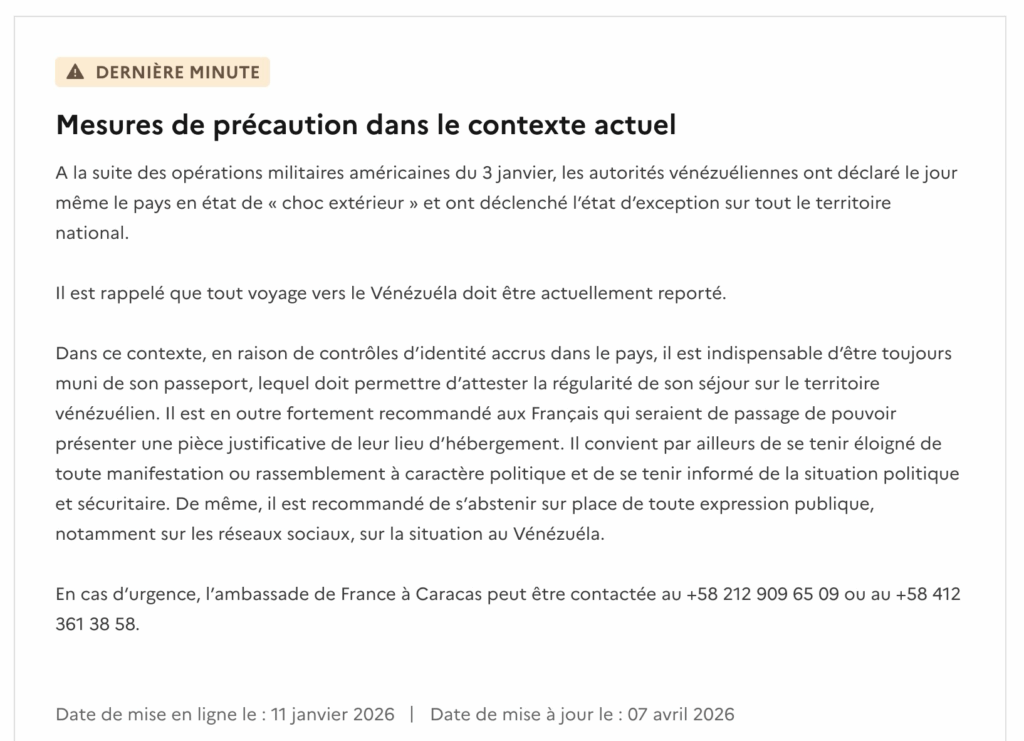
France Diplomatie continues to strongly discourage travel to Venezuela
Who actually benefits?
Beyond the sheer adventurer, several concrete profiles gain new mobility:
Venezuelan diaspora members in the U.S., Canada, Peru or Chile—many of whom haven’t seen family in Caracas, Maracaibo or Mérida for years. For them, the e-Visa is the first viable route in half a decade.
Journalists and researchers tracking regional politics who needed a fast lane; the dedicated press visa channel isn’t yet digitized, so the business visa doubles as a workaround for short trips.
Humanitarian operators working with NGOs on health and food crises.
Energy and infrastructure investors whose Caracas stopovers can be pivotal despite the headwinds.
Adventure travelers drawn by Gran Sabana, Orinoco Delta, Los Roques archipelago or Roraima’s tepui summits—they remain spectacular even as infrastructure buckles.
FAQs
How long can I stay on an e-Visa?
Up to 90 days per entry. The e-Visa itself is valid one year, so you can make multiple trips provided no single stay exceeds 90 days.
Can I work on this visa?
No. It covers tourism and short professional activities (meetings, negotiations, conferences). Paid employment requires a separate work visa—not yet available on the portal.
Does my child need their own e-Visa?
Yes. Each traveler, regardless of age, must possess their own passport and e-Visa. Minors traveling with one parent should carry a notarized parental authorization and a Spanish-translated birth certificate.
What if my application is refused?
Fees are non-refundable and reasons are rarely given. Identify likely shortcomings (data mismatch, poor scans, insufficient funds) before re-applying.
My passport expires in seven months—is that enough?
Technically yes (six-month rule). In practice, renew your passport before you apply: some Venezuelan immigration officers enforce the rule rigidly and you’ll dodge the need to redo an e-Visa tied to an expiring book.
How far in advance should I apply?
Minimum four weeks. That buffer covers payment glitches, document requests, or longer-than-expected processing.
Can I use a service provider?
Absolutely. Recommended for non-Spanish speakers, complex cases (business visas, minors, extended stays), or simply to avoid the quirks of Venezuela’s government interface. Visamundi handles document prep, photo compliance, submission and tracking all the way to PDF delivery.
Venezuela has swapped, in weeks, one of Latin America’s most cumbersome visa rules for arguably one of its most modern on paper. The process is fast, traceable, and accessible from anywhere. For the nationalities who need it, it’s transformative. |