Applying for ESTA for the U.S.: New Strict Document Quality Requirements
The U.S. has tightened ESTA requirements with mandatory biometric selfies and stricter identity verification rules. Learn what’s changing, how to comply, and avoid last-minute travel disasters.
·
The process for traveling to the United States without a visa has just gotten stricter. U.S. authorities have officially added a new biometric step to the Visa Waiver Program (VWP): the mandatory upload of a passport-style photo or a live selfie when applying for an ESTA.
Until recently, obtaining an Electronic System for Travel Authorization (ESTA) to visit the United States was a purely declarative and documentary process. Following updates to protocols by U.S. Customs and Border Protection (CBP), travelers from the 42 visa-exempt countries must now prove their identity in real time. This requirement, initially tested in the ESTA mobile app, has now been rolled out across all submission platforms.
Why has the U.S. government introduced this verification?
The addition of facial recognition in the ESTA application isn’t an isolated move—it’s part of a broader overhaul of U.S. border security measures. Three major factors are driving this change:
Combating identity theft and fraud: The algorithmic comparison between the biometric chip in your passport and the live photo ensures authorities can rule out the use of stolen or forged travel documents.
System harmonization: CBP has aligned the official website’s process with its mobile app (where live photos were already required), creating a unified digital workflow for its agents.
Accelerating “Seamless Travel”: By integrating biometric identification at the online application stage, the U.S. aims to streamline physical border checks at airport gates, mirroring systems already in place in Singapore or Dubai.
Getting Your “ESTA Selfie” Right: Strict Tips to Follow
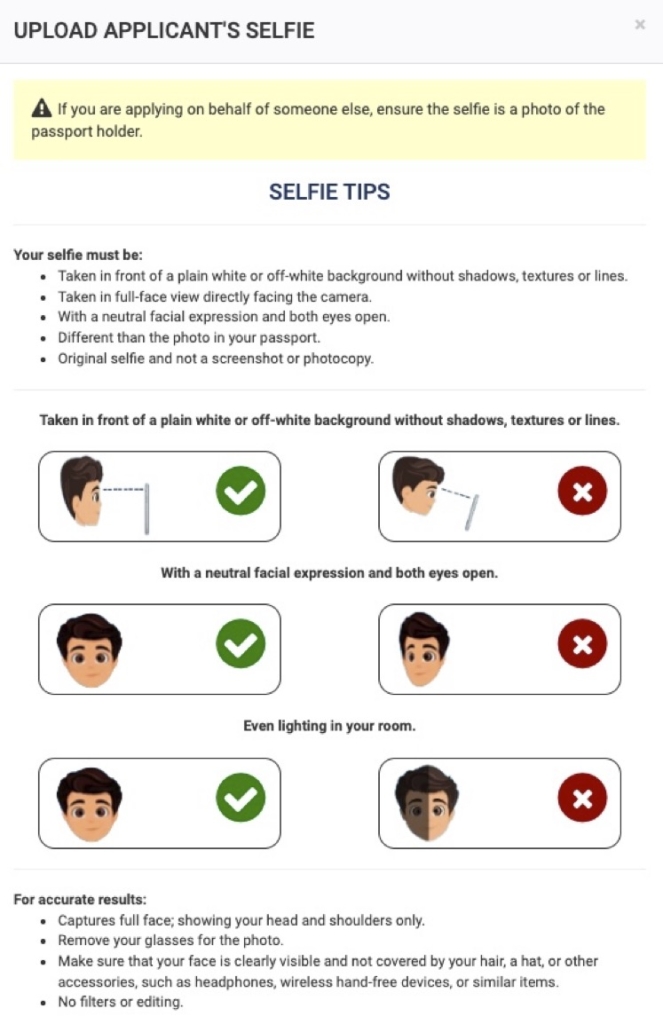
A selfie rejected by the U.S. government’s algorithm will immediately block your ESTA application. This isn’t a casual phone snap—it must meet the ICAO (International Civil Aviation Organization) biometric standards.
Here’s how to get it right the first time:
Keep it natural: No filters or digital enhancements. The image must be unaltered.
Use a neutral background: Stand against a plain wall, ideally white or very light-colored, with no objects or people in the frame.
Even lighting: Avoid shadows on your face. Position yourself facing a natural light source.
Clear face visibility: Remove glasses (even prescription), hats, caps, and masks. Your eyes must be fully visible and open.
Classic framing: Only your head and the top of your shoulders should appear.
Does This Apply to You?
If you hold citizenship in one of the 42 Visa Waiver Program (VWP) member countries—including most of the European Union, the United Kingdom, Australia, Japan, and Chile—and you’re planning a tourist, business, or transit stay of under 90 days in the U.S., then yes, this applies to you.
If your nationality isn’t covered by the VWP, this update to the ESTA process won’t affect you. You’ll remain subject to the standard B1/B2 visa application process (which requires an in-person interview at a U.S. embassy and fingerprinting).
💡 Insight from our team: Plan ahead
Adding the live selfie step slightly increases your prep time and requires a smartphone or a computer with a high-resolution webcam at the time of application.
Don’t let a framing or lighting error derail your travel plans. Given the rigidity of U.S. systems, many travelers find themselves locked out just days before departure for something as simple as an image’s shadow. By using our guided ESTA services, we check not only that your administrative data is compliant, but we also ensure your biometric files meet the requirements of U.S. Customs and Border Protection (CBP) before official submission.

Get our visa news first in your Google results: add Visamundi to your preferred sources.
