Latvia’s New ETA Requirement Takes Effect Today
The Republic of Latvia has implemented a new Electronic Travel Authorisation (ETA) for certain foreign nationals, including some visa-free and transit travelers, as of September 1, 2025.
·
The Republic of Latvia is tightening entry procedures with the introduction of a new requirement for some international travellers. Effective today 1 September 2025, the country has rolled out a mandatory Electronic Travel Authorisation (ETA).
This urgent rollout follows an announcement by the Latvian government just six days prior, on 29 August 2025.
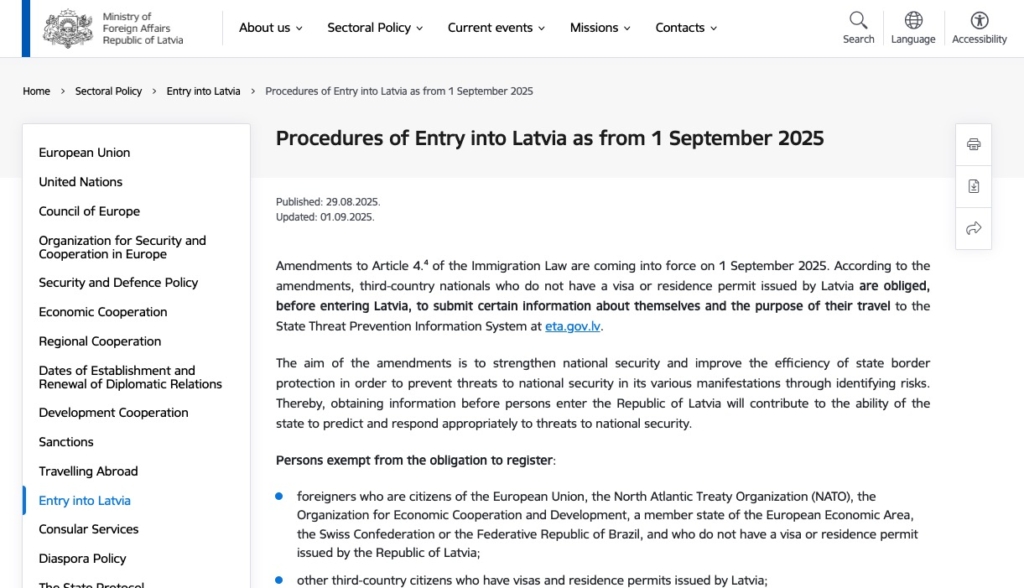
Official announcement of Latvia’s new ETA from the government portal.
As a national measure distinct from the forthcoming European ETIAS system, the ETA aims to bolster national security while improving border-protection efficiency. It will screen travellers to identify and pre-empt risks to state and public security. The two systems will initially operate side-by-side, and while their future alignment remains unclear, a temporary coexistence period may occur.
What is Latvia’s Electronic Travel Authorisation (ETA)?
Latvia’s ETA is an online form that travellers must complete in advance. Crucially, successful submission does not guarantee entry; it remains a declaration supporting national screening and does not replace valid travel documents.
After submitting the form, travellers receive an acknowledgement email; a second confirmation arrives within 48 hours if the submission is approved. Applicants are advised to apply 2–3 days before departure.
Who must apply for Latvia’s ETA?
The requirement applies to nationals of any non-EU/EEA/NATO/OECD/Swiss/Brazilian passport who do not hold a Latvian-issued visa or residence permit.
Specific groups covered include holders of a valid Schengen visa or residence permit issued by another EU state, even if in transit through Latvia. Russian and Ukrainian citizens are explicitly named: Russians with residence permits from other EU countries (e.g., Estonia) must still apply, and Ukrainians without a Latvian-issued permit are also liable.
Changes primarily affect citizens of Russia, Belarus, China, and a wide range of Asian and African countries, including India, Pakistan, Nigeria and South Africa.
Who is exempt?
Exemptions cover citizens of EU/EEA/NATO/OECD/Swiss/Brazilian passport-holders, plus Albania, Australia, Canada, Chile, Colombia, South Korea, Mexico, New Zealand, the UK, Turkey, among others.
Latvian visa or residence-permit holders are exempt, as are holders of diplomatic immunity under international law and personnel on official or technical support missions. Stateless individuals and anyone already physically present in Latvia before 1 September 2025 are also unaffected.
How and when to submit
Applications must be submitted online via the official portal eta.gov.lv and filed at least 48 hours before arrival. Each applicant must complete the form personally, except minors or legally incapacitated persons, whose legal representatives may file on their behalf.
If travel plans change—itinerary, timing, or mode—the traveller must submit a new declaration at least 48 hours before entry.
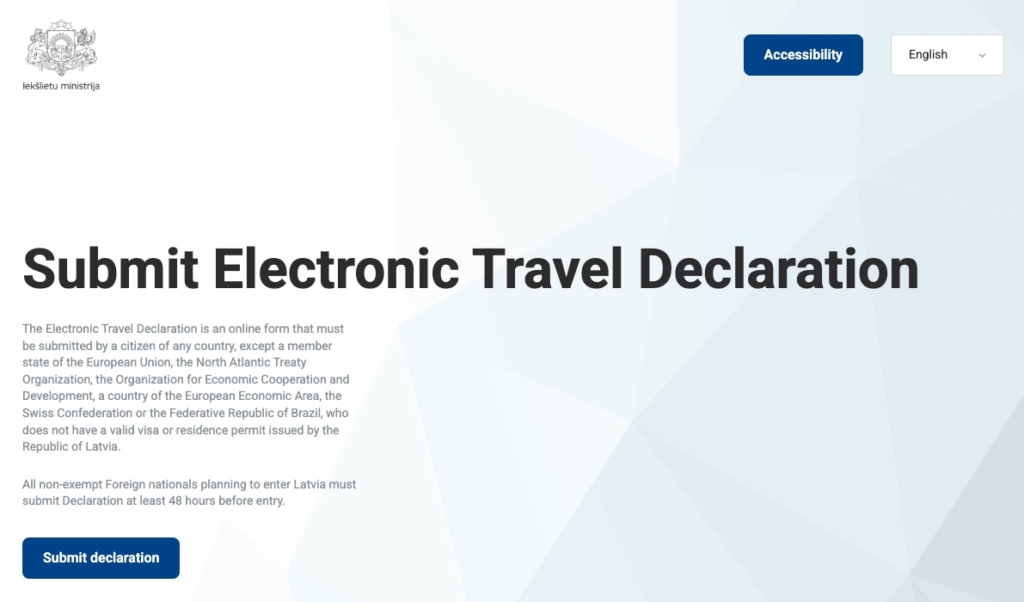
Latvia’s ETA online application portal.
Required information
The form collects personal details and passport data, travel purpose, intended length and place of stay, route, and contact information. Additional disclosures include career history and political affiliations, such as elected posts held by the traveller or close relatives, any candidacy in elections, former or current government posts, service in defence, intelligence, border guard, customs, home affairs, judiciary or foreign-affairs bodies (including diplomatic service). State Police, border guards and security institutions will have access to this information.
Failure to comply or submission of incorrect or incomplete information may result in a fine of up to €2,000. If security risks are flagged, state institutions may use existing legal instruments—including entry restrictions—to mitigate the threat. |

As CEO of Visamundi, I am dedicated to simplifying international travel by assisting our clients in obtaining visas worldwide. By staying at the forefront of ever-changing regulations, I ensure our agency remains a trusted pillar in the visa services industry.

Get our visa news first in your Google results: add Visamundi to your preferred sources.
