New Zealand triples IVL tourist tax to $100 starting October 1, 2024
New Zealand will increase its International Visitor Conservation and Tourism Levy (IVL) from 35 NZD to 100 NZD on October 1, 2024, funding sustainability initiatives and environmental conservation across the country.
Starting October 1, 2024, the New Zealand government will significantly raise the International Visitor Conservation and Tourism Levy (IVL). Originally set at 35 NZD, the fee will triple to 100 NZD (€50.38). Most international visitors entering New Zealand for stays under 12 months must pay the IVL.
Purpose and rationale behind the increase
Supporting eco-friendly tourism
The primary goal of the IVL hike is to advance sustainable tourism across New Zealand. Funds raised will support environmental preservation initiatives and upgrades to the country’s tourism infrastructure.
According to New Zealand’s Ministry of Tourism, the increase will lead to more effective management of tourism’s impact on the environment and local communities.
“A 100 NZD IVL would typically represent less than 3% of a visitor’s total spending during a trip to New Zealand, so we don’t expect it to materially affect visitor numbers,” said Minister of Tourism and Hospitality Matt Doocey and Minister of Conservation Tama Potaka.
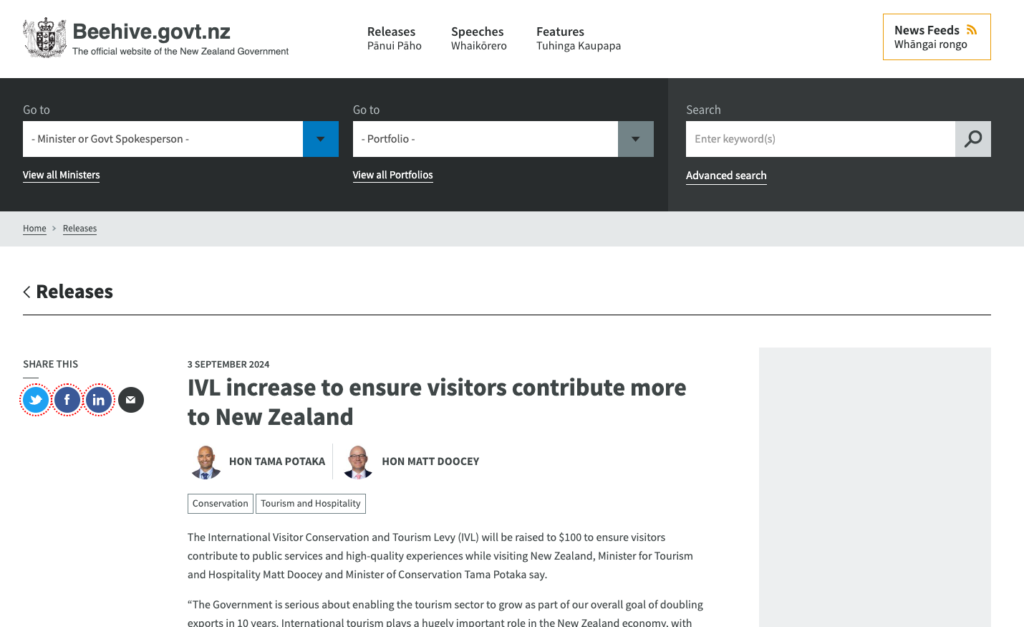
Official announcement from New Zealand authorities
The IVL is typically collected when applying for a visa or an electronic travel authority (NZeTA) for entry into—or transit through—New Zealand with baggage retrieval. These funds are managed by New Zealand Immigration.
From October 1, 2024, travelers using the mobile app to obtain their NZeTA will pay 117 NZD (€58.94), up from 52 NZD, while online applications will cost 123 NZD (€61.96), up from 58 NZD.
Exceptions and specific cases
Certain categories of travelers are exempt from paying the IVL, including:
Australian citizens
Australian permanent residents
Nationals from Pacific Island Forum countries (excluding New Caledonia and French Polynesia)
Holders of diplomatic, military, medical, or humanitarian visas.
Impact across visa categories
Working Holiday Visa
The Working Holiday Visa fee will also increase to 770 NZD, comprising a 670 NZD visa fee and a 100 NZD IVL.
Student Visa
Short-term international students (under 12 months) will face higher levies, while those enrolled in longer-term programs are exempt.
Global comparison
New Zealand is not the only destination implementing tourist taxes. Relevant examples from popular travel destinations include:
Japan (1,000 yen), Bali (150,000 Indonesian rupiah), Venice (€3–10, depending on season), Bhutan (US$200–250 per day), or the Galápagos Islands (US$100).
Allocation of additional funds
The New Zealand government has outlined how the higher IVL revenue will be used. Key investment areas include:
Investment Area | Allocation | Estimated Amount (in million NZD) |
|---|---|---|
Biodiversity conservation | 35% | 70 |
Tourism infrastructure | 30% | 60 |
Waste management and recycling | 15% | 30 |
Tourism education and training | 10% | 20 |
Research and innovation | 10% | 20 |
According to New Zealand’s Ministry of Economic Development, the increase is expected to generate an additional ~US$200 million annually based on 2025 visitor forecasts. These resources are intended to play a key role in funding sustainable tourism and conservation projects.
However, regional vice-president of IATA for North Asia and Asia-Pacific, Dr. Xie Xingquan, cautions that higher traveler fees may hinder New Zealand’s tourism recovery, potentially reducing the country’s competitiveness as a destination and prolonging sector challenges beyond 2026.