U.S. Will Now Verify Social Profiles for ESTA Travel Authorization
The U.S. will now screen ESTA applicants’ social media activity as part of expanded border-security checks, requiring travelers to submit five-year social media profiles and additional personal data. Travelers must also provide biometric exit confirmation via the CBP Home app.
·
The U.S. border-screening process is undergoing a major shift. American authorities will now verify travelers’ social media histories as part of the ESTA application process—marking a significant expansion in domestic-security protocols.
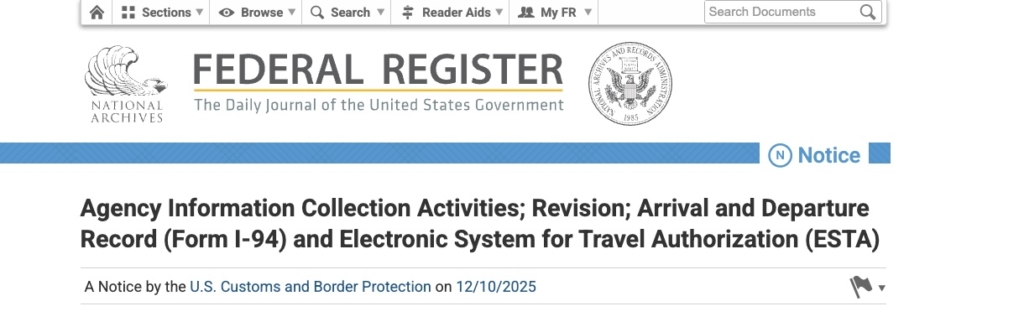
A notice published in the Federal Register, the official journal of the U.S. federal government, confirms that the Department of Homeland Security and U.S. Customs and Border Protection have revised the I-94 Arrival/Departure Record form and the Electronic System for Travel Authorization (ESTA). Since 12 October 2025, authorities have had 60 days to implement new screening measures.
These changes specifically target the ESTA travel-authorization procedure. Recipients of the Visa Waiver Program (VWP)—travelers from eligible partner nations—are already required to obtain ESTA clearance, but the U.S. government is adding a document inspection layer focusing on an applicant’s digital footprint.
Key updates for travelers
Single-source ESTA application via mobile app. The official web portal esta.cbp.dhs.gov is set to be phased out, leaving the CBP mobile app as the only route to submit an ESTA request.
Mandatory identity photo or selfie. Applicants must upload a passport-biographical page and provide a current photo or selfie during every ESTA submission—whether via web or app. The mobile process requires a real-time photo that is then compared against your stored image to verify authenticity.
Pursuant to Executive Order 14161—issued January 2025—“Protecting the United States From Foreign Terrorists…”—the ESTA form now requires mandatory disclosure of social-media profiles spanning the past five years.
The form is being updated to include higher-value data fields:
Phone numbers used in the past five years
Email addresses used in the past ten years
IP addresses and photo-upload metadata
Names, dates/locations of birth, and addresses of immediate family members (parents, spouse, siblings, children)
Family phone numbers used in the past five years
Work email addresses used in the past ten years
Work phone numbers used in the past five years
Under the revised I-94 departure process, travelers can confirm their exit via the CBP Home Mobile Application. A live photograph is captured, enabling U.S. authorities to record biometric departure confirmation.
Implications for international travelers
Applicants should anticipate that ESTA approval will no longer hinge solely on traditional administrative or judicial databases. The U.S. now aims to cross-reference social-media activity—posts, interactions, and affiliations—to flag high-risk travelers before departure. As America tightens its border-security criteria, travelers must comply with these enhanced measures to secure their ESTA authorization.
Looking ahead, the U.S. may add new countries to the Visa Waiver Program over the next three years, expanding eligibility for ESTA coverage.


Get our visa news first in your Google results: add Visamundi to your preferred sources.
