US Visa: How to Avoid Denial Under New Embassy Rules
The U.S. Embassy’s updated visa screening now includes mandatory asylum and security checks for temporary visa applicants, raising refusal risks for travelers from high-risk regions. Learn how to prepare for the new interview questions and consular expectations.
·
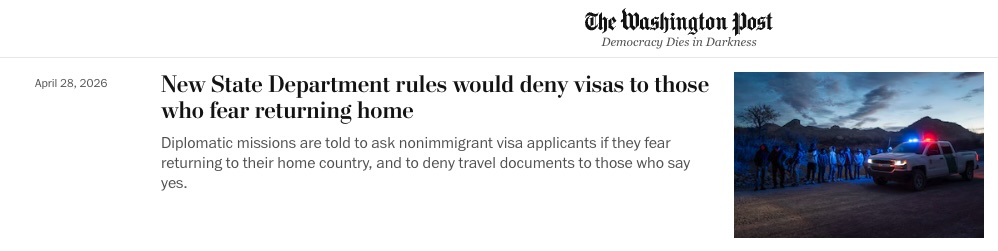
The process of obtaining a U.S. visa has just become substantially more complex. In late April 2026, an internal U.S. State Department memo surfaced, confirming a sweeping change to in-person consular interviews. Every applicant for a temporary visa now faces a strict filter tied to asylum and security conditions in their home country.
For international travelers—especially those from Africa, the Middle East, Latin America, or Asia, for whom a U.S. visa is essential—arriving at the embassy without thorough preparation is now a high-stakes gamble.
The State Department cable was first reported by The Washington Post.
What to expect during your embassy interview now
Historically, securing a U.S. visa—whether for tourism, study, or work—relied on one core principle: demonstrating strong ties to your home country to prove you wouldn’t overstay illegally. Today, U.S. officials have added a new layer. Consular officers are now tasked with assessing whether an applicant is attempting to flee their country.
Two new standard questions are now routinely posed during the interview:
“Have you suffered harm or mistreatment in your country of nationality or last habitual residence?”
“Do you fear harm or mistreatment if you were to return to your country of nationality?”
A positive or hesitant answer—or even outright refusal to respond—carries near-automatic consequences: your application will likely be denied. U.S. authorities openly aim to intercept individuals who may later seek asylum at ports of entry.
💡 Expert tip from our U.S. destination specialist
This is a legal minefield. Responding “no” constitutes perjury in front of a consular officer, which can trigger a lifetime entry ban. Speaking truthfully, however, will almost certainly result in immediate denial of your temporary visa. There is no room for improvisation when answering these questions.
Are you subject to this new directive?
The short answer is yes. Nearly 11 million non-immigrant visas are issued annually (per 2024 data), and the updated screening applies across all major categories: Tourism & Business (B1/B2): The world’s most requested visa type. Student visas (F, M): Already subject to intensified social-media vetting since 2025. Skilled workers (H-1B) and seasonal workers, who are nevertheless filling critical labor gaps in the U.S. economy.
These tightened measures mirror the current U.S. immigration climate, marked by recent presidential decrees and entry suspensions targeting travelers from more than a dozen countries. Consulates are under orders to err on the side of refusal—doubt alone is enough for rejection.
How our agency secures your ESTA application
An ESTA—the mandatory Electronic System for Travel Authorization—remains a prerequisite for visa-exempt nationalities. The entirely online process requires a clear, legible passport copy and a high-quality, neutral-background ID photo.
With U.S. authorities tightening scrutiny, filing an error-free ESTA is more vital than ever. We have overhauled our preparation strategy to incorporate the latest diplomatic requirements. Key recommendations to guarantee approval:
Document quality: Submit a pristine scan of your passport’s identity page—every character must be sharply legible. Your ID photo must be taken against a neutral background, centered on your face, with your eyes straight at the camera (remove glasses beforehand).
Social media: Provide URLs for all active profiles and ensure each is set to “public” visibility so officers can verify content if needed.
Travel history: Visits to North Korea, Iran, Iraq, Libya, Somalia, Sudan, Syria, Yemen, or Cuba after 1 March 2011 disqualify you from ESTA eligibility—even if you are a citizen of a Schengen country. The same restriction applies to nationals of these countries.
Adhering to these standards will minimize denial risk and prevent complications upon arrival. U.S. immigration rules are evolving monthly; our agency remains plugged into State Department directives to safeguard every step of your consular journey.
Get our visa news first in your Google results: add Visamundi to your preferred sources.
