
Available travel documents
Choose the visa that fits your trip. Fully online process, real-time tracking.
FUI (Entry to Rapa Nui)
Visamundi service: €39 incl. VAT
AuthorizationLost in the South Pacific, nearly 3,700 kilometres from the Chilean mainland, Rapa Nui — Easter Island — is one of the most isolated inhabited lands on the planet. Its people call it Te Pito o Te Henua, "the navel of the world", and its monumental moai have fascinated travellers for generations. But to set foot on this special territory of Chile, admiring a moai or booking a stay is no longer enough: since 2018, every visitor must first complete a fully digital entry authorisation. This document, which Visamundi refers to as the FUI (Formulario Único de Ingreso), is not a conventional visa: it is a legally framed travel authorisation, essential to safeguard an ecosystem and a cultural heritage unlike any other in the world.
01 · The essentials
The FUI: the mandatory entry authorisation for Rapa Nui
The FUI (Formulario Único de Ingreso) is the name Visamundi gives to the mandatory entry formality for the special territory of Rapa Nui. Officially, the Chilean authorities' online service is called the Sistema de Ingreso a Rapa Nui, and the document itself the Formulario de Ingreso a Rapa Nui (IRN). Whichever name is used, it is one and the same process: entirely digital and free of charge, with no government fee to pay.
It is essential to understand what the FUI is not. It is not a visa to enter Chile: your immigration status for entering the Chilean mainland (visa exemption, consular visa, etc.) remains governed by the usual rules, depending on your nationality. The FUI is added on top of those rules solely for crossing the border of the special territory of Easter Island. It is closer to an electronic travel authorisation — in the spirit of an ETA or an ESTA — than to a conventional consular visa: a prior declaration, checked before boarding, that conditions access to the island.
The purpose of this formality is directly tied to the fragility of Rapa Nui. A tiny territory, remote from everything, with limited water resources and infrastructure, the island faces growing tourism and demographic pressure. The FUI allows the authorities to regulate and monitor visitor flows, in order to protect a UNESCO World Heritage site and an indigenous community whose identity is inseparable from this land.
02 · Who is concerned
Who must complete the FUI — and who is exempt
The principle is simple and universal: the formality does not depend on your nationality. Whether you are European, North or South American, Asian, African, Oceanian — or even a Chilean citizen living on the mainland — if you travel to Rapa Nui as a visitor, you must complete the FUI before your arrival. It is the act of entering the special territory that triggers the requirement, regardless of any national lens.
This logic often surprises travellers, who are used to thinking in terms of "countries that need a visa" and "countries that are exempt". Here, that is not the question: a Chilean national from the mainland flying from Santiago for a tourist stay on the island is subject to the FUI just as much as a visitor from the other side of the world. Only certain categories of people, defined by law 21,070, are exempt from this obligation.
- Members of the Rapa Nui communityPeople belonging to the indigenous Rapa Nui people are not subject to the formality to reach their ancestral territory.
- Residents established on the islandPeople who can prove effective residence on the special territory of Isla de Pascua are exempt.
- Public officials and agents on official missionState agents travelling as part of an official mission to the island do not have to complete the FUI.
- First-degree relatives of residents and community membersThe spouse, children and parents (direct ascendants and descendants) of a resident or a member of the Rapa Nui community are exempt from the formality.
Every non-exempt visitor completes their own declaration, including minor children, who cannot be attached to a parent's file.
The FUI applies to all visitors in the same way. It does not replace or modify the entry rules for mainland Chile, which remain specific to each nationality.
The FUI is an authorisation to enter a special territory. Never equate it with a consular visa: they are two formalities of a different nature that can coexist.
03 · Before Rapa Nui
Entering Chile: the prior formality the FUI does not replace
Rapa Nui is a special territory of Chile, and every commercial flight to the island departs from Santiago (SCL). So before you even reach the FUI check, you must be admitted to Chilean territory under the country's general immigration rules. The FUI waives none of these formalities: it is added to them.
Entry conditions for Chile depend on your nationality. Many nationalities are visa-exempt for a tourist stay — the permanencia transitoria, generally granted for 90 days and extendable once through the Servicio Nacional de Migraciones (SERMIG). Others must obtain a consular visa before departure from a Chilean consulate. Check your situation against your passport: it is the first question to settle before booking a flight to Easter Island.
- Passport valid for the whole duration of the stayChile requires a passport valid for the entire stay. Nationals of Mercosur countries and Bolivia may enter with their national identity card alone.
- Proof of onward travel and of sufficient fundsAn onward ticket (air, bus) and proof of sufficient funds may be requested at immigration control.
- Tarjeta Única Migratoria (TUM): keep it until you leaveThe PDI issues a TUM on entry. Keep it for the whole stay: it is required to leave the country. If lost, a duplicate can be obtained from the PDI.
- Land entry: only through an official border postThe entry stamp and the TUM are issued only at an official border post. Entering without completing these formalities leaves the traveller in an irregular situation: fine, expulsion, or several months stuck in the country pending regularisation.
- Leaving Chile with a minorA child leaving Chile without both parents must present a notarised authorisation drawn up in Chile, or issued by a Chilean consulate — whatever the nationality of the child and the parents.
- Chileans holding another nationalityThe authorities require dual-national Chileans to enter and leave the country on a Chilean travel document; their other nationality cannot be relied upon in this respect.
04 · Timing and duration
Free of charge, submission window and length of stay
The formality is entirely free of charge: no official fee is levied for the FUI.
The online form can be submitted from 21 days before the planned entry date on the island.
The online form closes 72 hours before the flight: after that, it must be filled in on the spot, at the counter.
The authorised length of stay on Rapa Nui may not exceed 30 days.
The timeline of the formality deserves particular attention, as it is bounded at both ends. The submission window opens 21 days before the intended entry date on the island: it is impossible to submit the form any earlier. More importantly, it closes 72 hours before the flight: after that deadline the online form is no longer available and the declaration must be filled in manually at the counter on the day of departure, with all the risks that entails at check-in. Never aim for the last 72 hours: we recommend finalising your file at least 5 days before departure, so you keep a margin in case of a missing document or a correction to make.
Once on site, the maximum length of stay is 30 days. This cap, set by law 21,070, is part of regulating the human presence on a territory with limited resources. It is therefore advisable, from the planning stage, to align your entire itinerary — outbound flight, return flight and accommodation — with this duration constraint.
05 · Required documents
The documents to gather for a valid file
The FUI is based on a clear logic: proving that your stay on the island is limited in time and that you have identified accommodation. Three elements are systematically required, to which is added the acknowledgement of submission of the form itself. Consistency between these documents is decisive: a missing return ticket or a non-compliant accommodation booking is enough to jeopardise entry to the island.
- Valid passportThe travel document must be valid for the entire duration of the planned stay on the special territory.
- Non-modifiable return ticketThe booking must include a flight leaving the island. Its non-modifiable nature guarantees compliance with the 30-day maximum stay.
- SERNATUR-approved accommodation OR endorsed invitation letterEither a booking in accommodation approved by SERNATUR (Servicio Nacional de Turismo), or an invitation letter duly endorsed by the island's Gobernación Provincial.
- FUI acknowledgement of submissionThe receipt or confirmation of submission of the form, to be presented with the other documents at the pre-boarding check.
Do not take the accommodation question lightly. A booking in an establishment not approved by SERNATUR — or the absence of compliant proof of accommodation — is a direct ground for rejecting the file. And the check takes place before boarding: an incomplete file does not merely result in a refusal on arrival on the island, but in an outright denial of boarding at the departure airport. So make it a priority to verify that your accommodation is indeed on the list of approved establishments, or that you hold an invitation letter endorsed by the Gobernación Provincial.
06 · Two pathways
Arrival by air or by sea: two distinct files
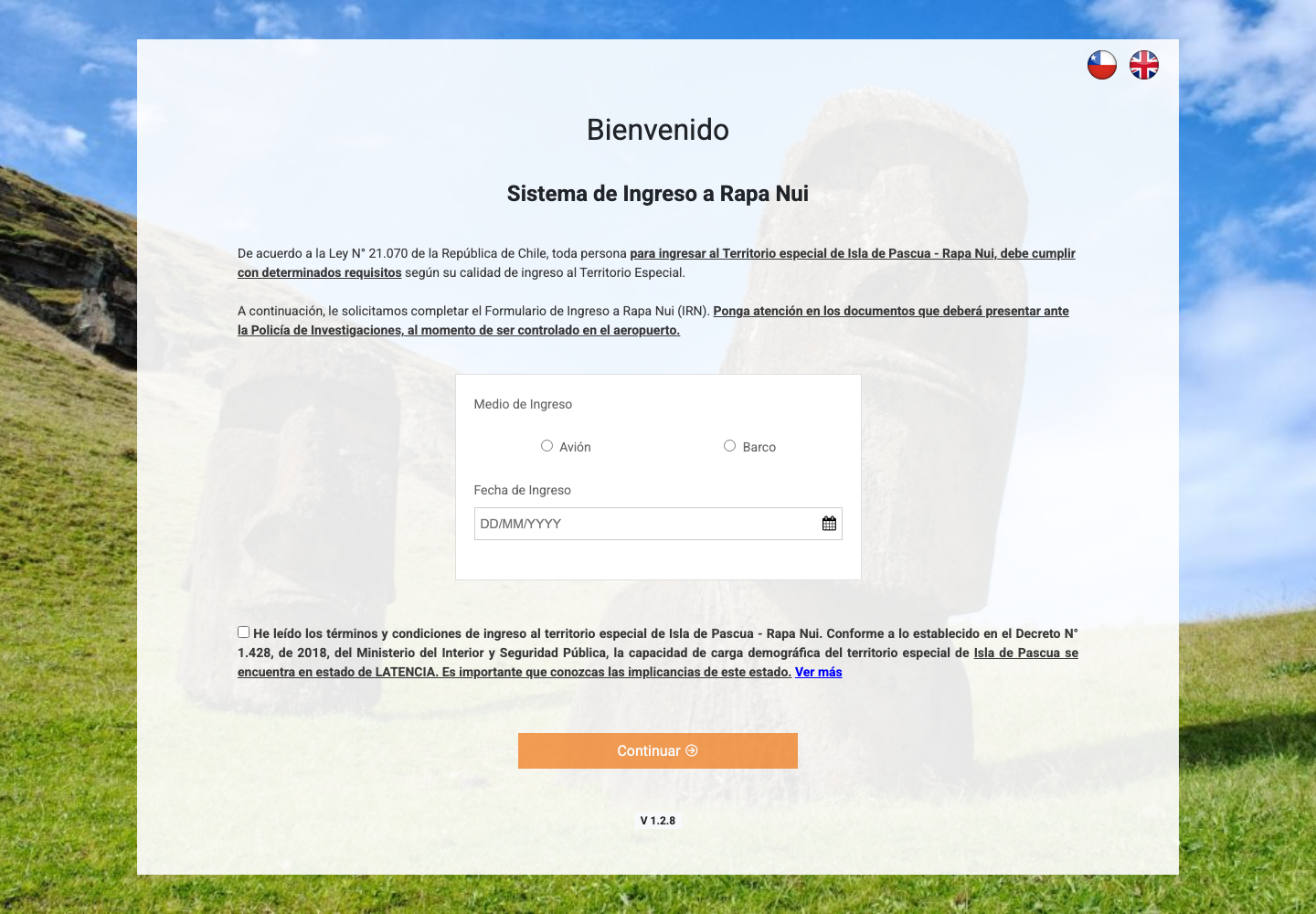
The very first question on our form determines the rest of the process: are you arriving by air (Avión) or by sea (Barco)? This choice conditions the expected supporting documents, because the two pathways do not require the same evidence.
The vast majority of visitors reach Rapa Nui by air, departing from Santiago. In that case, the file must include the flight booking (non-modifiable return) and SERNATUR-approved accommodation for the entire duration of the stay. This is the standard, and most closely checked, pathway.
Arrival by boat or on a cruise follows a different logic. The traveller must indicate the name of the vessel as well as the details of the stopover. Important point: if the nights are spent on board the vessel, no proof of land accommodation is required — the boat serves as lodging. However, any stay ashore beyond the stopover places the traveller back under the approved-accommodation regime.
- Point of departure
- Flight from Santiago (SCL)
- Ticket
- Non-modifiable return required
- Accommodation
- SERNATUR-approved for the full stay
- Check
- PDI at check-in, before boarding
- To declare
- Vessel name and stopover details
- Nights on board
- No proof of land accommodation
- Stay ashore
- Approved accommodation required beyond the stopover
- Duration
- Same 30-day cap
07 · The procedure
Completing the FUI step by step
- 1Check your eligibility
Make sure you do not fall into one of the exempt categories (member of the Rapa Nui community, resident, public agent on mission, first-degree relative of a resident). Otherwise, the FUI formality is mandatory, regardless of your nationality.
- 2Gather your supporting documents
Collect your valid passport, your non-modifiable return ticket and your proof of SERNATUR-approved accommodation (or your invitation letter endorsed by the Gobernación Provincial). For an arrival by sea, prepare the vessel name and the stopover details.
- 3Fill in the online form
The declaration can only be submitted from 21 days before the intended entry date. On our form, select your arrival mode (air or sea) and enter your date of entry to the island.
- 4Complete and check your information
Enter your personal data in accordance with your passport, your itinerary and your accommodation. Check the accuracy of each field: any inconsistency between the form and your supporting documents may lead to a rejection.
- 5Submit and keep the acknowledgement of submission
Validate your application, then carefully keep the receipt or confirmation of submission. It will be requested, along with your other documents, at the pre-boarding check. The online window closes 72 hours before the flight: finalise by that deadline at the latest, and ideally 5 days before departure.
- 6Present your file at the pre-boarding check
At check-in for the flight to the island, the PDI verifies that your file is complete. A compliant file gives you access to Rapa Nui; an incomplete file may result in denied boarding.
08 · On the island
Rapa Nui National Park: ticket and accredited guide are mandatory
Obtaining your FUI and clearing the PDI check is not enough to actually visit Rapa Nui. Once on the island, virtually every archaeological site travellers come for — Rano Raraku (the moai quarry), Orongo, Ahu Tongariki, Anakena — lies inside Rapa Nui National Park, which covers close to half the island. Access follows its own rules, entirely separate from the entry formality.
Since 23 November 2017, the park has been administered by the Ma’u Henua indigenous community, which manages it and reinvests the revenue on the island. It is Ma’u Henua, not the FUI, that governs access to the sites: buying an entrance ticket and being accompanied by a Ma’u Henua-accredited guide are both compulsory to enter the park. Many travellers only discover this once they have landed — and risk being turned away at the site entrances.
- Entrance ticket
- Compulsory and personal — one ticket per visitor. It is bought online on the park’s official portal and must be shown at the entrance to each site, together with photo ID.
- Accredited guide
- Compulsory. Entry to park sites is only permitted when accompanied by a guide accredited by Ma’u Henua, or by an authorised adult Rapa Nui host. Since January 2026 the requirement also covers the ceremonial ahu at Anakena (Ahu Nau Nau, Ahu Ature Huki), long freely accessible.
- Ticket validity
- 10 consecutive days from first use. Plan it around your stay, which is itself capped at 30 days by Law 21.070.
- Single-visit sites
- Rano Raraku and Orongo may be visited only once per ticket. The other sites can be revisited during the validity period.
- Where to buy
- Online on the official Rapa Nui National Park portal, and temporarily at the Ma’u Henua desk in Hanga Roa. Never buy your ticket from an unofficial reseller.
Rapa Nui is a UNESCO World Heritage site and its remains are protected by Chilean Law No. 17.288 on national monuments. The visiting rules are not advisory: stay on marked paths, respect the safety distances around moai and ahu, never climb onto a ceremonial platform or touch a statue, remove nothing, and do not fly a drone without authorisation.
Breaches are punished with fines of 5 to 100 UTM (Unidad Tributaria Mensual, the Chilean tax accounting unit, periodically revalued), on top of possible prosecution where damage is caused. The ahu are burial sites: the respect they are owed is as much cultural as it is legal.
- Book the park ticket onlineThe ticket is not part of the FUI file and is never checked at boarding: it is a separate step, to be handled before you arrive.
- Book a Ma’u Henua-accredited guideIn high season accredited guides fill up quickly. Book ahead, through a local agency or directly with an accredited guide.
- Fit the ticket into its 10-day validityFor a stay longer than 10 days, schedule your park visits inside a single validity window.
- Do Rano Raraku and Orongo in one goThese two sites open only once per ticket: give each a full visit rather than a quick pass.
09 · Legal & institutional framework
The legal foundation of the formality
The FUI is not a mere administrative formality: it rests on a legal edifice built specifically to protect Easter Island. Law no. 21,070, in force since 1 August 2018, governs the transfer, residence and permanence of persons on the special territory of Isla de Pascua. Its implementing decree no. 1,546 of 2019 sets out the concrete arrangements, and decree no. 1,428 of 2018 defines the state of the territory's "demographic carrying capacity".
At the time of writing, the territory's carrying capacity is in a state of latency — a figure liable to change, which the authorities update according to the demographic pressure observed on the island. Border enforcement of the system falls to the PDI (Policía de Investigaciones de Chile).
Regulating the carrying capacity of Rapa Nui is entrusted to a dedicated body: the Consejo de Gestión de Carga Demográfica. It is this body that ensures the number of people present on the island remains compatible with its resources and the preservation of its heritage. The FUI is the concrete tool that feeds this monitoring: by declaring your visit in advance, you become part of a mechanism designed to guarantee the sustainability of tourism on one of humanity's most precious sites.
This governance illustrates the spirit of the formality: far from being a gratuitous bureaucratic constraint, the FUI is a protective instrument, serving both the Rapa Nui community and visitors, who discover a preserved island.
The rigour of the system comes with deterrent penalties. Article 35, letter f) of law 21,070 classifies the presentation of falsified documents as a serious offence. It is punishable by a fine of 20 to 30 UTM (the Unidad Tributaria Mensual, the Chilean fiscal accounting unit whose value is periodically revalued). Beyond the financial penalty, fraud exposes the traveller to denial of entry and lastingly undermines their credibility with the authorities. The rule is simple: present only authentic and consistent documents, and let yourself be supported in building an impeccable file.
The FUI (Formulario Único de Ingreso) is a mandatory, free and 100% online entry authorisation, essential for travelling to the special territory of Rapa Nui — Easter Island. It is not a visa: it is a prior declaration, in the spirit of an ETA, that applies to all visitors regardless of nationality, except for the categories exempted by law 21,070 (Rapa Nui community, residents, public agents on mission, first-degree relatives).
Remember the timeline: online submission possible from 21 days before entry and up to 72 hours before the flight (after that, manual completion at the counter), finalisation recommended at least 5 days before departure, stay capped at 30 days. Gather a valid passport, a non-modifiable return ticket and SERNATUR-approved accommodation (or an endorsed invitation letter) — the latter being a direct ground for denied boarding if missing. The PDI check takes place before boarding, in Santiago, and not on arrival on the island.
Do not stop at the FUI: once on the island, access to Rapa Nui National Park — home to Rano Raraku, Orongo, Ahu Tongariki and Anakena — requires a personal ticket and a Ma’u Henua-accredited guide. Both are independent of the FUI, are never checked at boarding, and must be arranged separately.
Because the submission window is narrow and the documentary requirements strict, Visamundi's support secures every step: document verification, deadline compliance and follow-up through to validation, so that nothing stands between you and the moai of the navel of the world.
Safety
Travel advisories for Chile
The vigilance level recommended by five foreign ministries, on a shared scale.
Average level
Crime, social unrest and health risks, with severe weather and flooding reported in the north of the country (Tocopilla area).
- Read the advice

US Department of StateAdvice dated August 19, 2026
Increased caution · Chile - Level 2: Exercise Increased Caution
- Read the advice

Global Affairs CanadaAdvice dated September 24, 2026
Increased caution · Chile — Exercise a high degree of caution
- Read the advice

German Federal Foreign OfficeAdvice dated August 26, 2026
Normal precautions · Chile: Travel and Security Information
- Read the advice

UK Foreign Office (FCDO)Advice dated August 19, 2026
Normal precautions · Chile travel advice
- Read the advice

France DiplomatieAdvice dated September 15, 2026
Increased caution · Chile: Travel Advice
Levels published by the ministries cited, reproduced unchanged. Visamundi is a private agency with no ties to these administrations.
FAQ
Frequently asked questions
