
Available travel documents
Choose the visa that fits your trip. Fully online process, real-time tracking.
AD Card
Visamundi service: €29 incl. VAT
Arrival cardTrinidad and Tobago has modernised its entry and exit formalities: the paper form distributed on board aircraft has now been replaced by a mandatory electronic arrival and departure card for all travellers, regardless of nationality. Completely free of charge online, it generates a QR code to be presented at immigration — to be completed on arrival and departure, which is the main distinguishing feature of this destination. This guide walks you through the process step by step.
01 · The essentials
An electronic card for all nationalities, on arrival and departure
Trinidad and Tobago requires a separate electronic declaration on arrival AND on departure — two mandatory procedures for all travellers, with no exception based on nationality.
Your passport must be valid for at least 6 months from your date of arrival. A margin beyond your return date remains strongly advisable.
Medium level: the double requirement (arrival + departure) is the main source of oversights and delays.
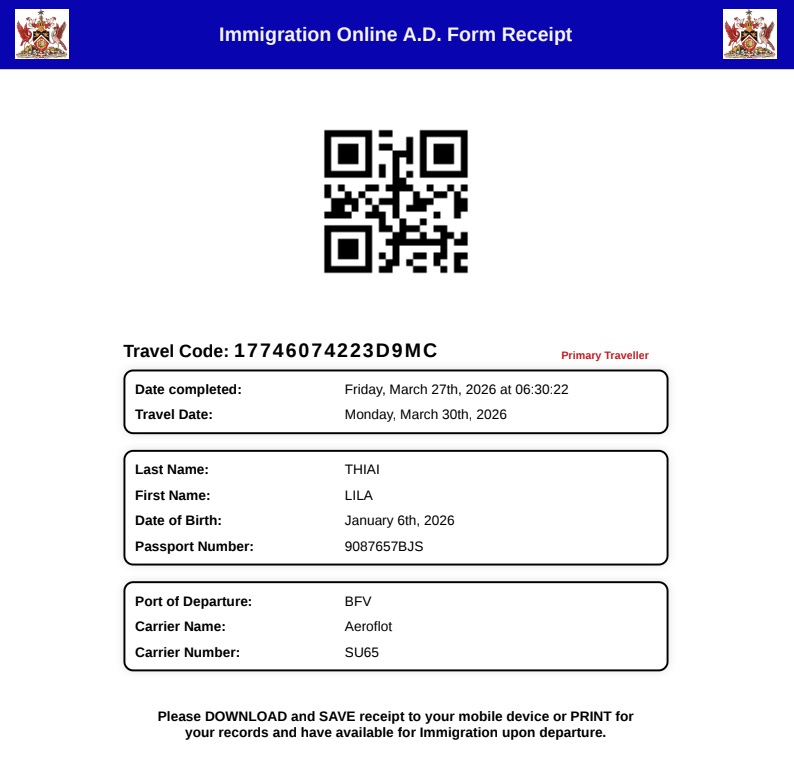
The major change introduced by Trinidad and Tobago is the replacement of the traditional paper card handed out on aircraft with an electronic form. This document, officially called the Arrival and Departure Card (AD Card), is mandatory for all travellers entering or leaving the country, regardless of nationality, age, purpose of travel or mode of transport. Launched by the Ministry of Homeland Security on 11 March 2026 and mandatory since 17 March 2026 — the date on which the paper form was definitively withdrawn — it is hosted on the official portal (Online Immigration & Customs Portal).
The form is completed online within the 72 hours preceding the scheduled arrival or departure time: the window does not open any earlier. The authorities first require you to create an online account on the portal and to upload the biodata page of your passport. Once submitted, the system instantly generates a digital receipt containing a QR code to be presented to immigration officers. It is advisable to download it to your smartphone and keep a printed copy as a precaution.
The arrival and departure card involves no consular fees or registration charges with the Trinidadian authorities.
Trinidad and Tobago is one of the few destinations that requires a declaration both on entry AND on departure from the country. These are two separate forms to be completed independently. Remember to complete your departure declaration before leaving your accommodation, to avoid any delays at airport check-in or maritime disembarkation.
No consular fees with the authorities. Service fees apply via Visamundi.
The form opens 72 hours before the scheduled arrival or departure: it is completed within that window, never earlier. Create your account ahead of time.
The card applies to 100 % of travellers, with no exceptions based on nationality, age or purpose of travel.
A receipt bearing two QR codes — immigration and customs — either digital (screenshot or PDF) or printed. Both formats are accepted at the checkpoint.
02 · Who is concerned?
All travellers without exception — tourists, cruise passengers, crew members
The electronic arrival and departure card is a universal formality. Here are the traveller profiles concerned:
- International tourists of all nationalities, whether travelling as families, couples or solo.
- Business travellers visiting Trinidad and Tobago for professional meetings, conferences, investments or missions related to the oil and gas industry — a key sector of the local economy.
- Cruise passengers stopping in Port of Spain or Scarborough (Tobago), even for just a few hours. The QR code is required at disembarkation at the port.
- Trinidadian residents and nationals returning home after a stay abroad. The form has a dedicated option for this profile.
- Transit travellers passing through a Trinidadian entry point, where the transit involves passing through immigration (baggage collection or terminal change).
- Ship and aircraft crew members operating on routes serving Trinidad and Tobago.
- Children and infants: every passenger, regardless of age, must have their own declaration and QR code. However, a responsible adult may complete the forms on behalf of children travelling with them.
If you are in simple airport transit (remaining in the international zone without passing through customs to take a direct connecting flight), the form is not required. However, if you need to collect your baggage and go through immigration again to change flights or airports, the declaration becomes mandatory.
To simplify family procedures, one adult may complete the online forms on behalf of all group members, including minor children and infants. Each person will receive their own individual QR code.
03 · Eligibility and visa
Visa policy: open for the vast majority of nationalities
It is important to distinguish the arrival and departure card (mandatory formality for everyone) from the visa (entry document required depending on nationality). Trinidad and Tobago has a relatively open visa policy: the vast majority of Western and Caribbean nationalities do not need a visa for a tourist stay.
Be aware: the country operates a positive list. Only nationals of the countries expressly exempted — around eighty states, plus all European Union member states (Ireland is listed separately), Iceland, Liechtenstein, Norway and Switzerland — may enter without a visa. All other nationalities must obtain a visa before departure (eVisa) or, where eligible, a visa waiver issued on arrival. Many countries in Africa, North Africa, the Middle East, Central Asia and South-East Asia appear in none of the exemption lists below: check your nationality carefully before booking.
The authorised length of stay without a visa depends on your nationality:
- 90 days maximum: United States, Canada, United Kingdom, Ireland, Argentina, Brazil, Chile, Colombia, Mexico, Russia, South Korea, Turkey, Israel, Japan, India, Pakistan, Bangladesh, Singapore, Malaysia, Hong Kong, United Arab Emirates, South Africa, Kenya, Ghana and most Commonwealth countries.
- 6 months ("definite entry"): nationals of CARICOM member states (Jamaica, Barbados, Bahamas, Guyana…), under the free-movement provisions of the Revised Treaty of Chaguaramas.
- 90 days within a rolling 180-day period: European Union countries (France, Germany, Italy, Spain, Belgium, Netherlands, Portugal…), Switzerland, Norway, Iceland, Liechtenstein. Ireland is the exception: although an EU member state, it falls under the general 90-day regime above.
- 30 days: Albania, Bosnia-Herzegovina, Montenegro, Serbia.
- Visa waiver on arrival ("Waiver of the Visa"): Australian, New Zealand and Philippine nationals can obtain it directly at the point of entry for 400 TTD €51.95. Nationals of other visa-required countries may also obtain it provided they present pre-arranged approval issued by the Immigration Division: this covers, among others, Andorra, Angola, Bolivia, Burundi, Cambodia, the Central African Republic, Chad, the DR Congo, the Republic of the Congo, Djibouti, East Timor, Gabon, Ivory Coast, Madagascar, Mali, the Marshall Islands, Mauritania, Micronesia, Monaco, Morocco, Nepal, Niger, Oman, Palau, São Tomé and Príncipe, Thailand and Yemen.
Beware: these durations are ceilings, not entitlements. The length of stay actually granted is decided by the immigration officer on arrival and written on the entry stamp: some nationalities are only given 30 or 60 days, even when the theoretical ceiling is 90 days. Always check the date on your stamp.
To stay beyond the period granted, an extension must be requested in person from the Immigration Division (Ministry of Homeland Security) in Port of Spain, before the authorised stay expires. Book an appointment at least two weeks ahead: overstaying exposes you to a fine, detention and a re-entry ban. An extension is expressly provided for nationals of Argentina, Brazil, Colombia, Costa Rica, Iceland, Israel, Liechtenstein, Mexico, Norway, South Korea, Switzerland and Uruguay; for other nationalities it remains at the discretion of the Immigration Division.
Venezuelan nationals have required an electronic visa since 17 June 2019. Nationals of North Korea, North Macedonia and Viet Nam, together with holders of ordinary Chinese and Haitian passports, must also obtain a visa before departure: these six nationalities are the only ones entirely excluded from the visa waiver on arrival, even with a pre-arranged approval. Holders of Chinese and Haitian diplomatic or service passports are, by contrast, exempt. If your nationality requires a visa, the arrival and departure card nonetheless remains an additional and mandatory formality that does not replace the visa.
Applications are now made entirely online on the eVisa portal of the Immigration Division (Ministry of Homeland Security): evisa.ttservices.online. The scheme issues a multiple-entry visa valid for the duration of the approved stay. Have ready a passport valid for at least 6 months, a digital photo in JPG format, your supporting documents in PDF and a Visa or Mastercard for payment (fees are non-refundable). Bona fide operating crew of aircraft and seagoing vessels are exempt from a visa, whatever their nationality. Holding an eVisa does not guarantee entry, which remains at the discretion of the immigration officer. Enquiries: immigration.visas@gov.tt.
- Passport required
- Valid for at least 6 months from the date of arrival in Trinidad and Tobago (a margin beyond your return is advisable)
- Flight ticket
- Return or onward ticket to another destination required at entry
- Accommodation
- Hotel booking, rental confirmation or invitation letter from host
- Financial resources
- Customs officers may request proof of sufficient funds for the duration of the stay
- AD Card
- Digital or printed QR code — mandatory for all nationalities
- Online account
- Mandatory: the AD Card can only be completed once an account has been created on the official portal
- Submission window
- Within the 72 hours before arrival, then within the 72 hours before departure
04 · The procedure
How to complete the arrival and departure card online, step by step
The completion procedure is straightforward and intuitive. The online form guides you through each step. The form is entirely online, with no postal submission or consulate visit required. Allow a few minutes to gather your travel information before you begin.
It is recommended to complete the form on a computer or tablet for greater comfort, although it is also accessible from a smartphone. Keep the QR code received in digital format and printed if possible, to guard against any battery or connectivity issues at the airport.
- 1Start your application
First create your online account on the portal: the Trinidadian authorities require one to access the form. The form then opens within the 72 hours preceding your scheduled arrival or departure — not before. You can complete it from a computer, tablet or smartphone.
- 2Select your status
The first page asks you to specify whether you are a visitor/non-resident or a returning Trinidadian resident/national. This choice determines the subsequent fields in the form.
- 3Enter your personal information
Last name, first name, date of birth, nationality, passport number, country of residence, full address, email address and phone number. Check each field carefully to avoid any rejection or delay at immigration.
- 4Upload your identity document
A digital photo or scan of the biographical page of your passport is required (JPEG or PNG format). Make sure the image is clear and legible, with no glare or cropped edges.
- 5Enter your travel details
Flight or vessel number, airline or shipping company, port of embarkation, planned arrival date, purpose of travel (tourism, business, transit, family visit…) and planned duration of stay.
- 6Provide your accommodation address
Name and address of your hotel, rental property, residence or host in Trinidad and Tobago. For cruise passengers, enter the name of the vessel and the port of call.
- 7Complete the customs declaration
The form includes a customs section: declare cash and monetary instruments from TT$20,000 or the equivalent in foreign currency, goods exceeding your personal allowance, and any food products, plants, animals and regulated items. The applicable allowances are set out below.
- 8Accept the terms and submit
Tick the consent box authorising the processing of your personal data, then submit the form. You will instantly receive a digital receipt bearing your two QR codes, to save to your phone or print.
| Allowance on arrival | Quantity admitted free of duty |
|---|---|
| Goods and gifts | TT$3,000 in total value, once a year only — each trip is counted until the annual limit is used up |
| Wine and spirits | 1.5 litres — travellers aged 17 and over only |
| Tobacco | 200 cigarettes, or 50 cigars, or 250 g of tobacco — travellers aged 17 and over only |
| Cash and monetary instruments | Declaration required from TT$20,000 or the equivalent in foreign currency, on entry as well as on exit |
Customs allowances applied to each traveller arriving in Trinidad and Tobago. Exceeding an allowance is not prohibited: the goods become dutiable and must be declared in the customs section of the form.
The receipt and its two QR codes (digital or printed) will be requested by officers at Piarco International Airport (POS) on the island of Trinidad, at A.N.R. Robinson International Airport (TAB) in Tobago, or at any other maritime entry point. Without this receipt, you will need to complete the form on the spot, which may cause additional waiting time.
If your flight is delayed by the airline, immigration authorities are notified and your QR code remains valid even if you land the day after the planned date.
05 · Entry points
Airports and ports: all entry points to Trinidad and Tobago
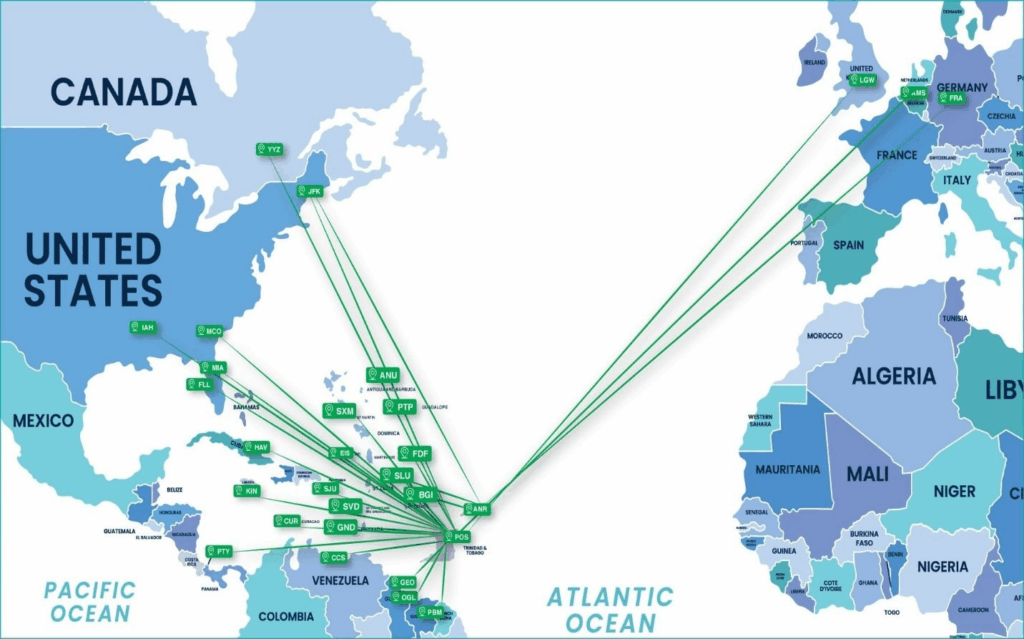
Trinidad and Tobago has several entry points for international travellers, spread across its two main islands.
By air:
- Piarco International Airport (POS) — Located approximately 25 km east of Port of Spain on the island of Trinidad, this is the country's main airport. It serves direct flights and connections from North America (Miami, New York, Toronto), Europe (London), the Caribbean and South America. Major airlines include Caribbean Airlines, American Airlines, JetBlue, British Airways and Copa Airlines.
- A.N.R. Robinson International Airport (TAB) — Located at Crown Point on the island of Tobago, this airport handles regional flights and some direct international flights, including from London and other Caribbean islands.
By sea:
- Port of Spain (Trinidad) — The country's main port, which regularly receives large cruise ships and international ferries.
- Scarborough (Tobago) — Scarborough port receives cruise ships and the inter-island ferry linking Trinidad to Tobago.
- Point Lisas and Chaguaramas (Trinidad) — Entry points for certain commercial vessels and pleasure craft.
The electronic arrival and departure card rule also applies to travellers entering the country by sea: international ferry, cruise ship or pleasure craft. The QR code will be requested upon disembarkation at the port of Port of Spain or Scarborough. Even for a day stopover, the form must be completed before disembarkation.
06 · Before you go
Preparation checklist and practical tips for a smooth passage
Trinidad and Tobago is a Caribbean destination that rewards well-prepared travellers. The southernmost island nation in the Caribbean is located just 11 kilometres off the coast of Venezuela and offers a striking contrast between its two twin islands.
Trinidad, the main island, is the country's cultural and cosmopolitan heart: energetic and vibrant, it is world-renowned for its spectacular Carnival, its exceptional culinary diversity and its unmissable musical heritage — this is where calypso, soca and the steelpan (steel drum) were born. Nature lovers will discover lush mountains and the famous Caroni Bird Sanctuary, where the scarlet ibis, the national bird, puts on a display at sunset.
Tobago, a few dozen kilometres away, is its perfect opposite: a timeless haven of peace. Fringed by paradisiacal white-sand beaches such as Pigeon Point and coral reefs prized by divers, Tobago is also home to the oldest protected forest reserve in the western hemisphere. It is the ideal destination for travellers seeking a balance between intense cultural immersion and seaside escape.
Before you travel, check the security situation. The United States rates Trinidad and Tobago at Level 3 "Reconsider Travel" on grounds of crime and terrorism risk: in the advisory renewed on 13 April 2026 the "kidnapping" indicator was removed and an area of increased risk was added. A national state of emergency is also in force across the whole territory, Tobago included: declared several times since late 2024, it was reinstated on 3 March 2026, extended by three months on 14 March and again on 11 June 2026 — until midnight on 17 September 2026, subject to any further extension by Parliament. No curfew or restriction on gatherings is in place, but the police may carry out arrests, searches of premises and body searches on mere suspicion. Crime, mostly gang-related, is concentrated in certain Port of Spain neighbourhoods (Laventille, Beetham, Sea Lots); Tobago is markedly safer than Trinidad. Avoid travelling alone at night, stick to tourist areas, and check whether a state of emergency is in force and the latest advice before departure (US State Department or your own country's foreign ministry).
- Valid passportMust be valid for at least 6 months from your date of arrival in Trinidad and Tobago. Check the expiry date well before your trip and allow a margin beyond your return.
- Photo or scan of passport (biographical page)JPEG or PNG format, clear and legible image, no glare. Required to complete the online form.
- Arrival card (QR code) — to be completed within the 72 h before arrivalDownload the PDF receipt to your phone AND print a paper copy to guard against any technical or battery issues.
- Departure card (QR code) — to be completed within the 72 h before departureA separate process from the arrival card. Do not forget this before leaving your accommodation for the airport or port.
- Return or onward flight ticketProof of a return ticket or onward ticket to another destination is required at entry to the country.
- Proof of accommodationHotel booking confirmation, rental confirmation, or invitation letter from your host in Trinidad and Tobago.
- Proof of sufficient fundsCustoms officers may request proof that you have the financial means to cover your stay (bank statements, credit cards).
- Visa (if required by your nationality)Trinidad and Tobago operates a positive list: any non-exempt nationality must obtain an eVisa before departure, or a waiver on arrival where eligible. Venezuela, North Korea, North Macedonia, Viet Nam and holders of ordinary Chinese and Haitian passports may only use the advance eVisa, with no waiver available at the point of entry.
Trinidad and Tobago presents a medium level of immigration complexity. The main difficulty is the obligation to complete two separate forms: one on arrival and one on departure. Many travellers forget the departure process, which can cause delays at check-in. Plan for both procedures from the moment you book your trip.
The electronic arrival and departure card for Trinidad and Tobago is a simple, free and entirely online formality — but it has one feature not to overlook: it must be completed twice, once on arrival and once on departure. For nationals of the European Union, Switzerland, the United States, Canada and the United Kingdom, no visa is required for a tourist stay — up to 90 days, and 90 days in any 180-day period for the European Union and Switzerland. Your valid passport, your return ticket, proof of accommodation and the two QR codes (arrival and departure) make up the full set of formalities to prepare.
Safety
Travel advisories for Trinidad and Tobago
The vigilance level recommended by five foreign ministries, on a shared scale.
Average level
Significant crime; a previously declared state of emergency has now been lifted, according to the UK.
- Read the advice

US Department of StateAdvice dated April 13, 2026
Reconsider travel · Trinidad and Tobago - Level 3: Reconsider Travel
- Read the advice

Global Affairs CanadaAdvice dated September 24, 2026
Increased caution · Trinidad and Tobago — Exercise a high degree of caution (with regional advisories)
- Read the advice

German Federal Foreign OfficeAdvice dated September 24, 2026
Normal precautions · Trinidad and Tobago: Travel and Safety Information
- Read the advice

UK Foreign Office (FCDO)Advice dated September 21, 2026
Normal precautions · Trinidad and Tobago travel advice
- Read the advice

France DiplomatieAdvice dated September 15, 2026
Increased caution · Trinidad and Tobago: Travel advice
Levels published by the ministries cited, reproduced unchanged. Visamundi is a private agency with no ties to these administrations.
FAQ
Frequently asked questions
