

Brazilian temporary VITEM visas now applied for online only
The Brazilian Ministry of Foreign Affairs has announced that temporary visas for eligible travelers will now be applied for exclusively online via the Integrated Consular System (SCI), starting September 1, 2026.
Since September 1, travelers who are exempt from visa requirements but need a VITEM for purposes such as studying, working, investing, or family reunification must submit their applications through the Sistema Consular Integrado. There is no need to submit hard copies of documents or present passports in person. Once approved, the visa is delivered electronically via email.
The announcement from Itamaraty is concise, making it clear that applications are processed through the Integrated Consular System (SCI) with supporting documents uploaded digitally. No physical documentation or passports need be presented. Upon approval, the visa is automatically sent to the email address provided in the application form.
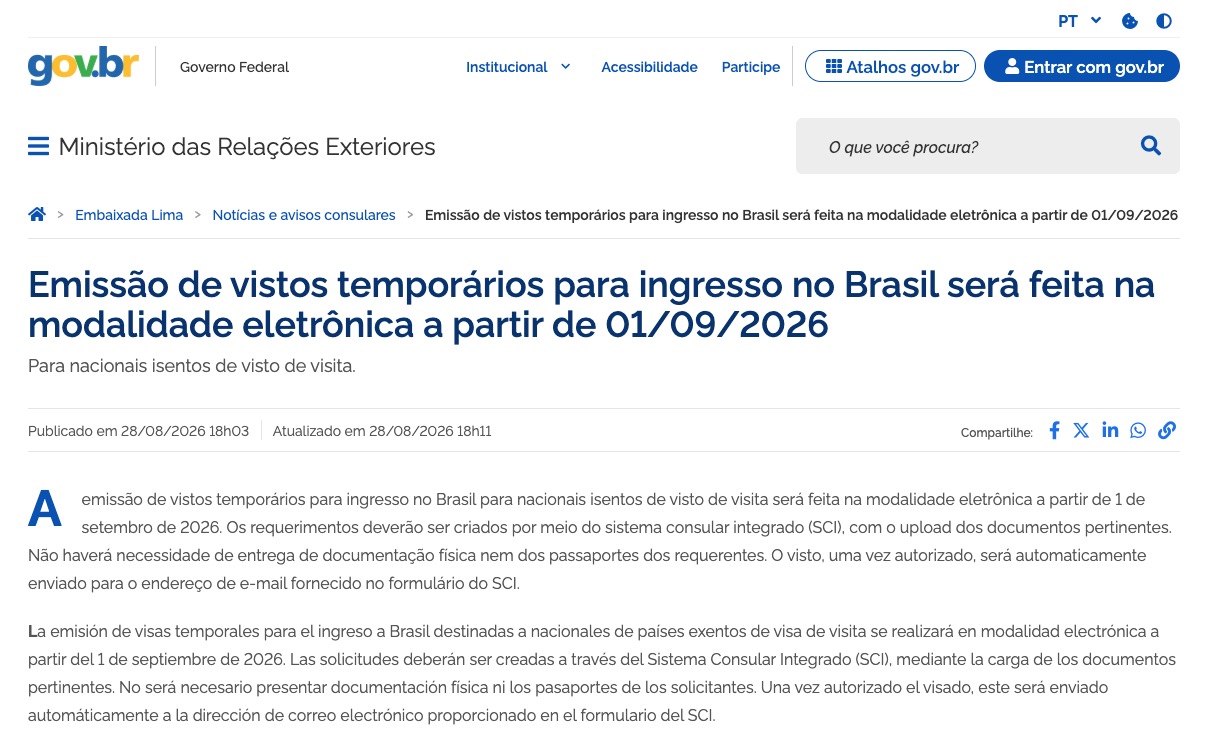
The change that affects travelers most involves the delivery method. Previously, a Brazilian temporary visa was issued as a physical sticker attached to the passport, requiring applicants to either leave their documents with the consulate or collect the sticker in person. Under the new system, the visa is an electronic document sent to the applicant’s email and must be presented at check-in and to the Federal Police upon arrival in Brazil.
Who is eligible?
The new digital process applies specifically to nationals exempt from visa requirements for short visits, known in Brazilian administration as holders of the VIVIS. These travelers can enter Brazil for tourism or business for up to 90 days, though this may vary based on bilateral agreements—Chinese nationals, for example, are granted a visa exemption valid for just 30 days. When the purpose of stay falls outside this scope, a temporary visa becomes necessary. The updated process now applies to such applications.
This covers a broad range of travelers. According to the Quadro Geral de Regime de Vistos, updated August 26, 2026, visa exemption applies to nationals of the European Union and the United Kingdom, Morocco, Tunisia, most Latin American countries including Mexico and Argentina, as well as Japan, South Korea, and New Zealand.
Other nationalities remain outside the digital system because they are not exempt from visa requirements. This includes travelers from Senegal, Côte d'Ivoire, Cameroon, Algeria, Lebanon, and Vietnam, as well as the United States, Canada, and Australia, which resumed mandatory visas on April 10, 2025. For these groups, the standard consular procedure continues to apply.
Covered visa categories
Brazilian temporary visas are categorized using Roman numerals, each corresponding to a specific purpose of stay. The VITEM I covers research and teaching, IV for academic studies, V for remunerated work, IX for investors, XI for family reunification, XII for artistic and sporting activities, and XIV for digital nomads.
Attention is needed for the digital nomad category, which is often mislabeled. The digital nomad visa is formally the VITEM XIV and exclusively pertains to individuals working remotely for a foreign employer or for clients outside Brazil. Applicants must provide evidence of monthly income of at least 1,500 USD €1,299.78 from foreign sources, or proof of available funds totaling at least 18,000 USD €15,597.31. The initial residency granted may extend up to one year. The VITEM XV, sometimes mistakenly associated with this category, relates to medical improvement processes and follows a distinctly different set of rules.
The rollout is not yet uniform
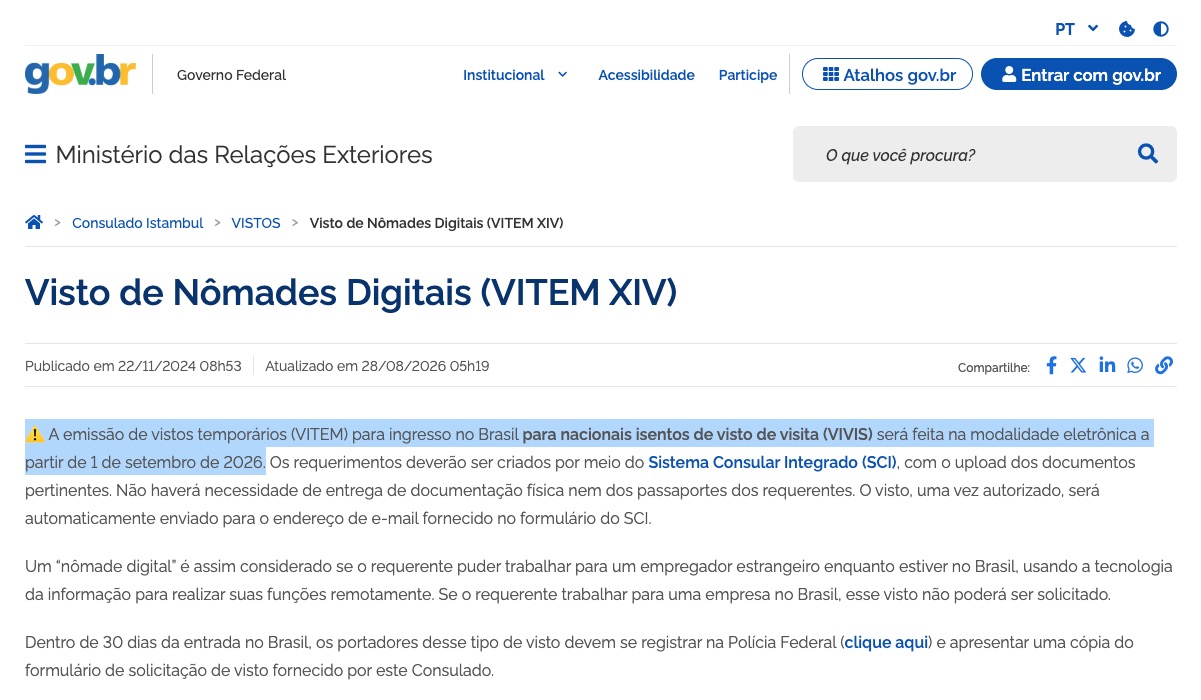
The notice officially took effect on September 1, but Brazilian consular posts have not all transitioned to the new system at the same pace. Some have implemented the changes early. The page for the Brazilian Consulate General in Istanbul, updated on August 28, 2026—the same day as the notice—clearly reflects the new electronic-only process, stating no physical documentation or passports need be presented.
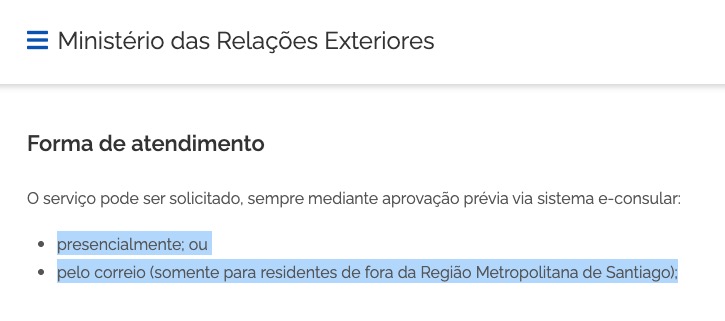
Other consulates still describe the old procedure. The page for the Consulate in Santiago, last updated June 23, 2026, continues to state that applications are filed through the e-consular system but are followed up “in person, or by mail” for residents outside the metropolitan region. The page for the Consulate in Lisbon goes further, erroneously specifying that uploading supporting documents does not replace the need to present originals in printed form. These outdated pages remain accessible online, meaning travelers who rely on them risk preparing for visits that are no longer required.
The guiding principle is straightforward: the ministry’s notice sets the official rule, while consular pages are updated with varying delays. Where discrepancies exist, the August 28 notice prevails, and it is advisable to contact the relevant consular post to confirm current procedures rather than assuming submission of paper documents is still mandatory based on outdated web information.
The digital shift applies only to how applications are submitted and visas received—it does not alter the substantive requirements for each category. The supporting documents requested for each visa type remain unchanged; they are simply uploaded digitally instead of being handed over at a counter. For example, a signed declaration and contract with a foreign employer are still required for a VITEM XIV, along with proof of income. The email address provided in the SCI form has now taken on greater importance, as it is the channel through which the visa will be delivered. Any typographical errors in this field cannot be corrected at a consular counter. It’s important to remember that the temporary visa allows entry but does not constitute a residence permit. Holders of a VITEM are required to register with the Federal Police after arrival to obtain their Registro Nacional Migratório (RNM) and the corresponding card (CRNM). While the registration process begins online via the Federal Police portal, the collection of biometric data necessitates a visit to a local unit. This requirement remains unchanged by the digitalization of consular submission. |

A specialist in regulatory monitoring and a content destination expert, she analyzes daily changes in entry formalities to turn complex administrative processes into practical guides. Her role blends ground-level expertise with technical precision to ensure the reliability of the information provided to travelers.

Get our visa news first in your Google results: add Visamundi to your preferred sources.
