

Obligatory travel insurance for mainland Tanzania is coming soon
Mainland Tanzania will soon require visiting foreigners to purchase a local travel insurance policy costing $44, as outlined in its Finance Act 2025 from 1 July 2025.
Travelers from East African Community (EAC) and Southern African Development Community (SADC) countries are exempt from this requirement. As of now, Tanzanian authorities have not announced when the policy will be enforced at mainland border crossings.
What the law says
The requirement stems from national legislation, not an administrative circular: Tanzania’s Finance Act 2025, which took effect on 1 July 2025, inserted section 134A into the country’s Insurance Act. The wording is clear: any foreigner entering mainland Tanzania—whether by land, sea, or air—must, upon arrival, purchase an incoming travel insurance policy whose premium equals 44 USD (denominated in Tanzanian shillings). €38.34
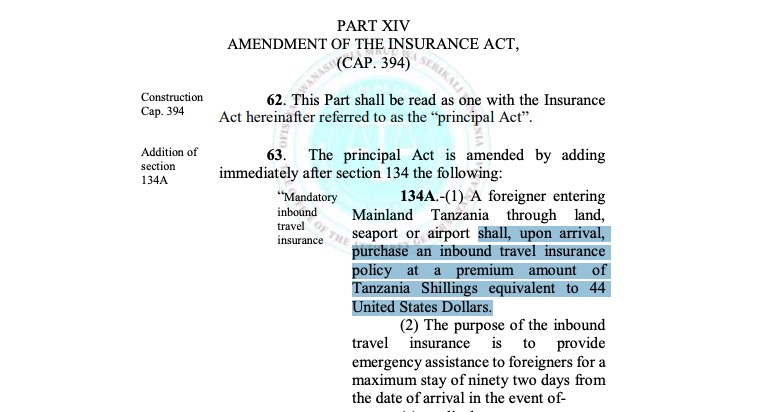
The law itself sets the duration and scope of coverage. It is valid for a maximum stay of 92 days from the date of entry and must cover three events: emergency medical care, baggage loss, and emergency medical evacuation or repatriation. Policies must be issued by the National Insurance Corporation of Tanzania, the public insurer, or by a registered partner working alongside it.
Who pays, who is exempt
The requirement applies across mainland Tanzania and covers all foreign visitors irrespective of travel purpose or point of entry. Whether you arrive in Dar es Salaam by plane, cross the border from Zambia by road, or disembark at a port, you are equally covered.
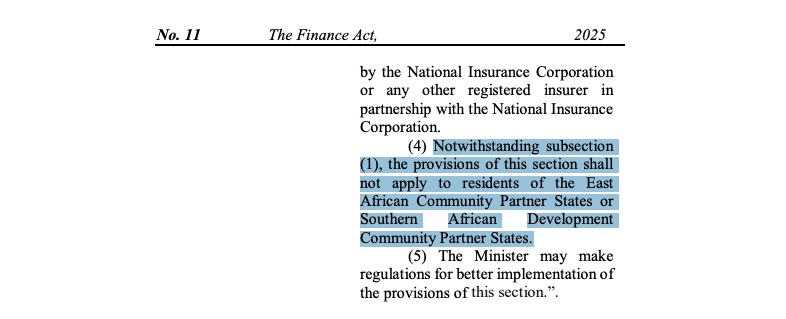
The only exception is regional. Section 134A explicitly excludes residents of states belonging to the East African Community and the Southern African Development Community. In practical terms, that takes in a large swath of the continent: Kenya, Uganda, Rwanda, Burundi, South Sudan, the Democratic Republic of the Congo, and Somalia under the EAC, plus South Africa, Angola, Botswana, Malawi, Namibia, Mozambique, Zambia, and Zimbabwe under the SADC. For all other passports—from Belgium, Canada, France, Ivory Coast, Lebanon, Morocco, Senegal, Vietnam and beyond—the $44 premium applies on arrival.
The law does not recognize equivalent policies purchased abroad. A European travel policy, a credit-card-backed guarantee, or an international assistance plan is not accepted: the required cover is a regulated premium paid to Tanzania’s public insurer, not simply proof of adequate insurance.
The legislation is in effect, but enforcement is still pending
Fifteen months after its passage, mainland travellers face no visible enforcement at border or airport checkpoints. Tanzania’s insurance regulator, the Tanzania Insurance Regulatory Authority, has published no implementing rules or circulars within its “Insurance Regulations” or “Circulars” sections. In early September 2026 the press reported that an implementing regulation matching these terms was about to be published, yet no government department has announced a go-live date. Until such a date is officially confirmed, travellers heading to mainland Tanzania do not need to take any advance action.
This delay is not unusual in the region. Kenya’s similarly proposed mandatory health insurance for foreign visitors—with a minimum cover several times higher—remains unenforced at borders, and its rollout was suspended by the courts in August 2026. A statutory obligation is one thing; face-gate enforcement is another.
Zanzibar already enforces the rule
Zanzibar, which administers its own insurance rules, has required visitors to hold a comparable policy since 2024—and it is actively checked on arrival. An official FAQ sets the premium at $44 all-in per visitor for up to 92 consecutive days inside Tanzania. The final price varies by age…
Zanzibar’s policy is single-use: guests remaining beyond 92 days must purchase a new one. The FAQ explicitly states that an international policy is not accepted; travellers must obtain cover from the Zanzibar Insurance Corporation. It also clarifies that the basic plan excludes terrorism and pre-existing conditions.
The two regimes are administered by different insurers—Zanzibar Insurance Corporation for the archipelago and the National Insurance Corporation for the mainland—and no statute allows a single policy to serve both territories. Travellers planning a safari on the mainland followed by a week in Zanzibar may therefore, once the mainland rule is enforced, be asked to arrange two separate policies.

As CEO of Visamundi, I am dedicated to simplifying international travel by assisting our clients in obtaining visas worldwide. By staying at the forefront of ever-changing regulations, I ensure our agency remains a trusted pillar in the visa services industry.

Get our visa news first in your Google results: add Visamundi to your preferred sources.
