Choose the visa that fits your trip. Fully online process, real-time tracking.
Visamundi service: €39 incl. VAT
Consular fee: ≈ €35(40 USD)
AuthorizationTo enter the United States without a visa, nationals of around forty countries — including French, Belgian and Swiss citizens — do not apply for a visa, but for an electronic travel authorisation called ESTA (Electronic System for Travel Authorization). This digital document is part of the American Visa Waiver Program: it is not stamped in the passport and is applied for entirely online, with no visit to the consulate. Valid for two years, it authorises tourist, business or transit stays of up to 90 days. Simple in principle, the process nonetheless requires careful entry of information: the slightest error can lead to an outright refusal.
01 · The essentials
Only nationals of the 42 countries that are members of the Visa Waiver Program can apply for this authorisation — other nationalities must go through the consulate.
The entire process is done exclusively on the internet, with no consulate visit or postal submission required.
The procedure is considered straightforward: the website can automatically detect data from your biometric passport and pre-fill several fields of the form.
It is important to clearly distinguish the ESTA from a visa. The ESTA (Electronic System for Travel Authorization) is an electronic travel authorisation reserved for nationals of Visa Waiver Program countries who are exempt from a US visa. It is not a visa stamped in the passport, but a digital document linked to your passport number in US databases.
In practice, at the time of boarding, the airline electronically checks that your passport is associated with a valid ESTA authorisation. If this is not the case, you will not be allowed to board, regardless of your eligible nationality. It is therefore essential to obtain your ESTA before leaving your country of residence.
The ESTA is valid for arrivals by air, sea and land — including if you enter from Canada or Mexico, or if you make a stopover on American soil during a cruise. It covers three purposes: tourism, business and transit.
02 · Eligibility
The right to apply for an ESTA is determined by the Visa Waiver Program (VWP), a bilateral programme between the United States and around forty partner countries. In practice, to be eligible for the ESTA, you must meet all of the following conditions:
Nationalities currently eligible for the Visa Waiver Program include: Germany, Andorra, Australia, Austria, Belgium, Brunei, Chile, South Korea, Croatia, Czech Republic, Denmark, Estonia, Finland, France, Greece, Hungary, Iceland, Ireland, Israel, Italy, Japan, Latvia, Liechtenstein, Lithuania, Luxembourg, Malta, Monaco, Netherlands, New Zealand, Norway, Poland, Portugal, Qatar, San Marino, Singapore, Slovakia, Slovenia, Spain, Sweden, Switzerland, Taiwan, United Kingdom. This list may change: check your eligibility before submitting an application.
Your passport must be a biometric or electronic model (RFID chip). An older passport without an electronic chip does not allow you to apply for the ESTA: a consular visa is then required. Your passport must remain valid for the entire duration of your stay in the United States.
All travellers, regardless of age — including infants — must have their own ESTA. It is not possible to include a child in a parent's application. Each passport requires a separate application.
The ESTA is tied to a specific passport number. If you renew your passport after obtaining an ESTA, the authorisation becomes void. You will then need to submit a new application for the new passport before your next departure.
The ESTA is strictly reserved for short stays for tourism, business or transit. Under no circumstances does it allow you to work, study or settle permanently in the United States. For these situations, a visa of category F1, J1, H1B or immigrant is required.
03 · The procedure
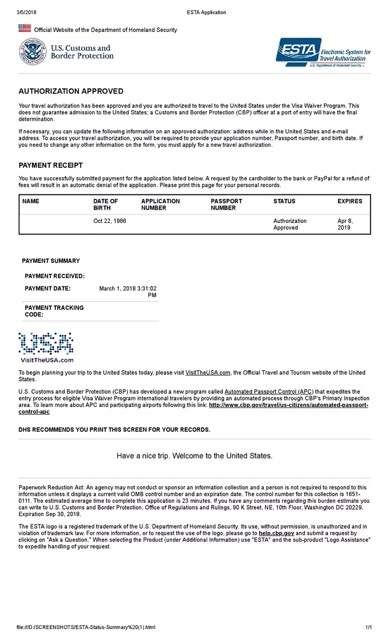
Obtaining the ESTA is done entirely online. No visit to the embassy is required, nor any postal submission. The application can be submitted from anywhere in the world, provided you are outside US territory at the time of submission. The website can automatically detect the information from your biometric passport: certain fields are then pre-filled, provided your passport is readable and in good condition.
We recommend submitting your application at least one week before your departure, even though authorisation is generally issued within 72 hours. This timeframe gives you the time needed in the event of a request for additional verification or a query about your file.
Access the ESTA application form. You will need to enter your personal details exactly as they appear on your biometric passport: surname, given name, date and place of birth, nationality, passport number, date of issue and expiry date. Any inconsistency with the passport data is a frequent cause of refusal.
You enter the purpose of your stay (tourism, business or transit), the approximate dates of your trip, and the address of your accommodation (hotel name or contact details of a host in the US). If you have not yet finalised your itinerary, enter a provisional address.
The form also asks for: the surnames and given names of your parents, your professional details (employer name, address, job title — to demonstrate the absence of immigration intent), your current home address, your phone number, and the contact details of a person to reach in an emergency.
A series of questions is asked about your travel history to restricted countries, your criminal record, your health, and any previous stays in the United States. These questions must be answered with the utmost accuracy.
Once the form is complete, you proceed to pay the official fees set by the US government, to which service fees are added if you use a provider. Then submit the photocopy of your passport to allow cross-referencing of information.
Your ESTA is sent by email once approved by the US authorities, generally within 72 hours of payment. In the event of a longer delay, first check the status of your application on the official authorities' website, then check your spam folder before contacting support.
04 · Fees & timelines
The price of the ESTA comprises two distinct components: the official fees set by the US government on the one hand, and the service fees relating to the processing of the file on the other. The US government fees amount to 40 $ €34.84. An important point to note: on 30 September 2025, the US authorities almost doubled the amount of the official ESTA fees. This increase is a sovereign decision by the US authorities, unrelated to service providers.
On top of these official fees, service fees are added when you use a provider, which cover the verification of your file, submission to the competent authorities, and the monitoring of your application. The details of the applicable fee are shown on the website before the start of the application procedure.
Regarding timelines, the ESTA is generally issued within 72 hours of payment being validated. However, the US authorities may sometimes request additional checks, which extend this timeframe. In rare cases, the document can be issued within minutes via the official website. It is strongly advised not to wait until the last moment: begin the process at least one week before your departure to have a comfortable safety margin.
If your ESTA is refused, you will not be informed of the reason for refusal: the US system does not communicate the grounds for a rejection. In this case, the only alternative route is to apply for a standard US visa at the American embassy or consulate in your country of residence.
05 · Validity & conditions
Once approved, the ESTA is valid for 2 years from its date of issue, or until your passport's expiry date if that is earlier. During this period, it allows you to make as many entries to the United States as you wish, within the limit of 90 days per stay. The ESTA does not provide for an official waiting period between two stays; however, repeated and closely spaced entries may attract the attention of US immigration officers, who remain the sole judges of your admission to the territory.
If your passport expires before the 2-year validity of your ESTA, the authorisation becomes void at the same time as your passport. When you renew your passport, you must submit a new ESTA application — even if the old one was still valid. The ESTA is indeed tied to a specific passport number and is not transferable.
It is not possible to extend the authorised length of stay (90 days) once on US territory. If you wish to stay beyond this limit, you must contact the local immigration authorities before your authorisation expires. Exceeding the authorised duration has serious consequences for your future travel to the United States.
An approved ESTA does not guarantee entry to US territory. The US immigration officer upon your arrival always retains the discretionary power to authorise or refuse your entry, regardless of the validity of your authorisation.
It is recommended to check and, if necessary, update the information in your ESTA file before each new trip. Certain changes in personal circumstances (employment, address) or travel plans may require an update to your application to ensure your authorisation remains compliant.
Since June 2023, the US authorities have introduced a mobile application allowing ESTA applications to be submitted. However, negative user feedback has been reported, particularly regarding the quality of the passport scanner and an intrusive selfie request not required on the standard form.
Permitted with the ESTA: tourist stays, business trips (meetings, conferences, negotiations), transit through the international zone of a US airport, entries by air, sea or land, stays of up to 90 days.
Prohibited with the ESTA: paid employment, studies, immigration, stays exceeding 90 days, asylum applications. For these situations, a visa of type F1 (studies), J1 (internship), B1/B2 (tourism/business for non-VWP eligible), H1B (work), L1 (intra-company transfer), or an immigrant visa is required.
06 · Before you go
The ESTA is just one of the preparation steps for a trip to the United States. Once the authorisation has been obtained, several other steps deserve your attention to ensure your stay goes as smoothly as possible. Entry checks at the US border are known to be strict: a well-prepared file with consistent supporting documents helps to ease your passage through customs and immigration.
Remember that the immigration officer always has the final say on your admission to US soil. Present yourself calmly, with all your documents in order, and answer questions clearly and factually.
Hawaii is reached with the same authorisation as the rest of the United States: the thing to watch is what you carry, not your paperwork.
For entry, Hawaii = USA: ESTA for visa-waiver nationals, or a B1/B2 visa otherwise. No island-specific document. The particularity is biosecurity: on arrival every passenger completes an agricultural declaration (Plants and Animals Declaration Form), and inspections are strict. Fresh fruit, plants, seeds, soil and certain foods are banned or inspected to protect a fragile island ecosystem. Inter-island flights are domestic US flights: no new formality, but an ID check.
Safety
The vigilance level recommended by five foreign ministries, on a shared scale.
Average level
Hurricane season, the only risk flagged by the ministries.

Global Affairs CanadaAdvice dated September 15, 2026
Normal precautions · United States — Exercise normal security precautions

German Federal Foreign OfficeAdvice dated September 10, 2026
Normal precautions · USA/United States: Travel and Security Warnings

UK Foreign Office (FCDO)Advice dated August 18, 2026
Normal precautions · USA travel advice

France DiplomatieAdvice dated September 15, 2026
Normal precautions · United States: Travel Advice
Levels published by the ministries cited, reproduced unchanged. Visamundi is a private agency with no ties to these administrations.
FAQ