
Cap-Vert's EASE airport tax rises to 4,400 CVE
Since November 4, 2026, the airport security tax (TSA) in Cape Verde costs 4,400 escudos per passenger on international flights, up from 3,400 previously.
A decree authorizes citizens of 91 countries requiring prior visas to apply online. This second measure is not yet in effect; applications still require visiting an embassy or consulate.
One decree, two changes
Decree-law No. 49/2026 was published in the Official Bulletin of Cape Verde on November 3, 2026, and came into force the next day. It amends Decree-law No. 2/2015, which regulates entry and stay for foreigners in the archipelago.
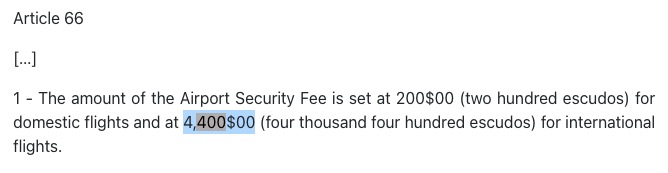
The new law affects two distinct groups. The TSA increase applies to nearly all foreign visitors, including those not requiring a visa. The visa reform, however, only targets nationals from the countries listed for prior visa requirements.
The decree contains no transitional provisions. No guidance is given regarding travelers who booked before November 4 but have not yet completed their EASE pre-registration.
TSA now at 4,400 CVE for international flights
The TSA must be paid during pre-registration on the official EASE portal, which is mandatory for all foreigners, whether they need a visa or not (the applicable regime for each nationality is detailed on our page dedicated to Cape Verde). The decree sets the tax at 4,400 escudos for international flights and 200 escudos for domestic flights, up from 150 previously.
On the EASE portal, the payment summary showed the updated amount on November 16, 2026. The increase took effect with a one-day delay: on November 5, the portal still charged 3,400 escudos.
The government states that pre-registration and payment must be completed up to five days before arrival. The process requires passport details and travel date.
Part of the revenue is reallocated. The decree now reserves 20% of the TSA for the National Civil Protection and Fire Service, covering equipment, vehicles, and alert systems.
Passengers born in Cape Verde, along with their children and spouses, are exempt from the TSA on international flights. The age limit previously applied to children has been removed; a child of a Cape Verdean-born parent no longer has to pay the tax.
Online visas planned but not yet available
Since January 1, 2026, citizens of 91 countries must secure a visa prior to departure. The list was established by a dispatch from the Ministry of Internal Administration, corrected in the Official Bulletin on January 23, 2026. It includes Algeria, Tunisia, Egypt, Ethiopia, Gabon, Madagascar, Pakistan, the Philippines, Indonesia, Vietnam, Mexico, Colombia, Peru, Haiti, among others. India, Turkey, Cameroon, and Rwanda are not on the list.
For these 91 nationalities, the visa on arrival is no longer permitted. Instead, under the new Article 14, they may apply through a digital platform. Approval remains contingent on a prior security and immigration risk assessment. Procedures such as additional documents, interviews, or preliminary review by the Directorate of Foreigners and Borders remain to be defined and are subject to an implementing ministerial order.
The decree does not specify the platform or set a launch date. As of November 16, 2026, the visa page on the GOV.CV portal still instructs applicants to submit their requests to Cape Verdean embassies and consular services, noting that the online service is in preparation. The EASE portal continues to redirect citizens to the nearest embassy.
Holders of valid residence permits issued by EU states, Iceland, Liechtenstein, the UK, Switzerland, San Marino, Vatican City, Brazil, Canada, or the U.S. are exempt from the prior visa obligation, provided their permit guarantees re-admission to Cape Verde. The same rule applies to holders of valid Cape Verdean residence permits.
Visa fees and validity
Upon payment of the visa fee (4,898 escudos €44.43), passports must be valid for at least three months beyond the intended stay. Tourist visas must be used within 60 days of issuance and allow stays of up to 90 days. Applicants from the 91 priority countries must then proceed, like all other visitors, with pre-registration on EASE and pay the new TSA rate before arrival.

A specialist in regulatory monitoring and a content destination expert, she analyzes daily changes in entry formalities to turn complex administrative processes into practical guides. Her role blends ground-level expertise with technical precision to ensure the reliability of the information provided to travelers.

Get our visa news first in your Google results: add Visamundi to your preferred sources.
