

Ceuta crisis: which countries are controlling borders with Spain since August 1?
Since August 1, 2026, Italy has been conducting targeted checks on non-EU travelers arriving from Spain by air or sea for one month. It is the only country to have introduced border measures specifically targeting Spain after the large-scale migration entry into Ceuta on July 30.
France has instead reinforced existing border controls rather than introducing new ones. If you're traveling this summer between Spain and the rest of Europe, a valid passport or ID card will suffice—but requirements may vary depending on your nationality.
Italy’s measures and their duration
Italy announced its decision on July 31, 2026, following the Interior Minister Matteo Piantedosi’s meeting with the Immigration and Border Security Analysis Committee at the Viminale. The ministry "ordered the reinstatement of border controls at air and sea ports with Spain" for a one-month period starting August 1st.
The announced goal is limited in scope: controls are to verify "in particular the regularity of extra‑community nationals’ circulation within the Schengen area". Checks apply to travelers who are neither Italian, Spanish, nor citizens of another EU country.
Screening began on August 1st at Italy’s major airports handling inbound flights from Spain—Rome Fiumicino, Milan Malpensa and Milan Linate—as well as at maritime ports. Italian authorities describe the checks as targeted and sample-based; they are not systematic but carried out on a selection of arriving passengers.
Only one country has acted despite public calls
This is the point most often misunderstood in coverage of the crisis. Several European governments have publicly demanded Spain’s suspension from the Schengen area, a demand widely echoed in media reports. Such a step has no legal basis: Schengen rules include no mechanism to suspend or expel a member state.
What member states may do, by contrast, is re‑introduce internal border controls at their own frontiers. The European Commission sets conditions: use of this emergency power is strictly limited to cases of a serious threat to public order or internal security, must be formally notified to the European Parliament, the Council, the Commission and other member states, and is strictly temporary. To date, Italy is the only country to have implemented such controls directed at Spain. The Commission’s published table of notifications has not yet been updated, with the most recent entry pre‑dating the Ceuta crisis.
A key distinction applies to France. On July 31, Interior Minister Laurent Nuñez announced reinforcements—tripling the workforce that day with 184 officers deployed and then quintupling it from August 1st, reaching an additional 334 police and gendarmerie officers alongside routine staff, plus three border police aircraft and increased patrols on the France‑Spain rail corridor. This is a temporary reinforcement of existing means, not a new legal measure.
France has maintained internal border checks since 2015 under successive notifications to the Commission; the current notification covers land and sea borders with six neighboring countries, including Spain. This pre‑existing regime predates the Ceuta crisis.
At EU level, an extraordinary meeting of EU interior ministers has been called for August 4, 2026 by the Irish presidency. As of the time of writing, it has not yet taken place and its outcome may alter the landscape in the coming days.
Why Ceuta does not trigger a suspension of Schengen
Ceuta and Melilla have operated under a special regime since Spain joined Schengen in 1991, expressly preserved under Article 41 of the Schengen Borders Code. On August 1, Spain’s Ministry of Foreign Affairs restated the arrangement in a published explanatory note: Schengen checks occur "on exit, by sea or air, the only two existing routes". No one can leave either city for mainland Spain without being processed by the national police at the port or airport.
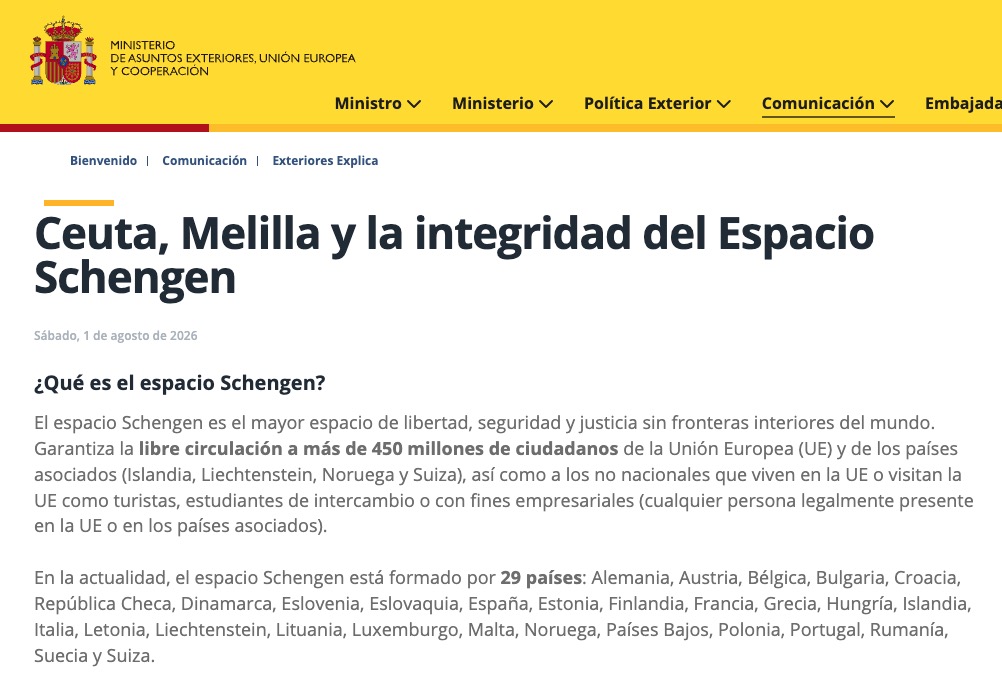
This double‑filter system—first at the Moroccan border, then again on exit from Ceuta or Melilla—means that any irregular entry into the cities does not constitute entry into the Schengen area and confers no right of residence or free movement within the EU.
Madrid’s figures support this: of roughly 50,000 people who entered irregularly on July 30, more than 48,000 had been returned to Morocco within 48 hours, and none had reached mainland Spain.
What actually changes for your travel plans
For the vast majority of travelers, the short answer is: nothing changes, except that you should carry your documents when arriving in Italy.
You hold a passport or national ID card from an EU country: you are not liable to the targeted Italian checks. Simply ensure you have a valid ID when boarding an international flight—already a legal requirement.
You are a third‑country national traveling from Spain to Italy by air or sea: you may be subject to arrival checks. Make sure you present a valid passport and current visa or residence permit.
Particularly affected are travelers who stack itineraries such as a stay in Barcelona followed by a flight to Rome. That flight remains within Schengen, but a targeted check on arrival is possible; an expired residence permit or one left at home can become a serious inconvenience.
If you hold an EU residence permit, travel with the original document rather than a copy or phone image. A renewal receipt alone can complicate border inspections in another country.
Two practical considerations: first, the Italian measure lasts one month from August 1st; Minister Piantedosi described it as precautionary and subject to revision, so it could be lifted earlier or extended. Second, even sample controls add processing time at airports. If you have a tight connection or train to catch from Fiumicino, Malpensa or Linate, allow extra time.
For travelers heading to Ceuta or Melilla, remember that any transfer to the Spanish mainland involves an identity check on departure regardless of the current crisis. This is standard procedure since 1991 and is not a change brought by recent events.

As CEO of Visamundi, I am dedicated to simplifying international travel by assisting our clients in obtaining visas worldwide. By staying at the forefront of ever-changing regulations, I ensure our agency remains a trusted pillar in the visa services industry.


Get our visa news first in your Google results: add Visamundi to your preferred sources.

