

EU ID cards: paper models no longer valid for travel from August 2026
As of 3 August 2026, paper-format EU ID cards without a machine-readable zone are no longer valid travel documents, even within the Schengen area. Travellers may be refused entry if they present an expired or invalid card at the border.
Even if a card’s expiry date hasn’t passed on paper, it can still be rejected at borders. Travellers must present an updated ID card featuring a machine-readable zone or a passport.
The exact requirements under EU regulations
The rule stems from European regulation (EU) 2019/1157, which standardised national ID-card formats from 2 August 2021. The new model is a card in ID-1 format, fitted with a machine-readable zone and a chip storing a facial image plus two fingerprints.
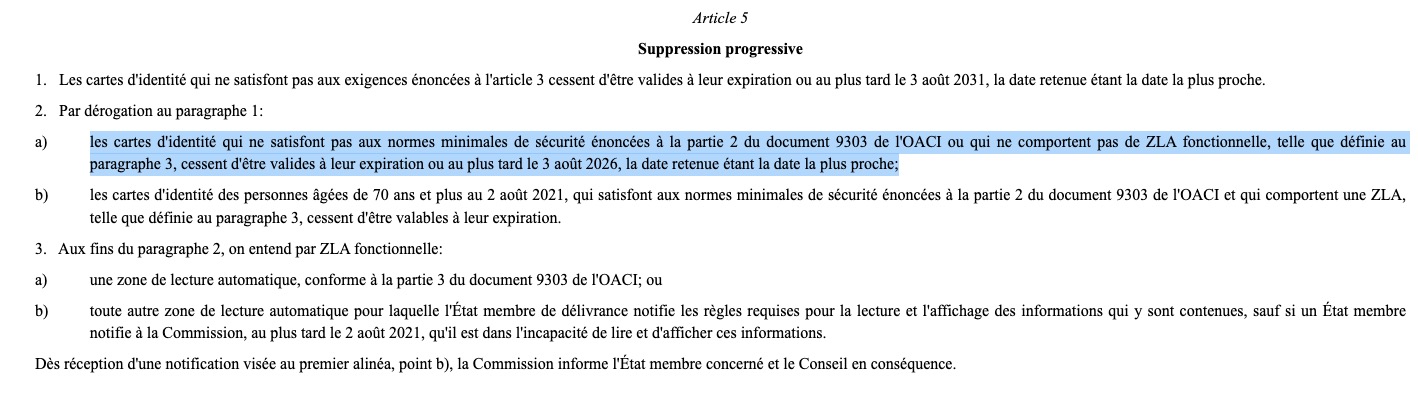
The regulation sets two distinct deadlines. Under article 5, card withdrawal happens in two phases:
Cards that fail to meet ICAO 9303 minimum-security standards or lack a working machine-readable zone stop being valid on expiry or—at the latest—on 3 August 2026, whichever comes first.
Cards with a readable but non-biometric zone remain valid until their stated expiry date, up to a final cut-off of 3 August 2031.
Only cards that display a functional two- or three-line machine-readable code at the bottom are still accepted today. Age and appearance do not matter; it is the presence of the scannable characters that counts.
A special rule applies to holders who were 70 or older on 2 August 2021: if those cards already meet ICAO security standards and have the required machine-readable zone, they remain valid until their own expiry date, without an extra deadline.
The danger of relying on printed expiry dates
The European Commission flagged the risk in its implementation report. Printed expiry dates can extend beyond the legal validity of the card. To avoid travellers being misled, the Commission urged member states to align printed dates with real cut-off deadlines—yet some have not. Therefore, check the bottom of the card: if the two- or three-line machine-readable zone is missing, it is no longer accepted at any border.
Deadlines vary by country, but the rule is the same
All EU member states must enforce the 3 August 2026 deadline, but the mix of card stocks in circulation means the impact differs from one country to the next.
In Italy, paper-format identity cards are directly affected. The Ministry of the Interior issued a circular to municipalities confirming that such cards can no longer be used for travel from 3 August 2026, “independent of the printed expiry date.” Italian authorities have lengthened counter hours and opened priority queues to handle a summer surge in renewal requests, and no duplicate fees will apply when switching from paper to the new eID card.
In Greece, “blue” police cards lacking modern security features or machine-readable zones are still accepted for domestic identification but are no longer valid for travel.
Wherever you are in the EU, if your ID card lacks the machine-readable zone it is now invalid for cross-border travel, regardless of the issuing state.
What changes for your next trip
Travelling with a passport
The rule does not affect passports.
Travelling within the EU using an ID card
Inspect the bottom of the card for the three-line machine-readable zone before departure. Cards without it are no longer accepted, even on Schengen routes where spot checks or airline boarding scans may occur.
Non-EU family members of EU citizens
Residence cards that do not meet the new technical standards must be replaced. Cards issued without a machine-readable zone were already due for replacement by 3 August 2023; others lose validity on their expiry date or, at the latest, by 3 August 2026.
Document checks are carried out by the carrier at boarding, not just by border guards. An invalid card can cost you a flight before you reach passport control—with no compensation rights.

As CEO of Visamundi, I am dedicated to simplifying international travel by assisting our clients in obtaining visas worldwide. By staying at the forefront of ever-changing regulations, I ensure our agency remains a trusted pillar in the visa services industry.

Get our visa news first in your Google results: add Visamundi to your preferred sources.
