

Russia: unified e-visa opens Yakutsk airport and Kani-Kurgan road bridge
Two new border crossings now accept Russia’s unified e-visa: Yakutsk Airport in the Sakha Republic and the Kani-Kurgan road checkpoint in Amur Oblast.
·
The Russian government order no. 1566-r dated 23 June 2026 raises to 109 the number of border crossings available to holders of this electronic document. For the 64 eligible nationalities, this opens two entry points that were previously missing in Russia’s Far East.
What the order actually says
The order signed by Prime Minister Mikhail Mishustin is just two lines long. It amends the annex to government order no. 2741-r of 23 October 2020, which lists the checkpoints open to the unified e-visa: the road-checkpoint section is updated with “Kani-Kurgan,” and the air section with “Yakutsk.”
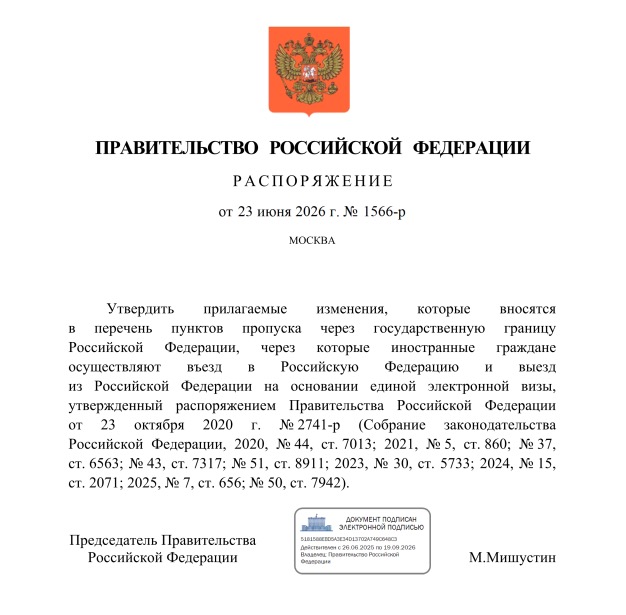
Approves amendments to the list of border-crossing points of the State Border of the Russian Federation authorized for entry and exit by foreign nationals holding a unified electronic visa (единая электронная виза), thereby amending the initial decree no. 2741-r of 23 October 2020.
Both new entries now appear on the list published by the consular department of the Russian Ministry of Foreign Affairs, under the Sakha Republic (Yakutia) for the airport and under Amur Oblast for the road checkpoint. Travelers should consult this list when planning a trip: an e-visa only authorizes entry and exit at the listed checkpoints, no matter what the intended itinerary.
A steady expansion pace
The unified e-visa mechanism has been in place since summer 2023, and its geographical reach has been growing incrementally, one or two additions at a time. In February 2025, the road checkpoint of Tashanta in the Altai Republic was added, bringing the total to 105. In January 2026, Yakutsk’s airport had already become the 107th. The two June 2026 additions bring the total to 109.
The logic behind these openings is clear: authorities are targeting regions that were previously unserved by the e-visa, rather than densifying already covered hubs. Yakutsk and Kani-Kurgan extend this push toward the Far East and Siberia.
What these two new points mean in practice
Kani-Kurgan is an Amur Oblast road checkpoint located opposite the Chinese city of Heihe on the far bank of the Amur River. It is especially relevant for travelers entering Russia from China by road who previously had to use another listed checkpoint or obtain a traditional consulate visa.
Yakutsk, meanwhile, is the air gateway to the Sakha Republic, Russia’s largest federal subject. Travelers wanting to fly directly there with an e-visa had to enter through one of the other airports on the list and then take an internal flight. Direct entry is now possible.
The unified e-visa permits a single entry, so both the entry and exit checkpoints must appear on the official list. Verify both before booking—don’t check only the arrival point.
What stays the same
The order affects only the list of border crossings. All other e-visa parameters remain as stated by the consular department of the Russian Ministry of Foreign Affairs:
a single entry, valid for 120 days from issuance;
maximum stay of 30 days from the date of entry;
issued within four calendar days, weekends and holidays included;
no invitation letters, hotel reservations, or purpose statements required;
applications accepted between 86 and 4 days before the planned entry date;
free for children under age 6.
The e-visa covers tourist, business, private, and humanitarian stays. It remains open to passport holders from 64 countries, a list set by the Russian government and unchanged by the June order.

As CEO of Visamundi, I am dedicated to simplifying international travel by assisting our clients in obtaining visas worldwide. By staying at the forefront of ever-changing regulations, I ensure our agency remains a trusted pillar in the visa services industry.

Get our visa news first in your Google results: add Visamundi to your preferred sources.
