

India’s 30-day e-Tourist visa becomes free for Thai nationals until end-2027
The Indian Embassy in Bangkok announced on 11 September 2026 that Thai nationals may obtain a double-entry 30-day e-Tourist visa at no charge until 31 December 2027.
The arrangement runs until 31 December 2027. One clarification is essential from the outset: the visa remains mandatory; only the fees are waived.
Full wording of the embassy notice
The embassy’s two-sentence announcement grants Thai nationals a double-entry 30-day e-Tourist visa « on gratis basis », valid until 31 December 2027 « or until further notice ». Applications are processed via the Indian government’s e-Visa portal, where the visa is issued without any visa fee.
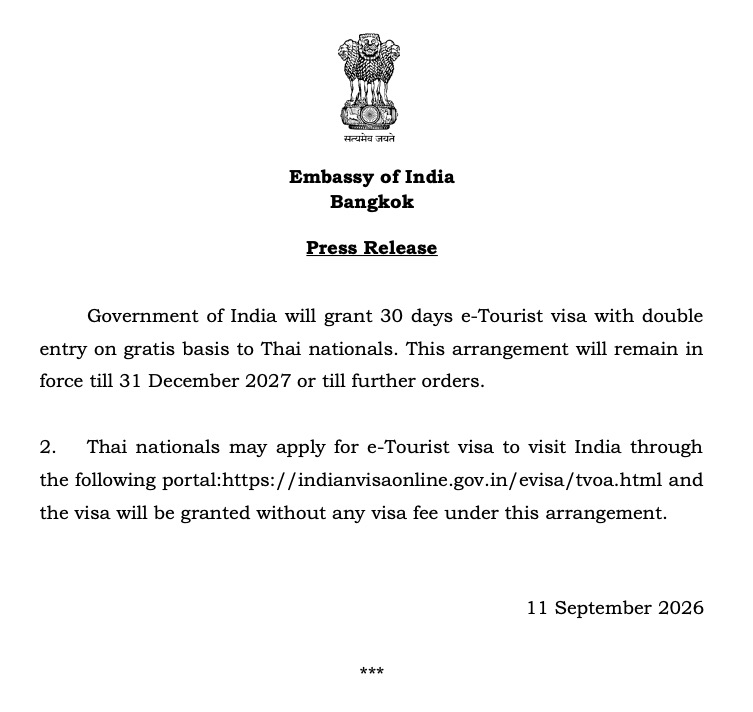
The phrase « or until further notice » should be taken literally. The 31 December 2027 date is not a firm 16-month commitment; it is a horizon Delhi can shift forward or backward. The recent history underlines this point: a 31 December 2025 notice extended the previous regime to 30 June 2026.
Fee waiver ≠ visa-free entry
This is the most common misreading since the announcement and one that can lead to boarding denials. A Thai traveller arriving at an Indian airport without prior authorisation, mistakenly believing India is open without formalities, would be turned away.
The application is still submitted online, still assessed, and still capable of refusal. The only difference is the payment field: where the portal formerly charged a fee indexed to nationality, it no longer does so for Thai passport holders under this specific category. In foreign-law terms, the distinction between « visa exemption » and « fee exemption » is fundamental, and the two regimes produce entirely different consequences for the traveller.
Scope: only one visa category
The waiver applies solely to the 30-day e-Tourist visa; it does not cover any other category. The Indian e-Visa portal also lists 1-year and 5-year e-Tourist visas, plus e-Business, e-Medical, e-Student and e-Transit visas—none included in the announcement.
The Bangkok embassy describes the visa as double-entry, while the e-Visa portal lists the 30-day e-Tourist visa as a multiple-entry permit. Both are official sources, with the embassy wording defining the Thai-specific measure. Travellers planning more than two entries into India during the validity period should confirm the actual number of entries recorded on their approval before mapping an itinerary around that assumption.
Thailand’s reciprocal step—and why it isn’t symmetrical
A few days before the Indian move, on 15 September 2026, Thailand introduced a revised visa-exemption scheme published in the Government Gazette on 31 August. Sixty countries—including India—now enjoy visa-free tourist stays of up to 30 days (previously 60).
Both measures ease travel between the two countries, but they are not mirror-image reciprocity. An Indian can enter Thailand without a visa; a Thai national must still hold a visa for India—but will pay no fee for the specified 30-day e-Tourist visa. The 11 September announcement makes that distinction explicit.

A specialist in regulatory monitoring and a content destination expert, she analyzes daily changes in entry formalities to turn complex administrative processes into practical guides. Her role blends ground-level expertise with technical precision to ensure the reliability of the information provided to travelers.

Get our visa news first in your Google results: add Visamundi to your preferred sources.
