
Thailand cuts no-visa stays to 30 days for 60 countries from September 2026
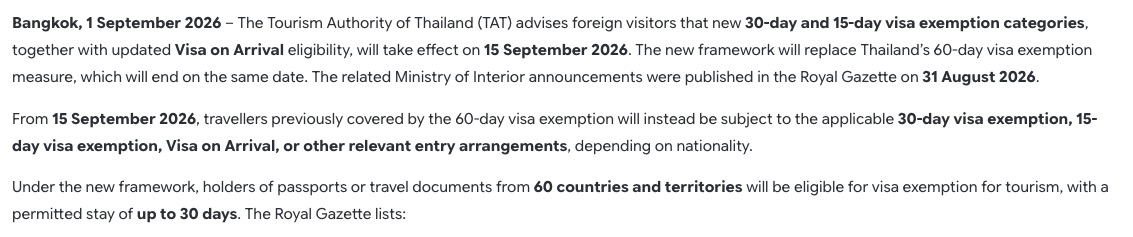
The Thai Interior Ministry will reduce visa-free stays from 60 to 30 days for 60 countries starting 15 September 2026, cutting Seychelles and Mauritius to 15 days and limiting overland border crossings.
From 15 September 2026, tourists from 60 countries and territories will be allowed to enter Thailand without a visa for stays of up to 30 days; Seychelles and Mauritius will receive only 15 days, and visa-on-arrival is now restricted to three nationalities.
Sixty-day stays scrapped from 15 September
The change—on the table for over a year—was framed by Bangkok as a crackdown on unauthorized work, as reported when the proposal was first floated. After two cabinet approvals in May and July 2026, the measures were published in Thailand’s Royal Gazette on 31 August 2026 and take effect 15 days later. That date marks the end of the 60-day, visa-free regime that had applied to 93 countries and territories since June 2024.
The Tourism Authority of Thailand confirmed on 1 September that visitors will fall into one of four categories from then on: 30-day exemptions, 15-day exemptions, visa-on-arrival or another entry scheme. Trips that begin before 15 September remain covered by the previous rules.
30-day exemptions for 60 countries and territories
Thailand’s Royal Gazette entry lists 60 countries and territories whose passport holders may enter visa-free for up to 30 days on tourist grounds:
South Africa, Germany, Saudi Arabia, Australia, Austria, Bahrain, Belgium, Bhutan, Brunei, Bulgaria, Canada, Cyprus, Croatia, Denmark, United Arab Emirates, Spain, Estonia, United States, Fiji, Finland, France, Georgia, Greece, Hungary, India, Indonesia, Ireland, Iceland, Israel, Italy, Japan, Jordan, Kyrgyzstan, Kuwait, Latvia, Liechtenstein, Lithuania, Luxembourg, Malaysia, Maldives, Malta, Norway, New Zealand, Oman, Netherlands, Philippines, Poland, Portugal, Qatar, Czech Republic, Romania, United Kingdom, Singapore, Slovakia, Slovenia, Sweden, Switzerland, Taiwan, Turkey, Ukraine.
The Kyrgyzstan is the only newcomer—it did not appear on the former 93-country list. For everyone else, the change simply means the duration is halved. After 30 days, tourists must apply for a visa before departure.
Overland borders limit set at two entries a year
The new rules cap the use of the 30-day exemption at land crossings to two calendar-year entries. Air arrivals are not subject to this ceiling.
Four nationalities are spared the land-border cap: Malaysia, Brunei, Indonesia and Singapore. The interior minister may add further exemptions by decree. The move aims to curb repeated border runs from neighbouring countries viewed by Bangkok as disguised stays.
15-day exemptions for Seychelles and Mauritius, visa on arrival for three countries
An alternative 15-day exemption covers passport holders from the Seychelles and Mauritius. For Mauritius—which previously enjoyed 60 days—the visa-free stay is trimmed to one-quarter of the former length. The same two-entry limit applies for land crossings.
Visa on arrival is now confined to nationals of Azerbaijan, Belarus and Serbia.
33 countries and territories drop off the exemption list
Compared with the 93 beneficiaries of the 60-day regime, 33 countries and territories have been removed altogether from the new exemption roster:
Albania, Andorra, Brazil, Cambodia, China, Colombia, South Korea, Cuba, Dominica, Ecuador, Guatemala, Hong Kong, Jamaica, Kazakhstan, Kosovo, Laos, Macao, Morocco, Mexico, Monaco, Mongolia, Uzbekistan, Panama, Papua New Guinea, Peru, Dominican Republic, Russia, San Marino, Sri Lanka, Tonga, Trinidad & Tobago, Uruguay, Vietnam.
Being dropped from the list does not automatically spell visa requirements. The Tourism Authority of Thailand notes that bilateral agreements and other arrangements may still grant exemptions—durations range from 90, 30 or 14 days depending on the specific accord with Bangkok. Travellers from any country that disappears from the list should therefore verify, before booking, whether such a bilateral exemption covers their nationality; otherwise a visa becomes mandatory.
These reforms do not alter the requirement for the Thailand Digital Arrival Card (TDAC), introduced earlier this year: the electronic health-and-travel form remains a prerequisite for entry, regardless of entry category.

As CEO of Visamundi, I am dedicated to simplifying international travel by assisting our clients in obtaining visas worldwide. By staying at the forefront of ever-changing regulations, I ensure our agency remains a trusted pillar in the visa services industry.
Get our visa news first in your Google results: add Visamundi to your preferred sources.
