
In Vietnam, apostille replaces consular legalization from September 11, 2026
Starting September 11, 2026, foreign public documents with an apostille will be accepted in Vietnam without consular legalization, and Vietnamese documents apostilled in Vietnam will be recognized abroad in other Hague Convention member states.
However, there are three exceptions to the new system: Germany, Austria and the Czech Republic have objected to Vietnam’s accession, and consular legalization remains mandatory when dealing with those countries.
The end of the dual consular process
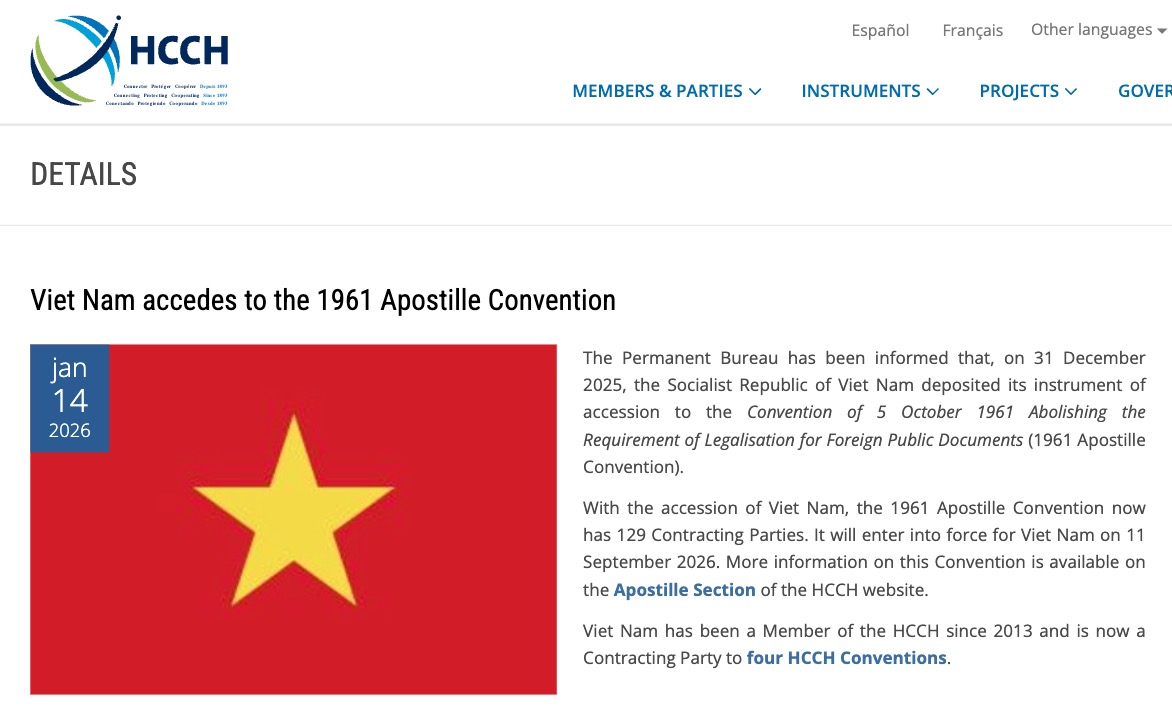
Vietnam joined the 1961 Hague Convention abolishing the requirement of legalization for foreign public documents, known as the Apostille Convention, on December 31, 2025. The Hague Conference on Private International Law (HCCH) announced Vietnam’s accession on January 14, 2026, setting the entry into force for September 11, 2026. With Vietnam’s adhesion, 129 states will now be bound by the Convention.
Until now, having a birth certificate, diploma, criminal record extract or court judgment issued abroad recognized in Vietnam required two steps: authentication of the document by the authorities in the issuing country, followed by legalization at a Vietnamese embassy or consulate. Two authorities, two queues, two sets of fees.
From September 11, 2026 onward, one step will suffice: the apostille, issued by the competent authority of the country where the document was drawn up. This certificate verifies the document’s origin—its signature, the official’s capacity and the seal—but not its contents. Once apostilled, the document will be accepted in Vietnam without any additional consular visa. The system is reciprocal: a Vietnamese document apostilled in Hanoi will also be recognized overseas in other Convention member states without further consular steps.
Germany, Austria, Czech Republic: consular legalization continues
A state’s accession to the Convention does not automatically apply to existing members: each has six months to lodge an objection. Three states have done so against Vietnam, as shown in the HCCH notification register: Germany on May 20, 2026, Austria on June 19, 2026 and the Czech Republic on July 2, 2026.
The consequence is direct: the Convention will not apply between Vietnam and these three countries. An Austrian civil-status document, a German degree or a Czech criminal record intended for Vietnam will still follow today’s consular-legalization route, and Vietnamese documents will still have to meet the same requirements to be used in Germany, Austria or the Czech Republic unless the objections are withdrawn.
Likewise for countries that are not party to the Convention at all: no apostille will be issued, and their documents will continue to be consular-legalized to be valid in Vietnam.
Who is (and isn’t) affected
If you are visiting Vietnam as a tourist, nothing changes: an e-visa and the other entry formalities for Vietnam still require only a passport and photo, no legalization of foreign documents.
The new rule concerns anyone who must submit official documents in Vietnam: work-permit applicants (diplomas, proof of experience, criminal-record extracts), residency-card candidates, students, people marrying in Vietnam or having a family status recognized in the country. A Canadian degree, a Moroccan criminal record, an Indian birth certificate or a Brazilian certificate—provided the issuing country is a Convention member—will need only the local apostille. Canada joined the Convention in January 2024, as we explained in our earlier article on Canada’s apostille system.
The change works both ways. Vietnamese nationals applying for a visa, study or immigration abroad, and anyone holding Vietnamese documents (a marriage in Hanoi, a birth registered in Ho Chi Minh City), will be able to obtain an apostille in Vietnam instead of having it legalized by the destination country’s consulate.
How Vietnam will issue apostilles
The Vietnamese government has structured implementation in two phases. An implementation plan approved on February 25, 2026 (Decision 330/QĐ-TTg) entrusts oversight to the Ministry of Foreign Affairs and provides for online applications via the national public-service portal, with electronic delivery of results.
The Decree 293/2026/NĐ-CP, published July 23, 2026 on the government portal, sets out the framework: the Ministry of Foreign Affairs will be the sole competent authority for apostilling Vietnamese public documents and may delegate the function to provincial authorities. Covered items include court and administrative documents (civil-status acts, diplomas, medical certificates), notarial acts and authenticated documents. Excluded—per the Convention—are documents issued by diplomatic or consular agents and administrative documents directly linked to commercial or customs operations.
Until September 11, 2026, the current consular-legalization rules continue to apply: any dossier to be filed before that date still follows the old procedure, apostille or no apostille.

A specialist in regulatory monitoring and a content destination expert, she analyzes daily changes in entry formalities to turn complex administrative processes into practical guides. Her role blends ground-level expertise with technical precision to ensure the reliability of the information provided to travelers.

Get our visa news first in your Google results: add Visamundi to your preferred sources.
