
No age-based visa interview exemptions for US visas, even for infants
Minors, including newborns, must appear in person for their US visa interview—no exemptions remain under the latest policy updates effective since October 1, 2025.
The U.S. Embassy in India emphasized on August 14, 2026, that children—no matter their age—must attend their visa interview in person, after reports of families arriving without their young children. Since October 1, 2025, the U.S. Department of State has eliminated all age-based interview exemptions, and no exceptions now apply to minors.
Updated policy since October 1, 2025
This policy stems from a State Department update published on September 18, 2025, effective October 1, 2025. The rule now requires in-person interviews with a consular officer for all non-immigrant visa applicants, “including those under 14 and over 79 years old,” as stated in the official announcement.
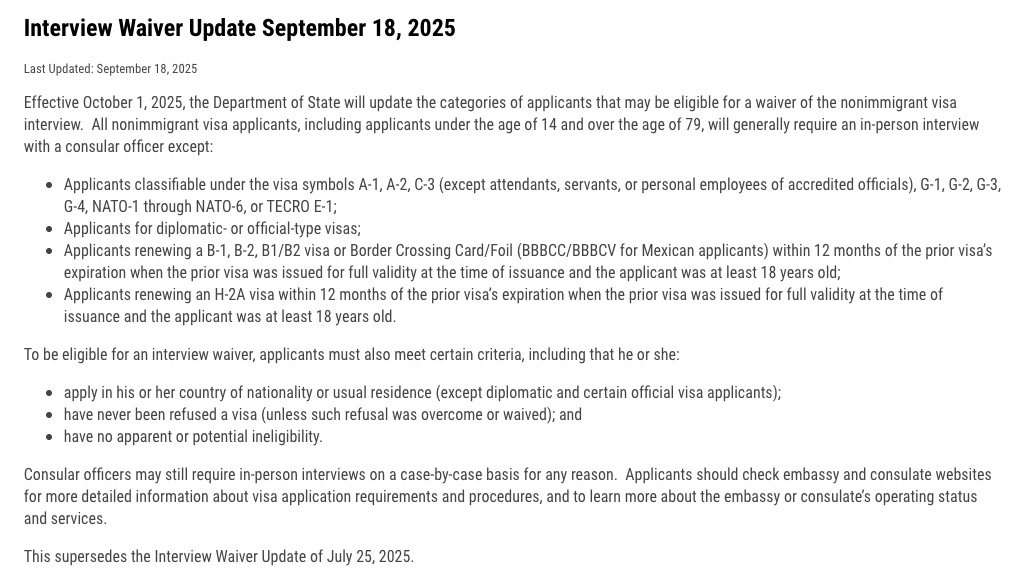
Previously, children under 14 and adults over 79 were exempt from in-person interviews; parents could submit applications on behalf of their children without the children ever visiting the consulate. This flexibility no longer exists, and embassies have spent the past year correcting misunderstandings of the rule.
The tightening occurred in two phases. An initial update, announced on July 25, 2025, effective September 2, 2025, already mandated in-person interviews. The September 18 update further narrowed exemptions. It is this second rule that applies today.
No exemptions possible for minors
The remaining exemptions are limited to adults or diplomatic visas. The primary exemption—renewing a B-1/B-2 visitor visa within 12 months of its expiration—explicitly requires the applicant to be at least 18. Minors, however, must attend an interview for all applications, including renewals, regardless of their parents’ visa status or history.
This was underscored by the U.S. Embassy in India’s reminder: whether an applicant is a “newborn or nearly of legal age,” they must appear in person, and a parent or guardian cannot attend on their behalf.
In practice, for a family trip, every member—including infants—must secure an appointment and appear at the consulate, accompanied by a parent. While the parent responds on the child’s behalf, the child’s physical presence is mandatory.
The few remaining exemptions
visas in categories A-1, A-2, C-3 (excluding domestic staff), G-1 to G-4, NATO-1 to NATO-6, and TECRO E-1;
applicants for diplomatic or official visas;
renewal of a B-1, B-2, or B1/B2 visa (or border crossing card for Mexican applicants) within 12 months of expiration, if the previous visa was issued for full validity and the applicant is 18 or older;
renewal of an H-2A visa (seasonal agricultural workers) under the same conditions.
Even in these cases, exemptions are not guaranteed. Applicants must apply in their country of nationality or habitual residence, have never been refused a visa (unless the refusal has been overcome), and show no apparent ineligibility. Consular officers may still summon any applicant for an interview at their discretion.
Heightened pressure on interview slots
The shift to in-person interviews has significantly increased demand for appointments: paperwork that once required no physical presence now occupies consular interview slots, including those for children. In response, the State Department is testing a paid priority appointment system for visitor visas in select embassies through December 2026.
The requirement to apply in one’s country of nationality or residence to qualify for renewal exemptions has grown more consequential due to the reduction of U.S. consular posts, particularly in Africa: applicants whose assigned embassy has closed may face longer travel distances, sometimes abroad, for the entire family to attend an in-person interview.

As CEO of Visamundi, I am dedicated to simplifying international travel by assisting our clients in obtaining visas worldwide. By staying at the forefront of ever-changing regulations, I ensure our agency remains a trusted pillar in the visa services industry.

Get our visa news first in your Google results: add Visamundi to your preferred sources.


