
Legalization and apostille: how to get an official document recognized abroad
A birth certificate, diploma, or police clearance certificate is not automatically valid abroad. Legalization or an apostille is required to certify its origin.
·
A birth certificate, diploma, or police clearance certificate is not automatically valid outside the country that issued it. To be accepted by a foreign administration, its origin must be certified: with an apostille in the 130 States party to the 1961 Hague Convention, or with consular legalization elsewhere.
The list of countries concerned has changed three times in a year, and Thailand will join on 1 February 2027.
What an apostille certifies—and what it does not
The most frequent cause of refusal is this misconception: an apostille does not attest to the content of the document. Article 5 of the Convention states that it confirms only « the authenticity of the signature, the capacity in which the signatory of the act acted and, where appropriate, the identity of the seal or stamp with which the act is authenticated ».
In other words, it proves that the person who signed your diploma was authorized to do so and that the institution’s seal is genuine. It does not validate your grades, the equivalence of your degree, or the truthfulness of what is written. A foreign administration can legally accept the apostille and still reject the document on substance.
Where the Convention’s Article 3 applies, an apostille is the only authentication required between Contracting States. A single certificate circulates without further steps. This contrasts with classic consular legalization, which stacks successive visas.
Which procedure applies: apostille or legalization
The choice does not depend on your nationality or the type of document, but solely on whether the issuing country and the destination country are both Parties to the Convention. If either one is not, consular legalization is mandatory. The process involves at least two counters, longer delays, and requirements that vary from one embassy or consulate to the next.
A common trap occurs when both States are parties but have not activated the Convention between themselves. Under Article 12, an existing State may object when another joins, rendering the Convention inoperative in their bilateral relations and forcing recourse to consular legalization. This is currently the case for documents issued in Algeria presented in Germany, Austria or Greece—these three States have objected to Algeria’s accession—and also for Vietnamese documents in Germany, Austria and the Czech Republic.
Documents excluded from the Convention
Article 1 excludes two categories, and refusal for this reason is frequent.
Documents issued by diplomatic or consular agents. A certificate delivered by your consulate abroad cannot be apostilled.
Administrative documents directly concerning a commercial or customs operation. Certificates of origin, legalized invoices, import licences: these belong to other regimes, usually handled by chambers of commerce.
Otherwise, the scope is broad: civil-status records, court decisions, notarial acts, diplomas from public institutions, extracts of criminal records, official statements attached to private instruments. A purely private contract, however, is not apostilled directly: the apostille attaches to the notary’s authentication of the signature, not to the contract itself.
A shifting map: Algeria, Vietnam, Thailand
The Convention now has 130 Contracting Parties, and three recent changes affect millions of files.
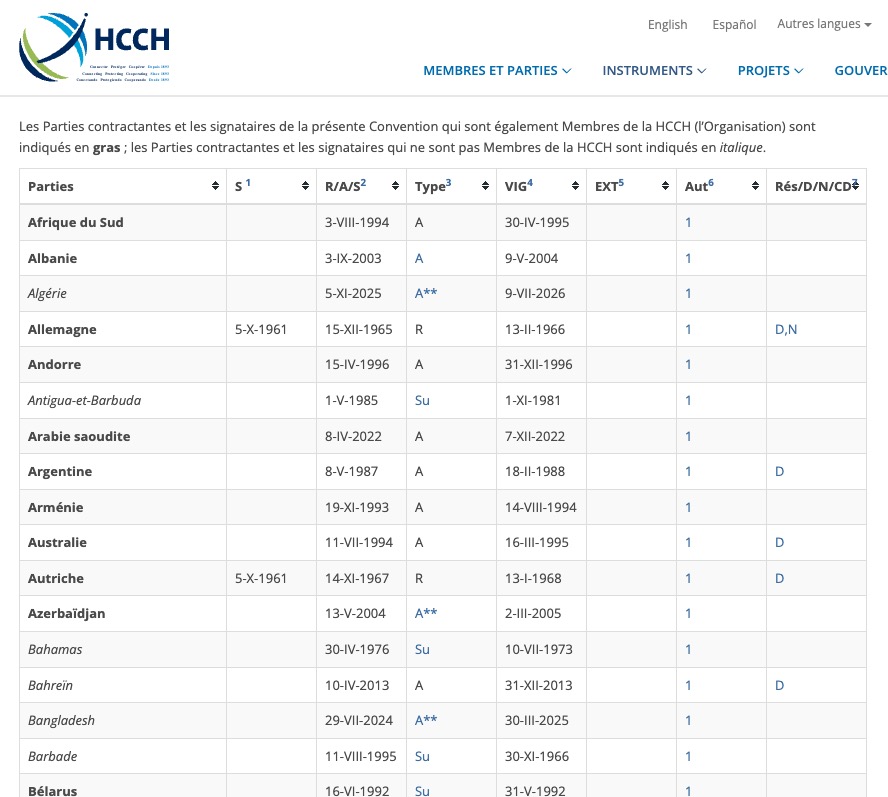
Algeria acceded on 9 July 2026, following deposit of its instrument of accession on 5 November 2025. Algerian civil-status documents now circulate under apostille in nearly all Contracting States, subject to the three objections noted above.
Vietnam followed on 11 September 2026; our article details the end of consular legalization for Vietnam.
Thailand deposited its instrument of accession on 30 June 2026. The Convention will enter into force there on 28 February 2027, after the six-month objection period under Article 12 followed by the prescribed 60 days. Until then, a Thai document destined for abroad, or a foreign document meant for Thailand, remains subject to consular legalization; an apostille affixed before entry into force will have no effect. Timing matters: a document apostilled on 1 February 2027 is accepted; the same document legalized the day before keeps its validity, because earlier procedures are not retroactively invalidated.
The rise of the electronic apostille
The e-APP programme, launched in 2006, rests on two independent modules: issuance of digitally signed electronic apostilles and an online register that lets destination administrations check authenticity without writing back to the issuing authority.
In the March 2026 progress report of the Hague Conference, 59 Contracting Parties have implemented at least one component, and 42 have both; nine joined both only in 2025, including Bangladesh, France, Mongolia and Panama, while Mexico, China and South Africa adopted only electronic issuance and Canada only the online register.
The Conference’s clear principle: an electronic apostille cannot be refused merely because it was issued electronically. In practice, acceptance still varies by office; some administrations still insist on paper. Before choosing a fully digital workflow, confirm what the destination authority will accept—it alone decides.
France’s recent transfer of competence
Several countries have recently changed the authority responsible for these formalities. France offers a current example: since 1 May 2025, apostilles are issued by notaries instead of the prosecution services of the courts of appeal; the switch for legalization followed on 1 September 2025. Applications are filed online for both paper and digital acts. Fees are set by regulation: €10 for a single act within three business days (or €5 from the fourth act in the same request) and €20 for a 24-hour fast-track (€10 from the fourth act). The changeover has not been seamless; we reported on early congestion on the new platform.
The lesson extends beyond France: the competent authority to authenticate varies by country—and it changes. Some States designate their foreign ministry, others the justice ministry, courts, state governors or notaries. The up-to-date list of designated authorities, maintained by the Hague Conference, is the only reliable source when a consulate’s webpage still points to a closed counter.
Three checks before you start
Three points govern acceptance of your file, and none are within your control.
First, the destination administration. It sets the rules; an apostille never replaces a required translation. Certified translations are a separate step that itself may need to be apostilled, and the order of operations matters. Translating an already apostilled document yields a different result from apostilling a translation.
Second, the document’s status. An apostille attaches to the original or a certified true copy; it cannot be placed on a plain photocopy. A few countries also impose time limits on civil-status records presented in support of an application, regardless of the apostille.
Third, the bilateral relationship between the issuing and destination States. The Contracting Parties status table published by the Hague Conference shows, for each State, the date the Convention entered into force and any objections. Rely on that table alone—not on secondary lists elsewhere—to know whether you need an apostille or consular legalization.

As CEO of Visamundi, I am dedicated to simplifying international travel by assisting our clients in obtaining visas worldwide. By staying at the forefront of ever-changing regulations, I ensure our agency remains a trusted pillar in the visa services industry.
Get our visa news first in your Google results: add Visamundi to your preferred sources.
