

Kazakhstan’s e-entry permit to become chargeable but fee delayed
A Kazakhstani draft decree proposes making the existing electronic entry permit a chargeable authorization, with the fee to be announced later in 2026.
Kazakhstan’s Ministry of Internal Affairs has released a draft decree for public consultation that, if adopted, will make the existing electronic entry authorization (ETA) a chargeable travel document. The consultation window runs until 17 August 2026 and foresees a phased roll-out from August through December 2026. At this stage, no fee has been published; the final amount will be set separately by the government.
What the draft decree actually proposes
The text—published on the government consultation portal « Открытые НПА »—amends Decree No 148 of 21 January 2012, which currently regulates entry, stay and exit of foreigners in Kazakhstan. Its purpose is straightforward: to regulate the issuance of an electronic entry authorization (ETA) for foreign nationals and stateless persons in the Republic of Kazakhstan.
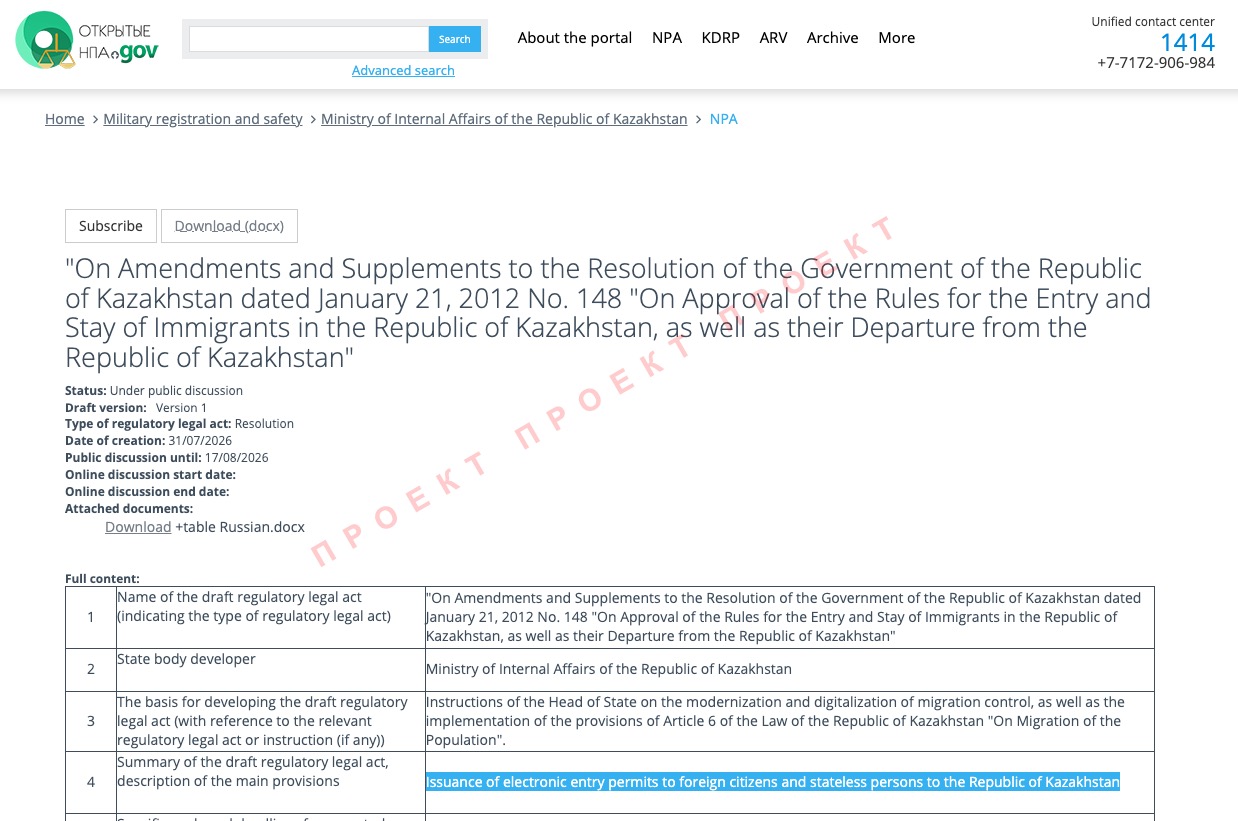
The official factsheet states that “differentiated fees” will help finance technical maintenance, digital-infrastructure upgrades and personal-data protection. The single word “differentiated” is the only clue about pricing structure; it implies not all travellers will pay the same, but no criteria are specified.
The announced timeframe—August to December 2026—is meant to allow border-crossing infrastructure and logistics to expand gradually. Although authored by the Ministry of Internal Affairs, the final act is a government decree, which is why the cabinet will decide the fee.
This remains a draft in public consultation. Until the definitive version is adopted, wording may change. With the public-consultation deadline set for 17 August 2026, little room remains for an official fee to appear before the end of summer.
No fee is known yet
This clarity is crucial: multiple figures are circulating, but none have any official basis. The draft decree and its underlying legal framework contain no price schedule; both defer the decision to a forthcoming government resolution. Any price quoted today—whether described as “Kazakh entry tax” or otherwise—is an unofficial estimate, not an official tariff. Until the amount is published in the Kazakhstani official gazette, no payment is legally due for entering Kazakhstan.
If any website or operator today demands what it labels the “Kazakh entry fee,” it is billing for something other than the government-mandated ETA charge.
How the ETA works today
The electronic travel authorization already exists and has been free of charge during a pilot phase. In January 2026, Kazakhstan launched the integrated digital platform QazETA, grouping e-visas, electronic travel authorizations, electronic residency status and cross-border attestations. As reported at launch, the platform commenced in pilot mode.
Diplomatic missions have clarified the current rules:
the ETA is for nationals of visa-exempt countries;
applications must be submitted via the mobile app at least 72 hours before travel;
the authorization is valid for 180 days from approval;
final admission still rests with border guards.
Three categories are exempt: holders of diplomatic or service passports, official delegations and accredited diplomatic representatives in Kazakhstan.
Most importantly, the legal text stresses that during the pilot, obtaining an ETA is merely recommended, not mandatory. Only after the pilot concludes will the obligation be phased in—distinct from the future paywall. Authorities have not linked the two timelines.
Who is affected, and what stays the same
The new fee mainly targets visa-exempt visitors. According to the national public-services portal, 54 countries are visa-exempt, including most of Europe, several Asian and American states and Kazakhstan’s regional partners. Citizens of these countries currently enter on their passport alone; in future, they will need the ETA before travelling.
The core stay rules remain unchanged. An updated government page dated 1 July 2026 reminds travellers of two key limits:
maximum 30 calendar days of free circulation per single entry;
maximum cumulative stay of 90 days within any 180-day period.
A third, often-overlooked rule: any host—hotel or private individual—must notify the migration service of the foreign guest’s arrival within three working days. Hotels handle the formality automatically; with private hosts or rentals it is the guest’s responsibility, and failure can trigger a fine at exit.
Nationals of the remaining 104 countries that do not benefit from visa exemption must still obtain an e-visa, valid for a single entry and covering categories from tourism to medical treatment and the digital-nomad visa. The e-visa requires an electronic invitation issued by police authorities and may only be used to enter through international airports.

As CEO of Visamundi, I am dedicated to simplifying international travel by assisting our clients in obtaining visas worldwide. By staying at the forefront of ever-changing regulations, I ensure our agency remains a trusted pillar in the visa services industry.

Get our visa news first in your Google results: add Visamundi to your preferred sources.
