
Kenya introduces mandatory travel health insurance – but is it fully implemented?
On Tuesday, October 6, 2026, when submitting eTA requests for Kenya, our teams encountered a new step: before paying for the authorization, the official portal requires travel health insurance and offers to purchase it directly for 45 USD. However, nothing about this requirement appears in official announcements.
Frankly, there was no official announcement accompanying this change, and we still don’t know whether it’s a full deployment or a pilot test.
What our teams saw on the portal
The new step appears once the eTA request form is completed, just before payment to process the eTA. A “Notice” box from the Kenyan Ministry of Health, titled Mandatory Inbound Travel Health Insurance Requirement, states that—pursuant to Gazette Notice No. 11492 of July 30, 2026—all travellers to Kenya must hold a valid travel health insurance policy issued under the auspices of the IRA, Kenya’s insurance regulatory authority. The text adds: All travellers must comply.
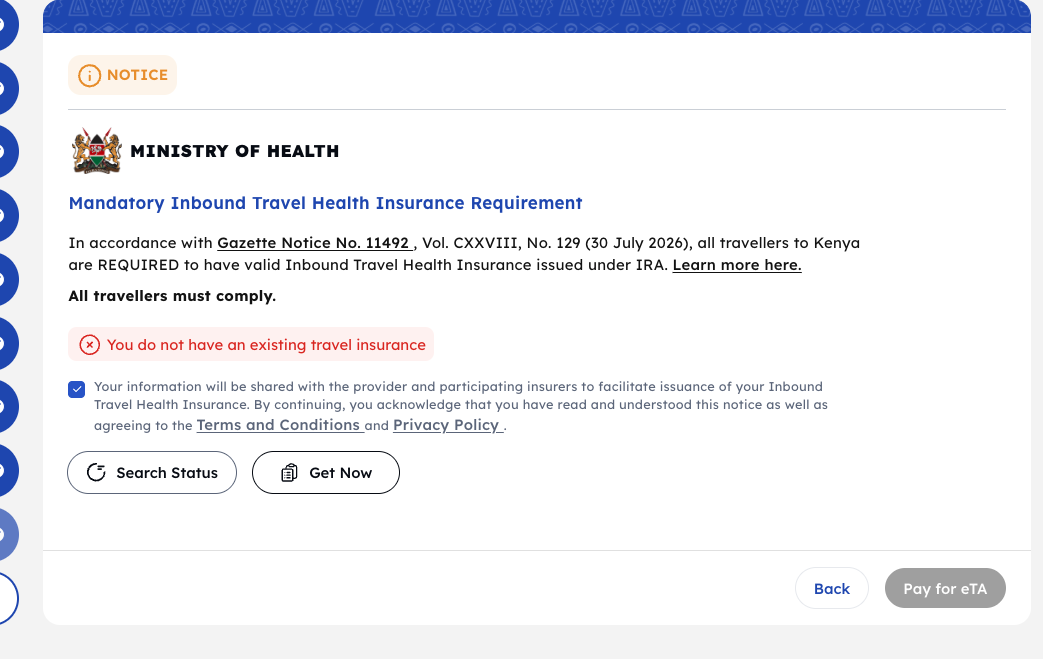
The portal indicates that the applicant has no existing policy, prompting them to authorise the sharing of traveler data with participating insurers. A checkbox is provided, followed by two buttons: Search Status and Get Now. On the screen our team captured, the Pay for eTA button was greyed out.
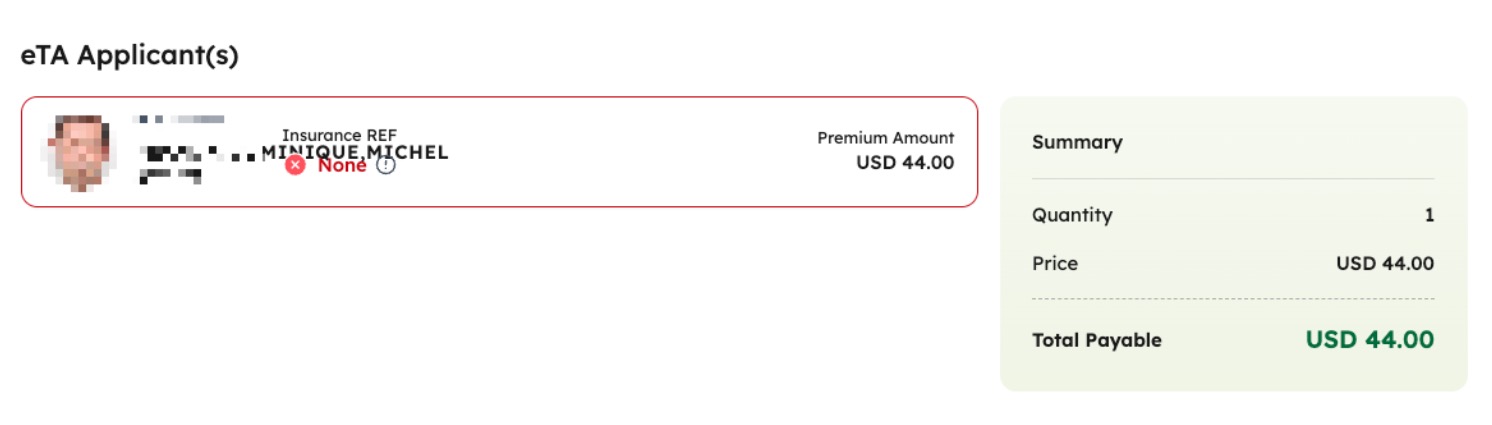
The summary of the application now includes, for each traveller, an Insurance REF row reading “None” until a policy is attached, along with the premium amount.
Policy priced at 44 USD plus fees
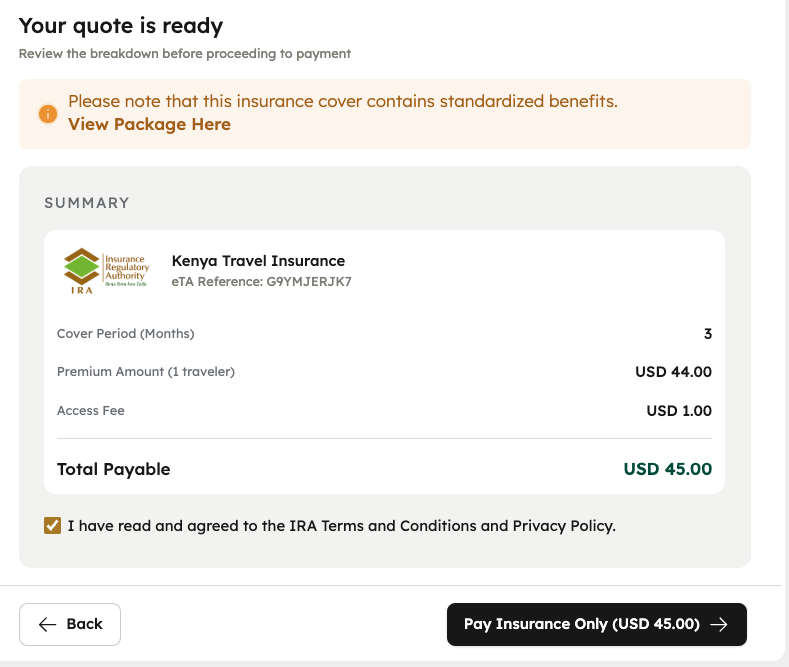
The policy covers a three-month stay and breaks down as follows:
Premium: 44 USD €39.24 per traveller;
Access fee: 1 USD €0.89;
Transaction fee: 7 USD €6.24
Standardised benefits are detailed via a link “View Package Here”, and the applicant must accept the general terms of the IRA. The validation button is labeled “Pay Insurance Only”, suggesting that the insurance is billed separately from the eTA.
This exact pricing matches the mandatory travel health insurance now required in mainland Tanzania since October 1, 2026—a policy we covered in our article on Tanzania’s 44 USD policy. Yet the two programmes remain distinct, with different designated insurers on either side of the border.
We had previously outlined the required benefits in August, including three coverage options depending on the length of stay: up to 30 days, 31 to 60 days, and international medical coverage for stays exceeding 60 days and up to 12 months. The same document stated that purchases would be processed via un.go.ke. As of October 6, 2026, that domain remains unresponsive; the purchase portal now appears directly within the eTA application.
Finally, the screen our team saw included no field for attaching an existing insurance policy from another provider. It’s unclear whether the Search Status button would attach an existing policy, purchased separately through the portal, or only activate purchases made from the portal itself.
As of the date of publication, no official Kenyan sources have confirmed the rollout of this step. The eTA Kenya FAQ makes no mention of the insurance requirement among the conditions for submission, and neither the Ministry of Health nor the IRA has issued a public notice setting an application date or tariff.
The legal landscape adds further uncertainty. Kenyan press reported in late August that the High Court of Marsabit had suspended the implementation of Gazette Notice No. 11492, at the request of two plaintiffs. That decision is not published on any official website, nor is there any publicly available document indicating whether it was later lifted.
At this stage we cannot confirm whether the step is displayed for all applicants; whether it actually blocks the eTA payment until insurance is purchased; or whether it’s merely an experimental system put online by authorities. We will update this report if the Kenyan Ministry of Health or the IRA provides clarification.

A specialist in regulatory monitoring and a content destination expert, she analyzes daily changes in entry formalities to turn complex administrative processes into practical guides. Her role blends ground-level expertise with technical precision to ensure the reliability of the information provided to travelers.

Get our visa news first in your Google results: add Visamundi to your preferred sources.
