
New US entry rule requires Ebola-free attestation for travelers from 3 November 2026
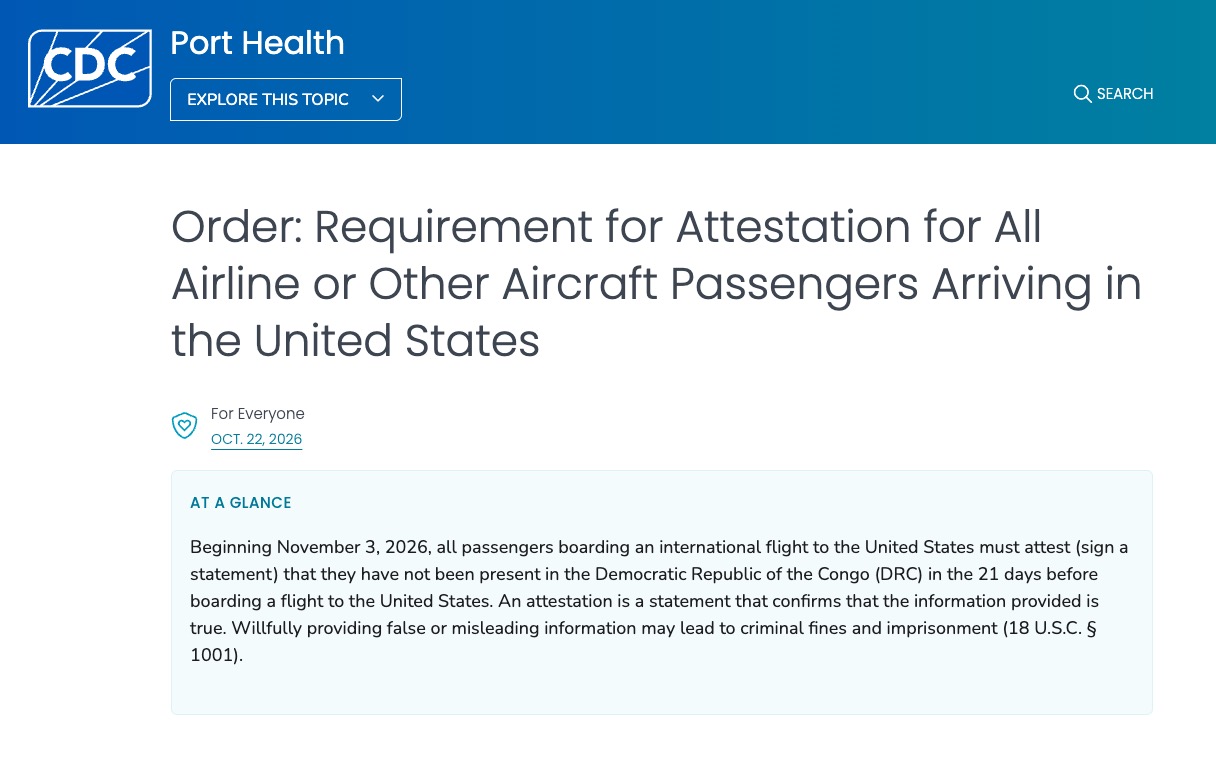
Starting 3 November 2026 at 11:59 PM EST, all passengers flying to the United States or connecting through an American airport must sign an attestation confirming they have not been present in the Democratic Republic of the Congo (DRC) in the 21 days prior to departure. Exceptions include overflights or flights with passengers who meet specific humanitarian exemptions.
This measure, issued by the US Centers for Disease Control and Prevention (CDC) due to the Ebola outbreak, applies to all nationalities.
A decree signed on 22 October 2026
The decree was signed on 22 October 2026 by the Assistant Secretary for Health at the US Department of Health and Human Services (HHS) and published on the CDC website. It affects flights departing from a foreign country starting 3 November 2026 at 11:59 PM ET. The restriction remains in place until it is withdrawn, modified, or 18 December 2026, whichever is earlier. Any extension will depend on the evolution of the outbreak factors—case numbers, geographic spread, and local transmission indicators.
This adds to existing entry restrictions implemented since May 2026, which deny entry to the US for foreign nationals who have been in the DRC (Democratic Republic of the Congo), Uganda, or South Sudan in the 21 days before arrival. The same CDC order is renewed about every month; last updated on 11 October 2026 for 30 days. Several countries’ border controls and restrictions were detailed by Visamundi in our earlier Ebola and borders article.
Who must sign this attestation?
All passengers boarding any commercial, private, or general aviation flight to the United States from a foreign country, regardless of nationality or origin. This includes passengers connecting through the United States. The only flights exempted are those flying over US airspace without landing.
Each traveler is required to complete an individual attestation. For minors under 18, a parent or legal guardian may sign on their behalf; the rule also applies to passengers who cannot act for themselves due to age, physical or mental disability.
The passenger attests that they have not physically been in the DRC (Democratic Republic of the Congo) during the 21 days prior to departure for the US. This includes travel via air, land, or sea routes. While an overflight without a stopover does not count as presence in the country, even with no disembarkation from the aircraft or airport, a transit in Congolese airports does count. The 21 days are calendar days; day 0 is when the traveler is outside DRC, and they may board from day 22 onwards. The attestation, titled “Passenger Disclosure and Attestation to the United States of America,” is signed on paper or digitally, including by electronic signature. Knowingly making a false statement under this rule may result in prosecution under section 1001 of the US Code (Title 18).
How airlines handle compliance
Airlines enforce the rule before boarding. They check that each passenger’s attestation is complete and signed; travelers without one will not be allowed to board. Airlines must keep a copy for at least 42 days after departure. The CDC encourages airlines to integrate the attestation into online check-in and to offer translations. In case of discrepancies, the English version prevails.
Passengers without an attestation, or with a false or misleading declaration, risk travel delays, denied boarding—even on future flights—and potential entry refusals.
Two exceptions to the attestation requirement exist: flights carrying confirmed Ebola patients with US government authorization, and travelers granted humanitarian exemptions by the CDC—such as medical emergency evacuations. These exempt passengers may face monitoring or quarantine upon arrival. |

A specialist in regulatory monitoring and a content destination expert, she analyzes daily changes in entry formalities to turn complex administrative processes into practical guides. Her role blends ground-level expertise with technical precision to ensure the reliability of the information provided to travelers.

Get our visa news first in your Google results: add Visamundi to your preferred sources.
