
Northern Cyprus e-visa replaces consular visa for 3 nationalities as of August 24, 2026
The Turkish Republic of Northern Cyprus has launched its e-visa system on August 24, 2026. Citizens of Armenia, Nigeria, and Syria no longer need to apply in person at an embassy or consulate; they now submit applications online via the Directorate of Immigration portal.
The single-entry e-visa costs 40 USD, and travellers must apply before departure.
What changes for the three affected nationalities
Until now, holders of Armenian, Nigerian, or Syrian passports were the only ones required to obtain a visa in advance by visiting an embassy, consulate, or high commission of Northern Cyprus. The Turkish Republic of Northern Cyprus Ministry of Foreign Affairs previously advised travellers to apply up to a month in advance, with processing times estimated at three business days.
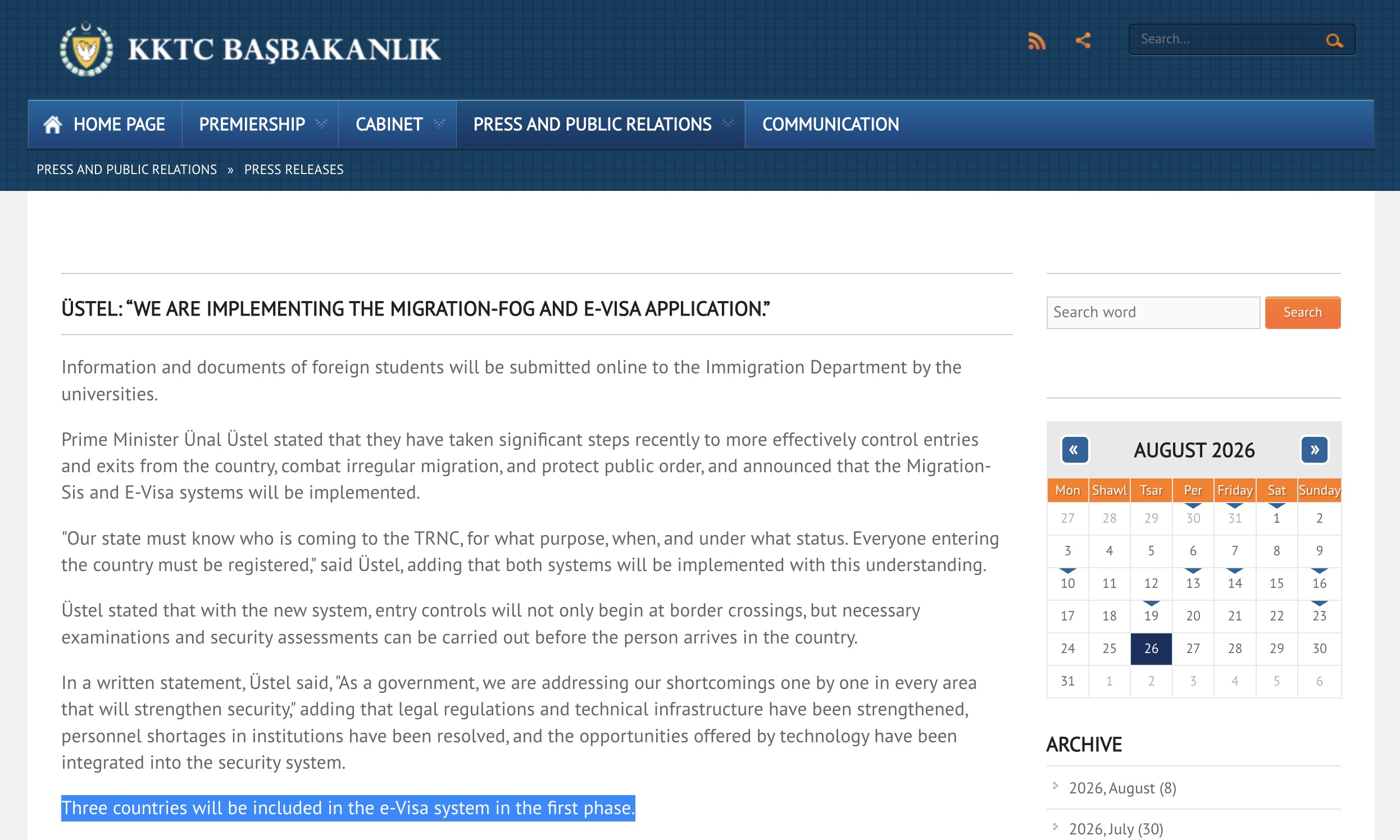
This consular route is now obsolete. On August 23, 2026, Prime Minister Ünal Üstel announced that, for these three nationalities, "the current practice of consular visas is abolished" and replaced by an online application. The Directorate of Immigration assesses each request in advance, consulting police and relevant authorities based on the purpose of travel. The following day, Official Gazette No. 154 published the E-Visa regulation and associated Cabinet decisions, including the list naming Nigeria, Armenia, and Syria. The regulation came into force on the date of publication.
Diplomatic missions abroad, including Berlin and Budapest, have since posted signs stating that visa applications for citizens of the three countries "must be submitted through this system."
Travellers from other nationalities are unaffected. They may continue to obtain visas directly from immigration officers at designated ports and border crossings for stays of up to 90 days within any 180-day period. Nevertheless, the Council of Ministers may extend the list of countries required to obtain an e-visa by simply publishing the decision in the Official Gazette, and the Ministry of Interior sets the criteria and conditions for submission.
Four tariffs based on entries and urgency
Decision Ü(K-I) 1743-2026 sets the fees as follows:
E-visa type | Fee |
|---|---|
Single-entry | 40 USD €35.7 |
Single-entry, urgent ("VIP" or express) | 80 USD €71.41 |
Multiple entries | 80 USD €71.41 |
Multiple entries, urgent | 120 USD €107.11 |
The fee is paid online. The portal collects payment at the second step—only once a request is approved—and processing is triggered only after payment. The regulation specifies that fees are non-refundable if an application is rejected or the visa is subsequently cancelled.
The number of entries granted depends on the declared travel purpose. A tourist receives either a single-entry or multiple-entry visa as requested. Those applying to seek a work permit or residency permit receive a single-entry visa automatically.
Processing times range from several days to two months
Two sets of figures apply, and both must be considered. The regulation states the baseline: an e-visa application "is decided within thirty days in principle" and "the period can be extended to a maximum of sixty days for administrative reasons." The urgent procedure, charged at double the fee, is processed within seven business days.
The portal, meanwhile, displays average processing times of three to five business days for tourist visas and notes that the durations for student visas and other categories "depend on document checks" or "assessments." The average times are indicative. The regulatory timeframe of thirty to sixty days applies, and even tourist applications may fall within that window if police or other service reviews are delayed.
How to apply on kktc-evize.gov.ct.tr
The portal kktc-evize.gov.ct.tr, managed by the Directorate of Immigration, is available in Turkish and English. Applicants select from three visa categories: tourism (holidays, cultural visits, family or friends), student (enrolment at a higher-education institution in the north of the island), and "other visa types" (business meetings, events, medical care, or official visits).
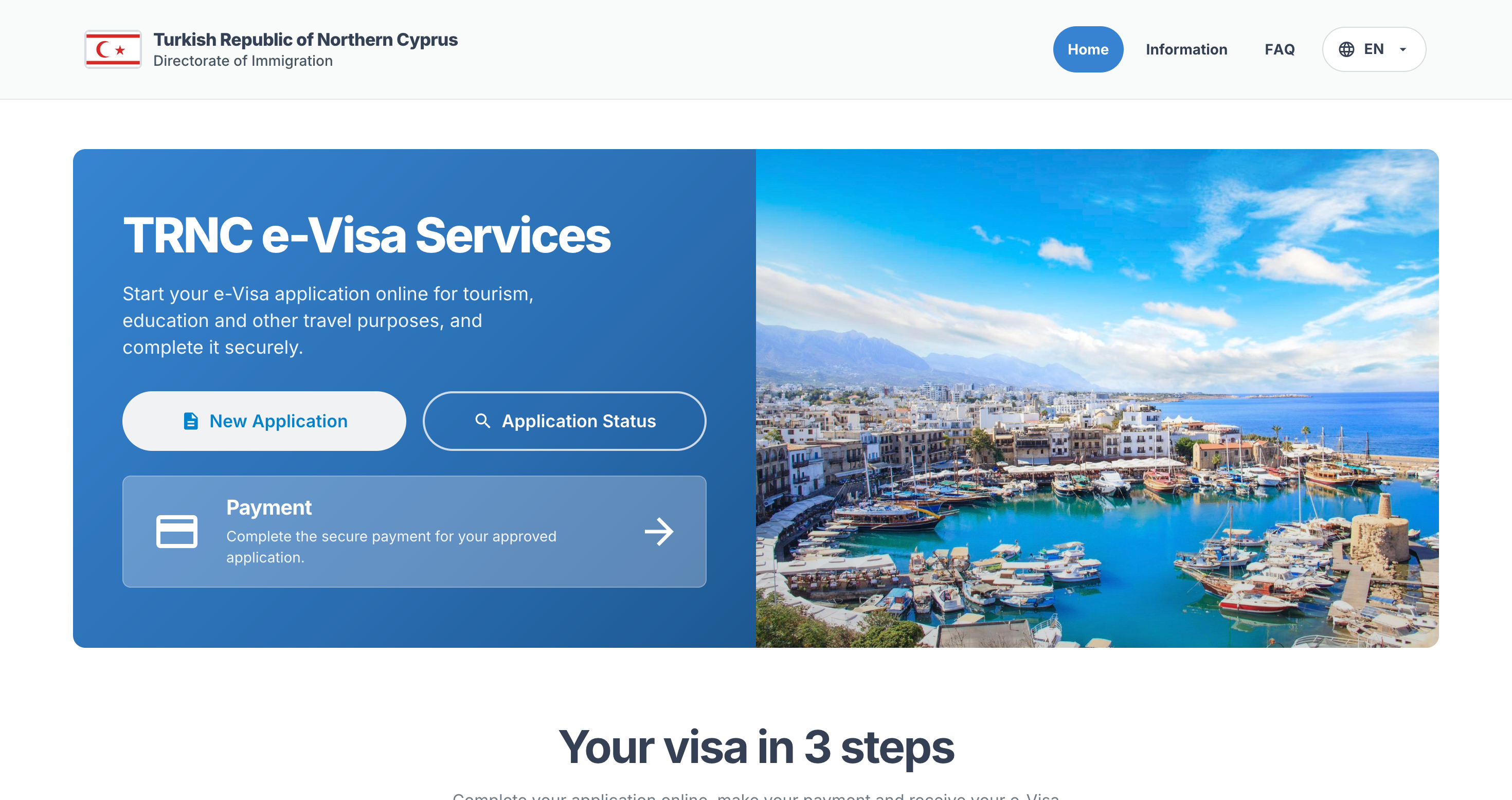
The application consists of six screens: visa type, arrival information, personal details, passport data, supporting documents, and a signed declaration of honour. Required documents include a clear scan of the passport biodata page, a recent biometric photo, proof of accommodation or reservation, and—if requested by the authorities—a flight reservation or other evidence supporting the purpose of the visit. Student applicants must add the admission letter or school certificate; other applicants must submit an invitation letter or supporting documents for the event.
Applicants can track progress using the application number, passport number, and the contact details provided; notifications are sent by email or SMS. A contact address (evize@muhaceret.gov.ct.tr) and helpline (+90 392 611 10 10) appear on every page. The portal warns that information should only be entered "on the official system." Given the platform’s newness, travellers should beware of unofficial third-party sites, many of which we have previously profiled in our guide to scam avoidance when applying for e-visas.
An e-visa is not a guarantee of entry
The regulation is unequivocal. Upon arrival, immigration officers may interview travellers on public-security grounds and refuse entry "even if they hold a valid e-visa." Persons discovered to have previously overstayed face admission only after payment of the applicable fine.
Two less-publicised provisions also merit attention. The Ministry of Health may require e-visa applicants to undergo pre-submission health tests; modalities will be set out in a ministerial circular. In case of system downtime or inaccessibility, the Minister of Interior may temporarily authorise visa issuance at entry points through a circular, restoring the pre-August 24 arrangement.
Students: universities now report directly to immigration
The initiative explicitly targets international students. According to the Prime Minister’s statement, an acceptance letter no longer serves as a standalone entry permit. Universities must submit all student data and documents online to the Directorate of Immigration, which adjudicates after consulting the Directorate-General of Police. Students from Armenia, Nigeria, and Syria must additionally complete the e-visa procedure. Once entry is granted, the system automatically assigns an alien identification number valid from arrival through registration and residency permit application.
The amending regulation also caps student residency permits at one year per application, renewable based on continued enrolment.
Entering via the north remains illegal for the Republic of Cyprus
Anyone planning to proceed to the southern part of the island or return there should note that the Republic of Cyprus recognises only Larnaca and Paphos International Airports and Larnaca, Limassol, Latsi, and Paphos ports as legal entry points. Entering through any other port or airport on the island, including Ercan Airport (Tymbou), constitutes a breach of national law and may result in prosecution regardless of the travel document obtained from Northern Cyprus authorities—e-visas included.

As CEO of Visamundi, I am dedicated to simplifying international travel by assisting our clients in obtaining visas worldwide. By staying at the forefront of ever-changing regulations, I ensure our agency remains a trusted pillar in the visa services industry.

Get our visa news first in your Google results: add Visamundi to your preferred sources.
